
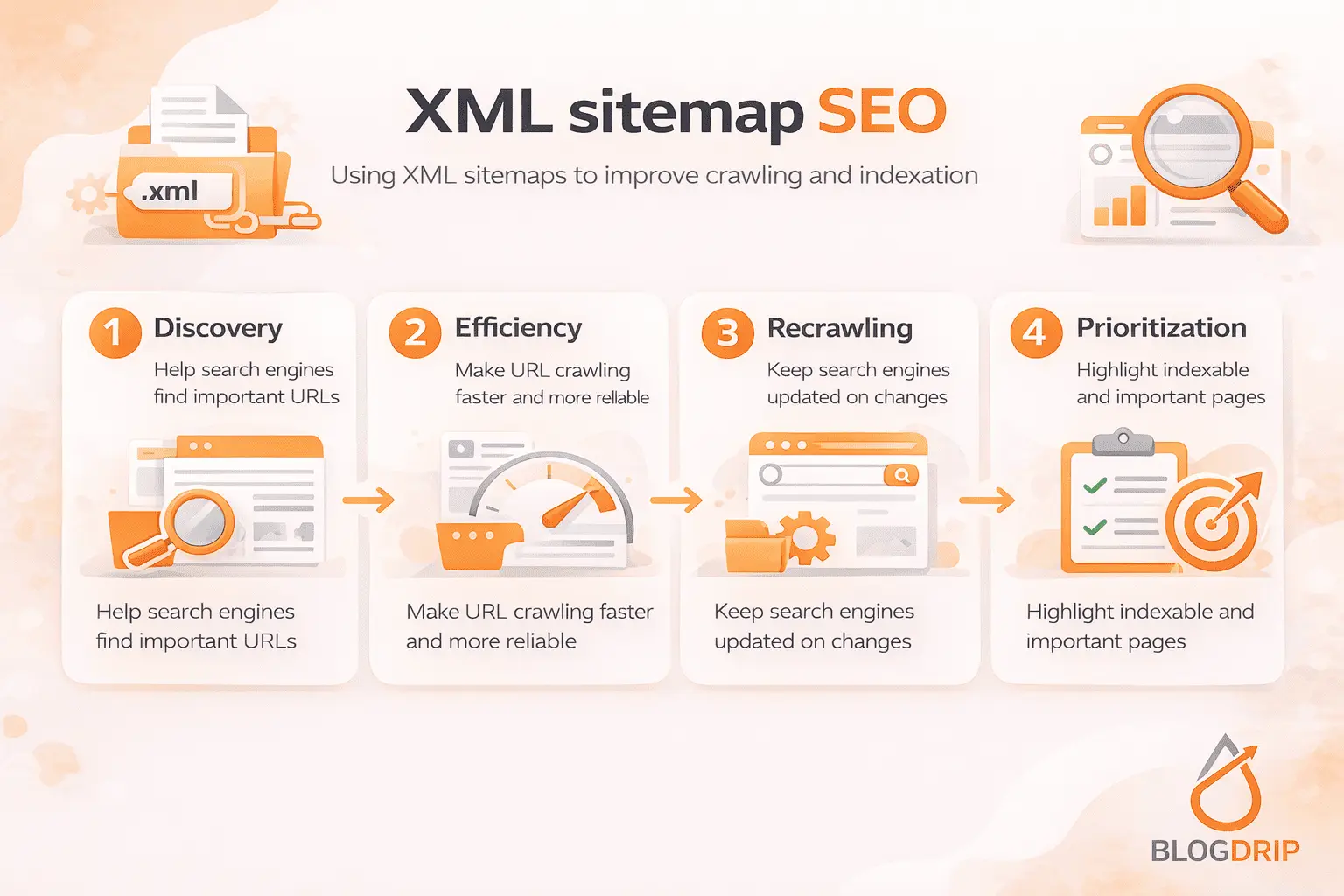
XML Sitemap SEO: How Sitemaps Support Crawling and Indexation
XML sitemap SEO is one of those topics that is easy to overstate or dismiss. Some people treat XML sitemaps as a ranking lever. Others assume they hardly matter. In practice, the truth is more useful than either extreme.
An XML sitemap will not make weak content rank, and it will not fix a poor site structure. But it can help search engines discover, revisit, and evaluate the right URLs more efficiently. That makes it an important supporting asset within technical SEO.
For a site building topical authority through a pillar-and-cluster model, XML sitemaps should reinforce the same priorities expressed through internal linking, clean architecture, and indexation control. They are not the main signal, but they are a valuable one when handled properly.
This cluster page explains XML sitemap SEO in practical terms: what it is, why it matters, how it works, what should be included, what to avoid, and how to use it strategically.
What Is XML Sitemap SEO?
An XML sitemap is a structured file that lists URLs you want search engines to know about. It is written for search engines, not for users, and helps them discover important pages more efficiently.
In practical terms, XML sitemap SEO means using XML sitemaps to support better crawling, discovery, and indexation.
That definition matters because a sitemap is not a command. It is a suggestion. Search engines can use it as guidance, but they still decide which pages to crawl, index, and rank based on quality, relevance, duplication, and site-wide trust.
What an XML sitemap actually helps with
A strong XML sitemap can help search engines:
- discover important URLs faster
- revisit updated pages more efficiently
- understand which URLs you consider canonical and indexable
- support crawling on large or complex sites
This is especially useful for sites with deep architecture, lots of content, or sections that are not always easy to reach through navigation alone.
What an XML sitemap does not do
A sitemap does not improve rankings by itself. It does not turn thin content into strong content. It does not fix duplicate pages, poor internal linking, or weak site structure.
That is the most important mindset in XML sitemap SEO: a sitemap is a supporting signal, not a shortcut.
Why XML Sitemap SEO Matters
XML sitemap SEO matters because search engines do not discover every page equally well. Internal links remain the strongest discovery path, but sitemaps help reinforce what should be crawled and reviewed.
It supports crawling and discovery
A sitemap gives search engines a cleaner path to important URLs. That makes it especially relevant within a broader cluster around crawling and indexing.
If your internal linking is already strong, a sitemap adds support. If your discovery paths are weaker than they should be, a sitemap can still help, but it should not be used as a replacement for proper architecture.
It helps reinforce indexation priorities
A clean sitemap tells search engines which URLs you want treated as valid, canonical, and worth considering for the index.
That is why this page should sit close to related cluster articles on canonical tags, indexation control, and robots directives. XML sitemap SEO works best when those signals align.
It becomes more valuable on larger sites
On a small website with clear navigation and a limited page count, a sitemap is useful but often not a major differentiator. On a large ecommerce site, publisher site, or content-heavy platform, it becomes more important because discovery and crawl efficiency are harder to manage at scale.
As a site grows, sitemap quality matters more.
How XML Sitemap SEO Works
An XML sitemap works by giving search engines a structured list of URLs to evaluate.
Search engines can find the sitemap through the robots.txt file, direct submission in tools such as Google Search Console, or prior discovery through crawling. Once the sitemap is found, search engines use it as a guide rather than a rulebook.
Discovery and submission
Most sites expose the sitemap location in robots.txt and submit it in search engine webmaster platforms. This makes the file easy to find and helps track how many URLs are discovered and indexed over time.
URL evaluation
Once a search engine reads the sitemap, it still evaluates each page on its own merits. It checks whether the URL is accessible, canonical, internally supported, and useful enough to index.
This is why a sitemap should only include pages that genuinely deserve to be crawled and considered.
Recrawling and updates
Sitemaps are not only useful for new pages. They also help search engines revisit updated content. On sites that publish regularly or change URLs often, that recurring discovery value becomes more important.
What Should Be Included in an XML Sitemap?
A good sitemap should include URLs that are indexable, canonical, useful, and strategically important.
In most cases, that means pages that:
- return a 200 status code
- are not blocked unintentionally
- are not marked noindex
- are the preferred canonical version
- offer unique value
- are suitable for organic visibility
The sitemap should represent the version of the site you actually want search engines to evaluate, not every URL your platform happens to generate.
Pages that usually belong in a sitemap
These often include:
- core service pages
- important category pages
- key product pages
- evergreen guides
- major blog posts
- high-value landing pages meant to rank
Pages that usually do not belong
These often include:
- redirected URLs
- noindex pages
- duplicate parameter URLs
- filtered pages with little standalone value
- internal search result pages
- thin utility pages
- error pages
- non-canonical duplicates
A sitemap becomes weaker when it includes noise.
Important Sitemap SEO Considerations
XML sitemap SEO only works well when it aligns with the rest of your technical setup.
Canonical Consistency
If a sitemap includes one URL but the page canonicals to another, the signal becomes mixed. Search engines may ignore the sitemap entry and follow the canonical instead.
That is why a related article on canonical tags for SEO should sit close to this one in the cluster.
Internal Linking Support
A sitemap should support internal linking, not replace it. If a page is important enough to be listed in the sitemap, it should usually also be reachable through clear navigation or contextual internal links.
Search engines generally trust internal linking more than sitemap inclusion alone. The strongest setup is when both point toward the same priorities.
This connects naturally to a supporting article on site architecture for SEO.
Sitemap Segmentation
Larger sites often benefit from splitting sitemaps by section, such as products, categories, blog content, or other major content types. This makes sitemap management cleaner and helps identify section-level problems more easily.
If one sitemap segment shows weak indexation compared with another, that often points to a quality or technical issue in that section.
Freshness and Maintenance
An outdated sitemap weakens trust in the file. If it still contains removed pages, redirects, noindex URLs, or low-value content, it stops acting as a clean crawl guide.
XML sitemap SEO is not a one-time task. It needs periodic review, especially on dynamic sites.
Common XML Sitemap SEO Mistakes
One common mistake is assuming a sitemap will solve poor discovery by itself. It helps, but it does not compensate for weak internal linking or bad site structure.
Another is including every available URL. Many CMS platforms generate sitemap files full of media pages, duplicate versions, parameters, or pages that should never be indexed. That reduces clarity.
A third mistake is allowing the sitemap to conflict with other technical signals. If a page is in the sitemap but is redirected, noindexed, blocked, or non-canonical, the sitemap is reinforcing confusion instead of reducing it.
Some teams also treat sitemap submission as a one-time setup task. In reality, XML sitemap SEO needs ongoing maintenance as the site evolves.
Practical Guidance
The best way to approach XML sitemap SEO is to treat the sitemap as a curated list of your best indexable URLs.
A simple test helps: if a search engine used this file as a discovery hint, would you be comfortable with every listed URL being reviewed for indexation? If not, the sitemap needs cleanup.
A practical process usually looks like this:
- include only canonical, indexable 200-status URLs
- remove redirects, duplicates, and noindex pages
- make sure important sitemap URLs are also internally linked
- split large sitemaps into logical sections where useful
- review sitemap health in webmaster tools
- update files when sections are added, removed, or restructured
For a pillar-and-cluster site, your main technical SEO pillar page and the strongest cluster articles should be easy to find both through internal links and through the sitemap. That alignment supports topical clarity.
Timing and Expectations
XML sitemap SEO can improve discovery and recrawling, but results are rarely dramatic on their own.
If the site already has strong internal linking and clean architecture, improvements may be incremental. If the site has a lot of important pages, regular publishing, or discovery challenges, the impact may be more noticeable.
It is also important to stay realistic. A sitemap helps search engines find and review URLs more efficiently, but it does not guarantee crawling, indexation, or rankings. Search engines still judge page quality, uniqueness, and overall site trust.
That is why XML sitemap SEO should be treated as part of a broader technical SEO system rather than a standalone tactic.
Conclusion
XML sitemap SEO matters because it helps search engines discover, revisit, and evaluate the right URLs more efficiently. It reinforces which pages are canonical, indexable, and strategically important.
Used well, a sitemap acts as a clean technical support signal. Used poorly, it becomes a list of conflicting or low-value URLs that weakens clarity.
As a cluster page, this article should support a broader technical SEO pillar page and connect naturally to related content on crawling and indexing, canonical tags, robots directives, and site architecture. That is the right role for XML sitemaps in a pillar-and-cluster strategy: not as a ranking trick, but as part of a disciplined, search-friendly site structure.