
Why Technical SEO Is Important for Sustainable Organic Growth
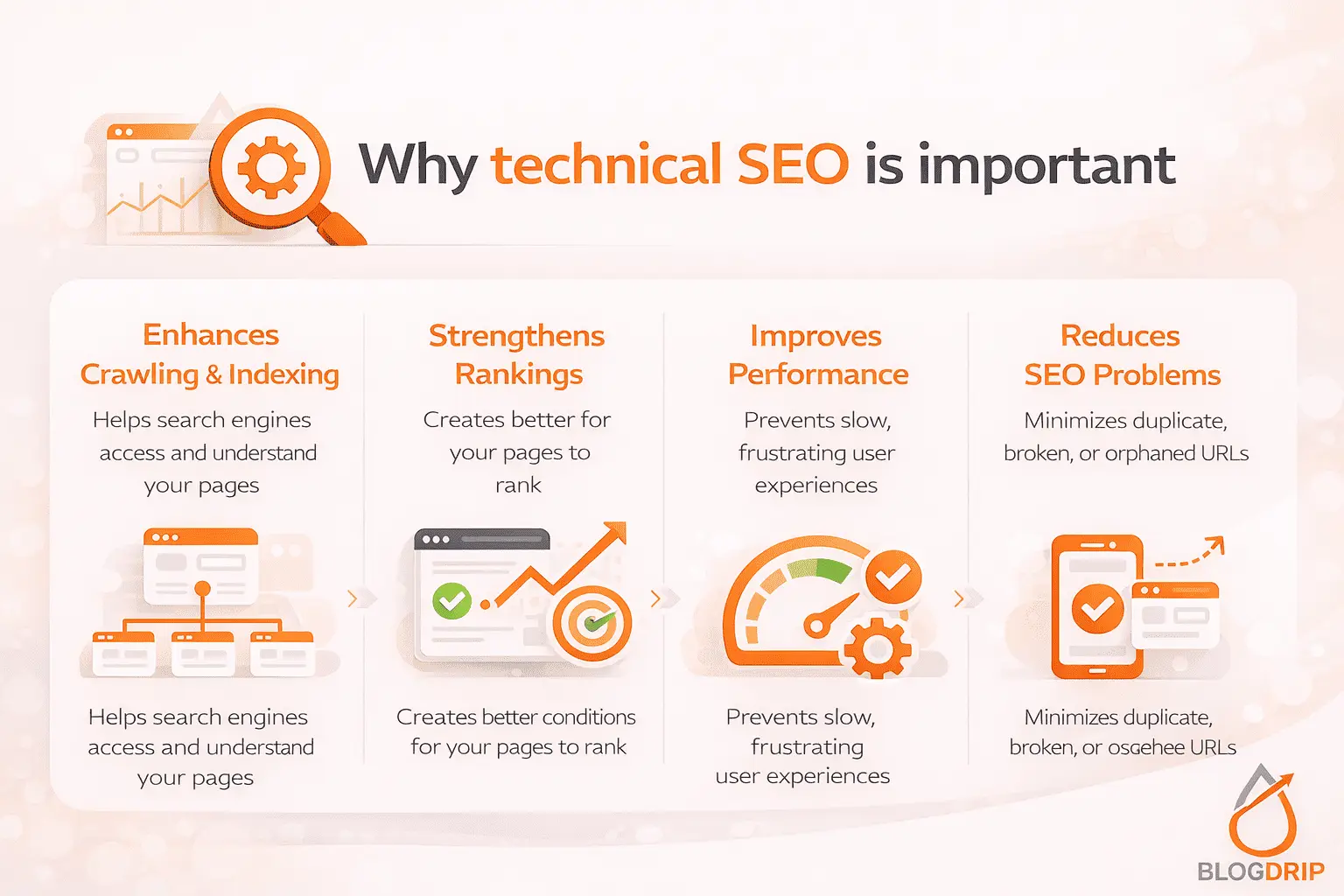
Technical SEO is important because it helps search engines access, understand, and index your website correctly. You can publish strong content and build authority, but if your site has crawl issues, weak architecture, duplication problems, or poor performance, those strengths are harder to convert into rankings.
That is why technical SEO is not just a support task. It is part of the foundation that allows the rest of your SEO strategy to work properly.
This cluster page focuses on a specific informational question: why technical SEO is important. Rather than covering the full discipline in broad detail, it explains where technical SEO creates value, how it influences search visibility, and what businesses should pay attention to first. It should also sit naturally beneath a broader technical SEO pillar page, with internal links to supporting articles on crawlability, indexation, site speed, canonical tags, and structured data.
What Is Technical SEO?
Before looking at why technical SEO is important, it helps to define it clearly.
Technical SEO is the process of improving a website’s technical setup so search engines can discover, crawl, render, and index pages efficiently. In practical terms, it removes barriers between your website and search engines.
This includes areas such as:
- crawlability
- indexation control
- site architecture
- internal linking
- page speed
- mobile usability
- canonicalization
- XML sitemaps
- redirects and status codes
- structured data
Technical SEO does not replace content SEO or off-page SEO. It supports both. Content provides relevance. Authority signals build trust. Technical SEO makes those signals easier for search engines to process.
A natural related article here would be a cluster page answering what technical SEO is, while this page stays focused on why it matters.
Why Technical SEO Matters
The clearest reason technical SEO matters is that search engines cannot rank pages well if they cannot process them well.
A page may target the right keyword and satisfy search intent, but that alone does not guarantee visibility. If the page is hard to crawl, sits in a weak site structure, loads poorly on mobile, or competes with duplicate versions, its performance can suffer.
Technical SEO matters because it improves the environment around your content. It helps search engines spend time on the right pages, interpret signals more clearly, and trust the site structure more confidently.
It supports the entire SEO system
Technical SEO is often misunderstood as a checklist of small fixes. In reality, its value is broader. It strengthens the way content, internal linking, and authority work together.
Without technical clarity, good content can remain under-discovered, poorly indexed, or diluted by structural issues elsewhere on the site.
It reduces wasted effort
One of the most practical reasons technical SEO is important is that it prevents wasted SEO effort. There is little value in publishing at scale if the site keeps generating crawl waste, duplicate pages, broken internal paths, or inconsistent canonical signals.
In that sense, technical SEO protects the return on content and SEO investment.
Why Technical SEO Is Important for Rankings and Visibility
Technical SEO does not guarantee rankings by itself, but it strongly influences whether a page is in a position to compete.
It improves crawl efficiency
Search engines do not crawl every site without limits. They allocate resources and make decisions about where to focus. If your site has too many low-value URLs, redirect chains, dead ends, or confusing structures, crawlers may waste time on pages that do not matter.
That can slow discovery and reduce attention on your priority pages.
A useful internal link here would be to a cluster page on crawlability and crawl efficiency.
It improves indexation quality
Not every page should be indexed. Many sites accidentally allow search engines to index duplicate URLs, filtered pages, thin archives, internal search pages, or parameter variations.
Technical SEO helps keep the index focused on pages that deserve visibility. That usually leads to stronger overall site clarity and fewer signals being spread across low-value pages.
This connects naturally to supporting articles on indexation, canonical tags, and robots directives.
It strengthens signal consistency
Search engines rely on multiple signals to decide which page is primary and how pages relate to one another. Canonicals, redirects, internal links, sitemaps, and status codes all help shape that understanding.
When those signals conflict, search engines have to make more of their own decisions. Technical SEO reduces that ambiguity.
Why Technical SEO Is Important for Website Performance
Technical SEO also matters because it affects the quality of the website experience.
Performance affects both users and search
Slow pages create friction. They make sites harder to use, especially on mobile, and they can reduce engagement on pages that would otherwise perform well. Technical SEO helps identify issues such as bloated templates, heavy scripts, poor caching, or oversized assets that affect performance across the site.
A related supporting article here would be site speed for SEO.
Mobile usability is essential
A page that works well on desktop but poorly on mobile creates a weaker overall experience. Since search engines evaluate sites from a mobile-first perspective, technical SEO has to include mobile usability, layout stability, and content accessibility across devices.
This fits naturally with a cluster page on mobile SEO best practices.
Technical trust matters
Technical quality also influences trust. Secure HTTPS setup, stable redirects, correct canonical versions, and clean handling of duplicate paths all contribute to a site that feels reliable to both users and search engines.
How Technical SEO Works in Practice
To understand why technical SEO is important, it helps to see where it affects the search process. In simple terms, search engines move through discovery, crawling, rendering, and indexation.
Discovery
Search engines first need to find your pages through internal links, XML sitemaps, backlinks, and navigation paths. If important pages are buried too deep or left orphaned, discovery becomes weaker.
Crawling
Once a page is found, search engines try to crawl it. Server errors, redirect loops, blocked resources, broken links, and poor URL structures can create problems here.
Rendering
Modern websites often rely on JavaScript and dynamic interfaces. Search engines can handle much of this, but not always efficiently. If important content or links are difficult to render, visibility can be affected.
Indexation
After crawling and rendering, search engines decide whether a page should be indexed. Duplication, poor canonical signals, weak content differentiation, or unclear internal context can all influence that decision.
Technical SEO helps make each stage cleaner and more reliable.
Important Subtopics That Show Its Value
The importance of technical SEO becomes easier to understand when you break it into the areas it supports most directly.
Site Architecture and Internal Linking
Strong site architecture helps search engines understand hierarchy and relationships between pages. Internal linking helps distribute authority and guide crawlers toward important content.
For a website using a pillar-and-cluster model, this is essential. The technical SEO pillar page should link naturally to cluster pages on crawlability, site speed, canonical tags, structured data, and audits. Those pages should also link back to the pillar in natural ways.
Without that structure, content can become isolated.
Canonicalization and Duplicate Control
Duplicate or near-duplicate pages are common on many websites, especially when filters, parameters, or CMS behavior generate multiple versions of similar content. Technical SEO helps consolidate those signals through canonicals, redirects, and consistent linking.
A useful related article here would be canonical tags for SEO.
XML Sitemaps and Structured Data
XML sitemaps help search engines discover preferred URLs more efficiently. Structured data helps them understand page meaning more clearly. Neither replaces content quality, but both can improve clarity when implemented correctly.
These are useful supporting topics within the wider technical SEO cluster.
Common Mistakes
One common mistake is assuming technical SEO only matters for large or complex websites. Larger sites usually feel technical problems faster, but smaller websites can also lose visibility through weak structure, slow pages, or indexation issues.
Another mistake is treating technical SEO as a one-time audit. Websites change constantly through new content, template updates, plugins, and redesigns. Technical quality needs ongoing attention.
It is also common to focus too much on minor warnings from tools while ignoring more important issues such as poor internal linking, accidental duplication, crawl waste, or weak mobile performance.
Practical Guidance
The best way to apply technical SEO is to start with the fundamentals.
Make sure your most important pages are:
- crawlable
- indexable where appropriate
- internally linked
- mobile-friendly
- fast enough to support a solid experience
- returning the right status codes
Then look for recurring issues across templates and site sections. Many technical SEO problems are systemic, not isolated.
It also helps to align technical priorities with business reality. A small service website does not need the same roadmap as a large ecommerce platform. The principles are the same, but the scale and risk are different.
Timing and Expectations
Technical SEO improvements can lead to meaningful gains, but not always immediately.
Some fixes, such as removing accidental noindex directives or correcting canonical errors, can produce visible changes relatively quickly. Other improvements take longer because search engines need time to recrawl and reassess the site.
It is also important to stay realistic. Technical SEO does not replace strong content, search intent alignment, or authority. It supports them by making the site easier to process and trust.
Conclusion
The real answer to why technical SEO is important is that it gives the rest of your SEO strategy the structure it needs to perform.
Technical SEO helps search engines find the right pages, crawl them efficiently, interpret them accurately, and index them with more confidence. It reduces friction, strengthens signal clarity, and supports site performance across the board.
As a cluster page, this article should support a broader technical SEO pillar page and connect naturally to related supporting articles on crawlability, indexation, canonical tags, site speed, mobile SEO, and structured data. That is the right role for technical SEO within a pillar-and-cluster strategy: not as a separate technical checklist, but as a core part of long-term organic growth.