
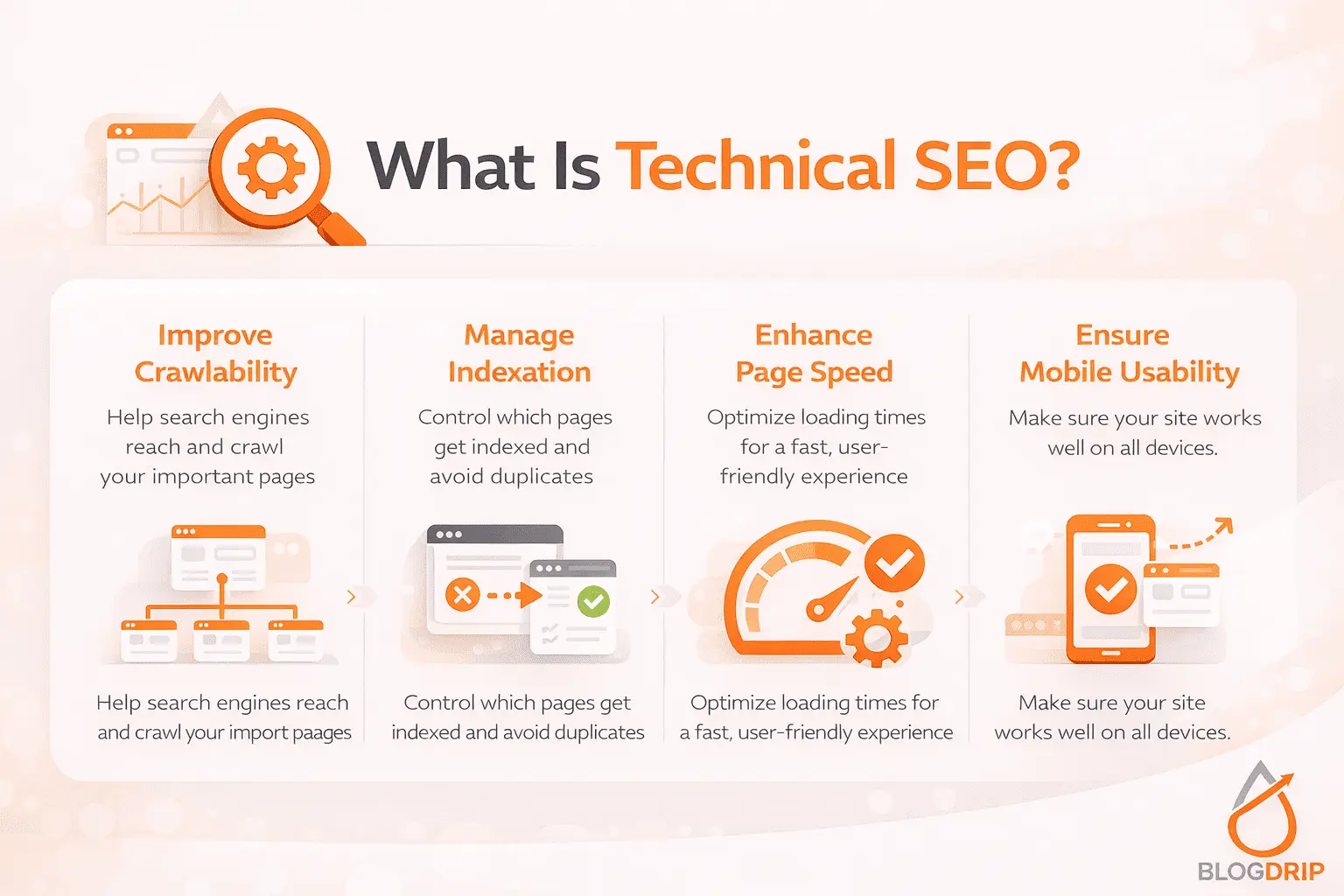
What Is Technical SEO? A Practical Guide to the Foundations of Search
Technical SEO is the part of SEO that helps search engines access, understand, and index your website properly. It sits beneath content strategy, keyword targeting, and link building, but it has a direct impact on how well those efforts can perform.
That is why the question what is technical SEO matters. It is not just a beginner topic. It is a core part of building a website that can compete in search consistently.
Many websites do not struggle because the content is bad. They struggle because important pages are hard to crawl, duplicated across multiple URLs, poorly linked, too slow, or sending mixed technical signals. When that happens, strong content can still underperform.
This page is written as a focused cluster article. Its purpose is to explain what technical SEO is in clear terms, show why it matters, and outline the main areas it covers. It should also sit naturally beneath a broader technical SEO pillar page, with internal links to supporting articles on crawlability, indexation, site speed, canonicals, and structured data.
What Is Technical SEO?
Technical SEO is the process of improving a website’s technical setup so search engines can discover, crawl, render, and index pages efficiently.
In practical terms, technical SEO reduces friction. It helps search engines reach the right pages, interpret their purpose correctly, and avoid wasting attention on unimportant or duplicated URLs.
A simple way to frame it is this:
- content SEO focuses on relevance
- off-page SEO focuses on authority
- technical SEO focuses on accessibility, clarity, and performance
All three work together. Technical SEO does not replace good content or strong authority signals, but it helps those assets do their job.
When people ask what is technical SEO, they usually want more than a definition. They want to know what it includes in practice. The answer usually covers things like crawlability, indexation, site architecture, page speed, mobile usability, structured data, canonical tags, redirects, status codes, and XML sitemaps.
Not every site needs advanced work in every category, but every site needs a technically sound foundation.
Why Technical SEO Matters
Technical SEO matters because search engines cannot rank pages properly if they cannot process them properly.
A site may publish useful content and still struggle if key pages are buried too deep in the structure, blocked from crawling, duplicated through URL variations, or slowed down by weak templates. In those cases, the problem is not always content quality. Often, it is the technical environment around the content.
It supports discovery and crawling
Search engines first need to find your pages. Technical SEO supports this through internal linking, XML sitemaps, clear navigation, and clean site structure.
If important pages are orphaned or difficult to reach, they may be crawled slowly or inconsistently. That is why related cluster pages on crawlability and site architecture for SEO are important in a broader technical SEO topic cluster.
It improves indexation quality
Not every page should be indexed. Many sites generate low-value URLs through filters, tags, parameters, internal search pages, or duplicate archives. Technical SEO helps control which pages search engines should treat as valuable enough to index.
This is where supporting topics like indexation, canonical tags, and meta robots directives become important.
It strengthens user experience
Technical SEO also overlaps with usability. Slow pages, unstable layouts, and weak mobile experiences can affect both engagement and search performance. Search engines increasingly want to rank pages that are accessible and usable, not just relevant.
That makes site speed and Core Web Vitals natural supporting articles within the cluster.
It helps websites scale
As websites grow, technical problems become more costly. A small site can sometimes absorb minor issues. A large site with many templates, categories, or filtered URLs usually cannot. Technical SEO helps prevent growth from creating duplication, crawl waste, and structural confusion.
How Technical SEO Works
Technical SEO works by aligning your website with the way search engines process pages.
At a broad level, search engines move through four key stages: discovery, crawling, rendering, and indexation. Technical SEO influences each stage.
Discovery
Search engines discover URLs through internal links, sitemaps, backlinks, and prior crawl history. If your site has weak internal linking or poor navigation, discovery becomes less efficient.
Crawling
Once a URL is found, search engines try to crawl it. Problems at this stage often include server errors, blocked resources, broken links, redirect chains, and poor URL structures.
Rendering
Modern websites often rely on JavaScript and dynamic components. Search engines can render many of these pages, but that does not mean they always interpret them as intended. If important content or links depend too heavily on scripts, technical SEO needs to assess whether search engines can access them reliably.
Indexation
After crawling and rendering, search engines decide whether a page should be indexed. That decision depends on content quality, duplication, canonical signals, metadata, and overall site confidence. Technical SEO helps make those signals clearer and more consistent.
Important Subtopics Within Technical SEO
A good answer to what is technical SEO should explain the main areas that shape it in practice.
Crawlability and Site Architecture
Crawlability is about whether search engines can access your pages efficiently. Site architecture is about how those pages are organized and connected.
A technically strong site usually has a clear navigation system, shallow click depth for important pages, logical URL structure, and contextual internal links between related content.
For a site using a pillar-and-cluster model, this matters even more. The main technical SEO pillar page should link naturally to cluster articles, and those supporting pages should link back using varied, natural anchor text.
Indexation and Canonicalization
One of the most common technical SEO problems is poor control over what gets indexed.
Many websites allow search engines to index pages that add little value, such as filtered URLs, duplicate category variations, internal search pages, or session-based duplicates. Over time, that can dilute quality signals.
Canonical tags help indicate preferred versions of similar pages. Meta robots directives help control whether a page should be indexed. Internal linking also reinforces which pages matter most.
A dedicated article on canonical tags for SEO would be a natural supporting page from here.
Site Speed and Performance
Performance is a core part of technical SEO because slow pages create friction for both users and search engines.
The strategic goal is not to chase scores for their own sake. It is to identify what makes the site slower in real use. That might include oversized media, bloated code, heavy third-party scripts, weak caching, or inefficient templates.
This topic should naturally connect to a supporting article on site speed for SEO.
Mobile Optimization
Technical SEO must also account for mobile usability. A site may work well on desktop but still fail on mobile if layouts break, content is hidden, or navigation becomes difficult to use.
Search engines evaluate pages through a mobile-first lens, so mobile completeness matters. Your site should present the same core content, internal links, and metadata across devices.
Structured Data
Structured data helps search engines interpret page content more clearly. It can support understanding of articles, products, FAQs, organizations, and breadcrumbs.
It is useful, but it should be implemented accurately and strategically. Structured data is not a shortcut to rankings. It is a technical layer that can improve clarity and search feature eligibility when done correctly.
Common Mistakes
One common mistake is assuming technical SEO is only for developers. Some issues do require development support, but site owners, marketers, and content teams also need to understand the basics. Otherwise, technical problems often get missed until performance drops.
Another mistake is treating technical SEO as a checklist rather than a system. Fixing isolated warnings from audit tools is not the same as improving how the site works in search.
Some teams also focus on minor issues while ignoring bigger ones. For example, they may spend time on secondary schema improvements while important pages remain poorly linked, duplicated, or slow.
It is also common to confuse crawling with indexing. A page can be crawlable but not indexable. It can also be technically indexable but hard to discover. Good technical SEO requires understanding the difference.
Practical Guidance
The best way to approach technical SEO is to start with priorities, not complexity.
Focus first on your most important pages. Make sure they are crawlable, indexable where appropriate, internally linked, mobile-friendly, fast enough to perform well, and returning the correct status codes.
Then look for pattern-level issues. Many technical SEO problems come from templates, CMS logic, faceted navigation, or platform behavior rather than isolated pages.
It also helps to connect technical work directly to site architecture. This cluster page answers what is technical SEO, but it should guide readers toward the broader technical SEO guide and deeper supporting content on crawling, canonicals, sitemaps, performance, and structured data.
That supports both usability and topical authority.
Timing and Expectations
Technical SEO improvements can produce meaningful results, but not always immediately.
Some fixes have fast impact, especially when they address crawl blocks, broken redirects, accidental noindex directives, or major duplication signals. Other improvements take longer because search engines need time to recrawl and reassess the site.
It is also important to stay realistic. Technical SEO creates the conditions for stronger organic performance, but it does not replace content quality, intent alignment, or authority. It supports them.
That is why technical SEO should be treated as an ongoing operational discipline rather than a one-time cleanup.
Conclusion
The clearest answer to what is technical SEO is this: it is the part of SEO that helps search engines access, understand, and index your website correctly.
It covers the technical foundations behind crawling, indexation, performance, site structure, mobile usability, and signal clarity. Without those foundations, good content often struggles. With them, your broader SEO strategy has a much stronger chance to succeed.
As a cluster page, this article should support a wider technical SEO pillar page and connect naturally to related articles on crawlability, indexation, canonical tags, site speed, mobile SEO, and structured data. That is the right role for technical SEO within a pillar-and-cluster strategy: not as an isolated checklist, but as a core part of sustainable search growth.