
Website Speed SEO: Why Performance Still Matters for Search and User Experience
Website speed SEO is often discussed in oversimplified terms. Some people treat speed as a direct ranking shortcut. Others dismiss it because faster pages do not automatically outrank better content. Both views miss the bigger picture.
Speed matters because it affects how users experience a page and how efficiently a website performs overall. A slow site creates friction. It can reduce engagement, weaken conversions, and make strong pages less competitive than they should be. In SEO terms, website speed is rarely the only reason a page wins or loses, but it is often part of the reason a site underperforms.
That is why website speed belongs in any serious technical SEO cluster. It supports crawl efficiency, mobile usability, page experience, and site quality. It also works best when treated as part of a broader system that includes clean code, sound architecture, and realistic prioritization.
This cluster page explains website speed SEO in practical terms: what it is, why it matters, how it works, what influences it, common mistakes, and how to approach it strategically.
What Is Website Speed SEO?
Website speed SEO is the practice of improving how quickly web pages load and become usable in ways that support search performance and user experience.
In practical terms, this means reducing unnecessary delays between a user requesting a page and the page becoming meaningfully interactive and stable. It also means improving how efficiently page resources are delivered to browsers and rendered across devices.
Website speed SEO is not just about one score or one tool. It includes several related ideas:
- page load performance
- server response time
- render speed
- visual stability
- mobile responsiveness
- resource efficiency
Speed is therefore both a technical and strategic topic. It sits between development, UX, and SEO.
Why Website Speed SEO Matters
Website speed SEO matters because performance affects both search visibility and business outcomes, even if the relationship is not always direct or linear.
It improves user experience
Users notice slow pages before they notice almost anything else. If a page feels heavy, unstable, or delayed, trust drops quickly. That can reduce engagement, increase abandonment, and weaken the value of otherwise strong content.
A fast page is not automatically a good page, but a slow page can make a good page feel worse than it is.
It supports page experience signals
Search engines increasingly evaluate the quality of the experience a page delivers, not just the relevance of the content. That is one reason performance metrics such as Core Web Vitals matter within the broader technical SEO picture.
A related supporting article here would be a cluster page on Core Web Vitals.
It helps mobile SEO
Performance matters even more on mobile because device capability, network quality, and layout constraints create additional friction. Pages that feel acceptable on desktop can still perform poorly on mobile.
That is why website speed SEO naturally connects to related cluster topics such as mobile SEO and technical SEO fundamentals.
It supports crawl efficiency at scale
On larger sites, performance can also influence how efficiently search engines crawl pages. A slower, more resource-heavy site may be harder to process at scale than a cleaner, faster one. This is usually more noticeable on large ecommerce, publisher, or enterprise sites, but the principle applies broadly.
How Website Speed SEO Works
Website speed SEO works by reducing the technical barriers that slow down how pages load, render, and become usable.
Request and response
When someone visits a page, the browser sends a request to the server. The server responds with HTML and other required resources such as images, CSS, JavaScript, and fonts. Delays can start here if hosting is weak, caching is poor, or the page depends on too many heavy assets.
Rendering and interactivity
After the browser receives those resources, it still needs to process and display them. Large scripts, render-blocking files, unoptimized media, and heavy front-end frameworks can all delay visible content or interactivity.
This is why website speed is not only about hosting. It is also about how the page is built.
Stability and usability
A page may appear quickly but still feel broken if elements jump around while loading or if buttons become usable too late. Good website speed SEO therefore includes not just raw speed, but smoothness and stability.
That is why performance should be measured through actual user experience, not just by whether the page eventually loads.
Important Factors That Influence Website Speed SEO
Several technical areas shape how well a site performs.
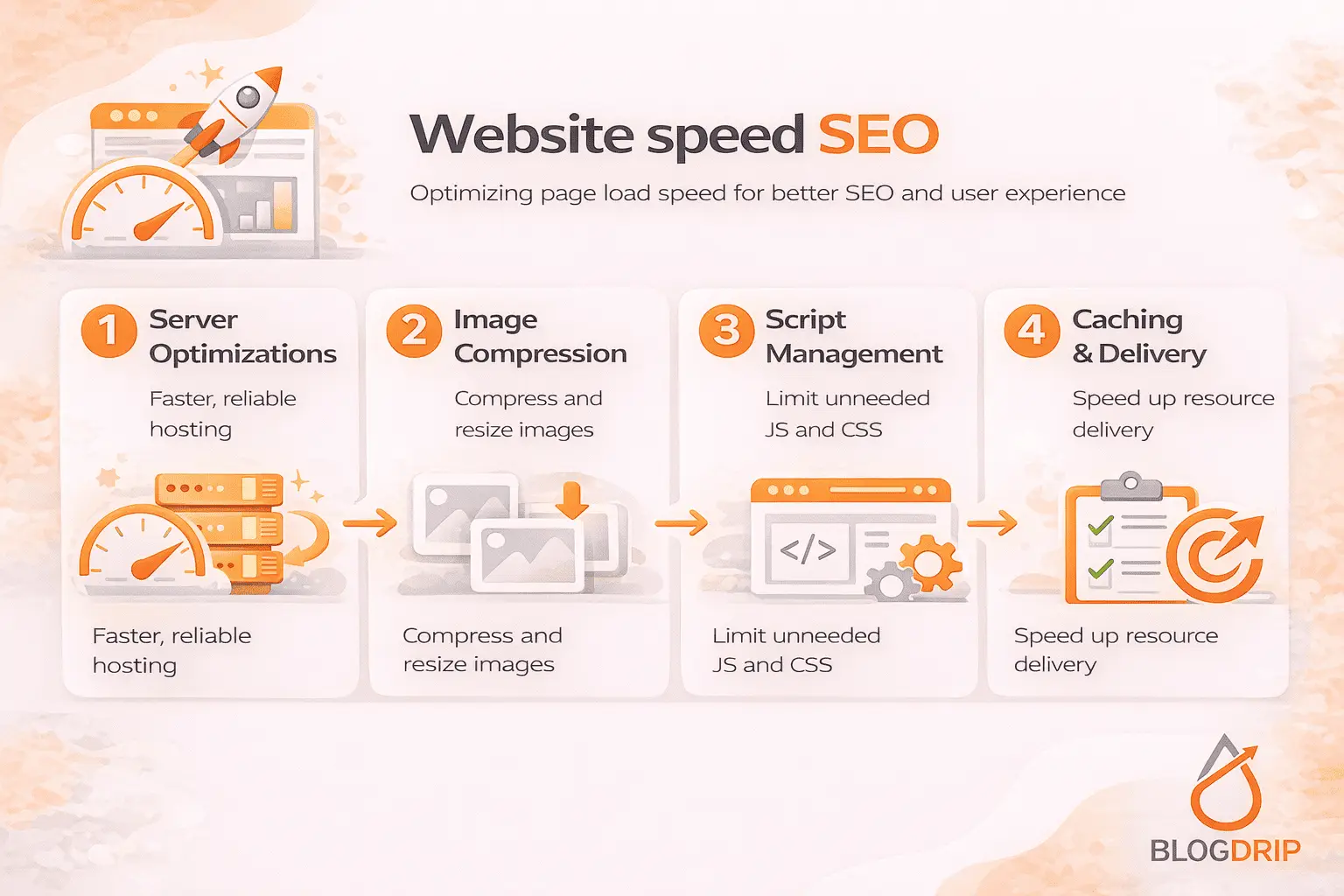
Server and hosting quality
A poor server environment can slow everything down before the page content even arrives. Weak hosting, slow database queries, lack of caching, and overloaded infrastructure all create delays that content optimization alone cannot solve.
For some sites, the biggest speed gains come from infrastructure changes rather than front-end tweaks.
Image and media optimization
Images are one of the most common causes of slow pages. Oversized files, incorrect dimensions, unnecessary formats, and missing compression all add avoidable weight.
This is especially important on content-heavy sites, ecommerce pages, and pages with visual components. Media should support the experience, not dominate it.
JavaScript and third-party scripts
Many websites become slow because of front-end complexity. Tracking scripts, chat widgets, testing tools, ad systems, and animation libraries can all add substantial overhead.
This is where technical SEO needs realism. Not every script is unnecessary, but every script has a cost.
A related supporting article here could be JavaScript SEO.
CSS, fonts, and render-blocking resources
Heavy CSS files, unnecessary font requests, and resources that block visible rendering can all delay the first usable view of the page. Even visually simple pages can be slowed down by bloated template systems underneath.
Caching and delivery
Efficient caching helps repeat visitors and reduces unnecessary load on the server. Content delivery networks can also improve how quickly resources reach users across regions.
For larger or international sites, this becomes more important.
Common Mistakes
One common mistake is treating website speed SEO as a score-chasing exercise. Teams often focus on improving tool scores without asking whether the changes actually improve user experience or business outcomes.
Another mistake is assuming speed is a one-time fix. Performance often declines over time as new plugins, scripts, design elements, and tracking systems are added. Without ongoing control, even a fast site can become slow again.
Some businesses also focus only on homepage speed while ignoring templates that matter more for traffic or conversions, such as service pages, product pages, or blog templates. That creates a misleading sense of progress.
It is also common to blame content when the real issue is template bloat. A strong page can underperform simply because the surrounding codebase is too heavy.
Practical Guidance
The best way to approach website speed SEO is to prioritize performance issues by impact.
Start with the pages and templates that matter most. Look at your core organic landing pages, high-conversion pages, and primary content templates. If those are slow, they deserve attention before lower-priority sections.
A practical approach usually includes:
- improving image compression and sizing
- reducing unnecessary scripts
- reviewing template bloat
- improving caching
- checking mobile performance first
- fixing obvious layout shifts and delayed interactivity
It also helps to separate symptoms from causes. For example, a slow page score may be caused by oversized images, too many third-party tags, weak hosting, or poorly managed JavaScript. The right fix depends on the real bottleneck.
Within a pillar-and-cluster structure, this page should connect naturally to a broader technical SEO pillar page and related supporting articles on Core Web Vitals, mobile SEO, JavaScript SEO, and crawlability.
Timing and Expectations
Website speed SEO can lead to meaningful improvements, but results are not always immediate or dramatic in rankings alone.
Some changes improve user experience right away. Others may take time to influence search performance as search engines recrawl, re-evaluate, and compare the improved pages against competitors.
It is also important to stay realistic. Speed improvements usually work best when they strengthen already valuable pages. A faster weak page is still weak. A faster strong page is more competitive.
That is why performance should be treated as an enabler, not a standalone ranking strategy.
Conclusion
Website speed SEO matters because performance affects how pages are experienced, processed, and trusted. It supports usability, mobile performance, technical quality, and overall site competitiveness.
It is not a magic ranking lever, but it is a meaningful part of technical SEO. When handled strategically, it removes friction that can hold strong content back.
As a cluster page, this article should support a broader technical SEO pillar page and connect naturally to related topics such as Core Web Vitals, mobile SEO, JavaScript SEO, crawlability, and page experience. That is the right role for website speed SEO in a pillar-and-cluster model: not as a standalone obsession, but as a core part of building a technically strong website.