
How Clean URLs Support Search Clarity and Site Architecture
URL structure SEO is rarely the single reason a page ranks, but it often shapes how clearly a website is organized, understood, and maintained. A good URL structure supports both users and search engines. A poor one creates friction, duplication risk, and long-term technical mess.
That is why URL structure deserves a place in a technical SEO cluster. It sits at the intersection of site architecture, crawlability, internal linking, and content organization. Once a site grows, weak URL decisions become harder to undo. Redirect chains, inconsistent folders, duplicate paths, and unclear hierarchy can all become expensive technical debt.
This cluster page explains URL structure SEO in practical terms. It covers what it is, why it matters, how to approach it, what commonly goes wrong, and how to build URLs that support long-term search performance.
What Is URL Structure SEO?
URL structure SEO is the practice of organizing page URLs in a way that supports crawlability, clarity, maintainability, and logical site structure.
In simple terms, it is about how your web addresses are written and how they fit into the broader architecture of the site.
A well-structured URL usually does three things:
- makes the page purpose reasonably clear
- fits logically within the site hierarchy
- stays stable over time
For example, a short, descriptive path is usually easier to understand and manage than a long URL filled with unnecessary folders, parameters, dates, or auto-generated strings.
What URL structure includes
URL structure is not just the visible slug at the end of a page. It also includes:
- folder hierarchy
- category paths
- slug naming conventions
- trailing slash consistency
- lowercase or mixed-case handling
- parameter usage
- canonical path choices
That is why URL structure SEO is both a content and technical topic. It affects how pages are published, how templates are built, and how site sections scale.
Why URL Structure SEO Matters
URL structure SEO matters because URLs send structural signals. They are not as powerful as content quality or internal linking, but they still influence how cleanly a site is understood and managed.
It improves site clarity
A clean URL helps users and search engines understand where a page sits within the website. It supports hierarchy and makes related sections easier to interpret.
For example, a page under a clearly organized topic path usually creates more architectural clarity than one buried under inconsistent or arbitrary folders.
This connects naturally to related cluster pages on site architecture and technical SEO fundamentals.
It reduces technical friction
Weak URL structures often create avoidable technical problems. These include duplication, inconsistent internal linking, messy redirects, and confusion around canonical versions.
The issue is not only what the URL looks like today. It is how many problems it creates later when pages are updated, moved, or scaled.
It supports better maintenance
Stable, predictable URLs are easier for teams to manage. They reduce the risk of accidental duplication and make internal linking more consistent across content, development, and CMS workflows.
For a site using a pillar-and-cluster model, that matters even more. A strong cluster structure depends on clear page relationships, and URLs can help reinforce those relationships.
How URL Structure SEO Works
URL structure SEO works by aligning page paths with the logic of the site.
Search engines use many signals to understand a page, and URLs are only one of them. But when URLs are clean, descriptive, and consistent, they support that understanding rather than getting in the way.
Structure supports crawlability
Search engines discover pages through internal links, sitemaps, and crawl paths. A clean URL structure helps make the site easier to navigate and less prone to duplicated or fragmented versions of similar content.
This is especially important when combined with related technical signals such as canonical tags, XML sitemaps, and crawling and indexing.
Naming supports context
A descriptive slug can add useful context, especially when it reflects the page topic naturally. That does not mean stuffing keywords into every URL. It means choosing clear names that match the content and fit within the site hierarchy.
Consistency supports trust
Inconsistent URL rules often signal weak site governance. Search engines can handle many URL patterns, but websites tend to perform better operationally when structure is stable and intentional.
Important Elements of Good URL Structure SEO
A good article on URL structure SEO should move beyond “keep URLs short” and explain what actually makes a URL structure work over time.
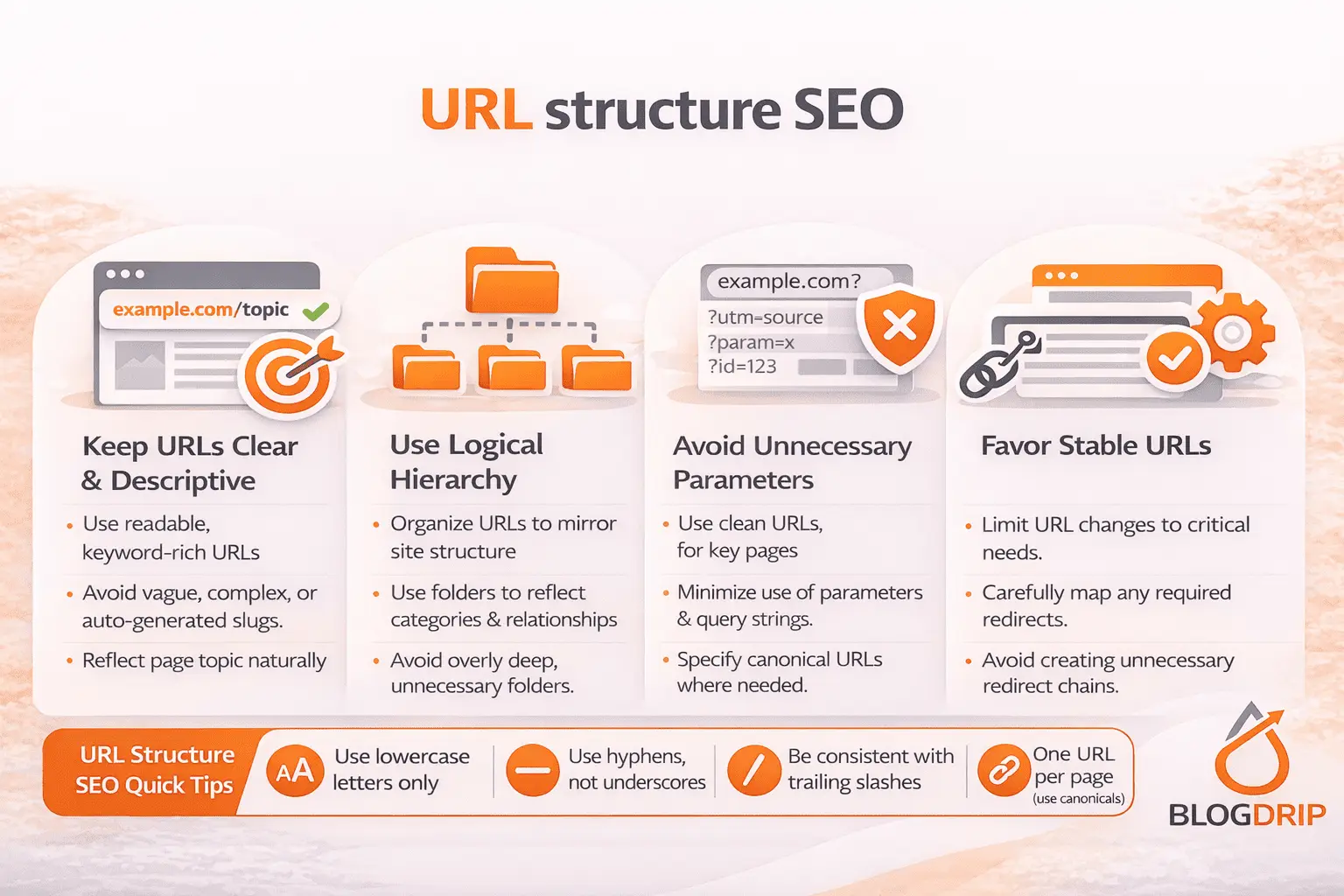
Keep URLs Clear and Descriptive
A good URL should be readable and easy to interpret at a glance. In most cases, that means using plain words rather than random IDs, excessive dates, or vague labels.
Shorter is usually better when it preserves clarity. But short alone is not the goal. A vague short URL is not better than a slightly longer one that is clearer.
For example, descriptive topic-based slugs usually work better than system-generated strings.
Use Logical Hierarchy
Folder structure should reflect real site organization, not just CMS behavior.
If your site has a pillar-and-cluster model, the URL structure can reinforce that relationship. A pillar page can sit at a broader path, while related cluster pages sit under relevant supporting paths when that makes structural sense.
That said, hierarchy should help the user and the site, not exist just to create deeper folders. Overly nested URLs usually create more complexity than value.
Avoid Unnecessary Parameters
Parameters are sometimes unavoidable, especially for filtering, tracking, or dynamic systems. But they should not define your core SEO structure unless there is a clear reason.
URLs filled with query strings are often harder to manage, easier to duplicate, and less stable for long-term search use.
This is one reason canonical tags and robots directives often sit close to URL structure within a technical SEO cluster.
Keep Formatting Consistent
Consistency matters more than perfection. Common best practices include:
- lowercase URLs
- hyphens instead of underscores for word separation
- one preferred trailing slash format
- one canonical version of each URL path
Mixed formatting creates avoidable duplication and linking inconsistency.
Favor Stable URLs Over Frequent Changes
One of the most overlooked parts of URL structure SEO is stability. Good URLs should not need constant editing. Changing URLs repeatedly creates redirect dependencies, weakens link stability, and adds maintenance overhead.
This is why naming decisions should be made with long-term use in mind, not only short-term campaign logic.
Common URL Structure SEO Mistakes
Many URL issues come from small local decisions that create larger structural problems over time.
Making URLs too long or too complex
Long URLs with multiple folders, repeated keywords, dates, or extra descriptors often reduce clarity rather than improve it. Complexity is rarely a ranking advantage.
Stuffing keywords into the slug
Using keywords naturally in the URL is fine. Repeating them excessively is not. Search engines do not need awkward, over-optimized slugs to understand page intent.
A clean, readable path is usually better than a forced exact-match chain.
Changing URLs without a strong reason
Teams often rewrite URLs for cosmetic reasons after a page is already live. Unless there is a serious structural issue, that can create more risk than reward. Every URL change introduces redirect dependency and potential internal linking cleanup.
Letting categories and URLs drift apart
Sometimes site categories evolve while URL paths stay outdated or become inconsistent across sections. That creates confusion for both users and teams. URL structure should reflect the current architecture clearly enough to remain manageable.
Allowing multiple live versions of the same path
Case-sensitive differences, trailing slash inconsistencies, and parameter-based duplicates can all create multiple accessible versions of a page. That weakens structural clarity and often requires stronger canonical control.
Practical Guidance
The best way to approach URL structure SEO is to think in terms of site governance, not just individual page naming.
Start with a few simple principles:
- keep URLs readable
- keep structure consistent
- use hierarchy only when it adds real clarity
- avoid unnecessary complexity
- choose stable naming from the start
Then apply those principles at the template and section level, not just page by page.
Build around the site architecture
Your URLs should reflect how the site is organized. If a topic belongs within a clear cluster, the URL can support that. If deeper folders add no value, do not force them.
For a pillar-and-cluster strategy, the main technical SEO pillar page should connect naturally to supporting cluster pages such as URL structure SEO, site architecture, canonical tags, and XML sitemap SEO.
Audit for duplication and inconsistency
Look for patterns, not isolated examples. Common issues include:
- mixed trailing slash rules
- duplicate category paths
- inconsistent slug styles
- old campaign folders still active
- unnecessary parameter indexing
- page moves handled through long redirect chains
Pattern-level problems matter more than single imperfect URLs.
Prioritize stability during migrations
Site redesigns and CMS migrations are where URL mistakes become costly. Before launch, make sure URL rules are consistent, redirects are mapped properly, and important pages retain stable paths where possible.
Timing and Expectations
URL structure SEO improvements can help quickly in some cases, especially when they reduce duplication, simplify crawl paths, or clean up major structural confusion. But many benefits are cumulative rather than immediate.
A cleaner URL structure supports stronger internal linking, easier maintenance, and better technical consistency over time. It is usually more valuable as a foundation than as a one-off ranking lever.
It is also important to stay realistic. Rewriting every URL on an otherwise healthy site is rarely the best use of effort. The biggest gains usually come when URL improvements are tied to broader structural cleanup, migration planning, or long-term architecture work.
Conclusion
URL structure SEO matters because clean, stable, descriptive URLs support site clarity, technical consistency, and long-term maintainability. They help reinforce architecture, reduce duplication risk, and make the site easier to manage as it grows.
They are not a substitute for content quality, internal linking, or authority. But they are part of the technical foundation that helps those strengths work more cleanly.
As a cluster page, this article should support a broader technical SEO pillar page and connect naturally to related topics such as site architecture, canonical tags, XML sitemaps, crawling and indexing, and robots directives. That is the right role for URL structure SEO in a pillar-and-cluster model: not as a cosmetic detail, but as part of building a site that stays organized, scalable, and search-friendly.