
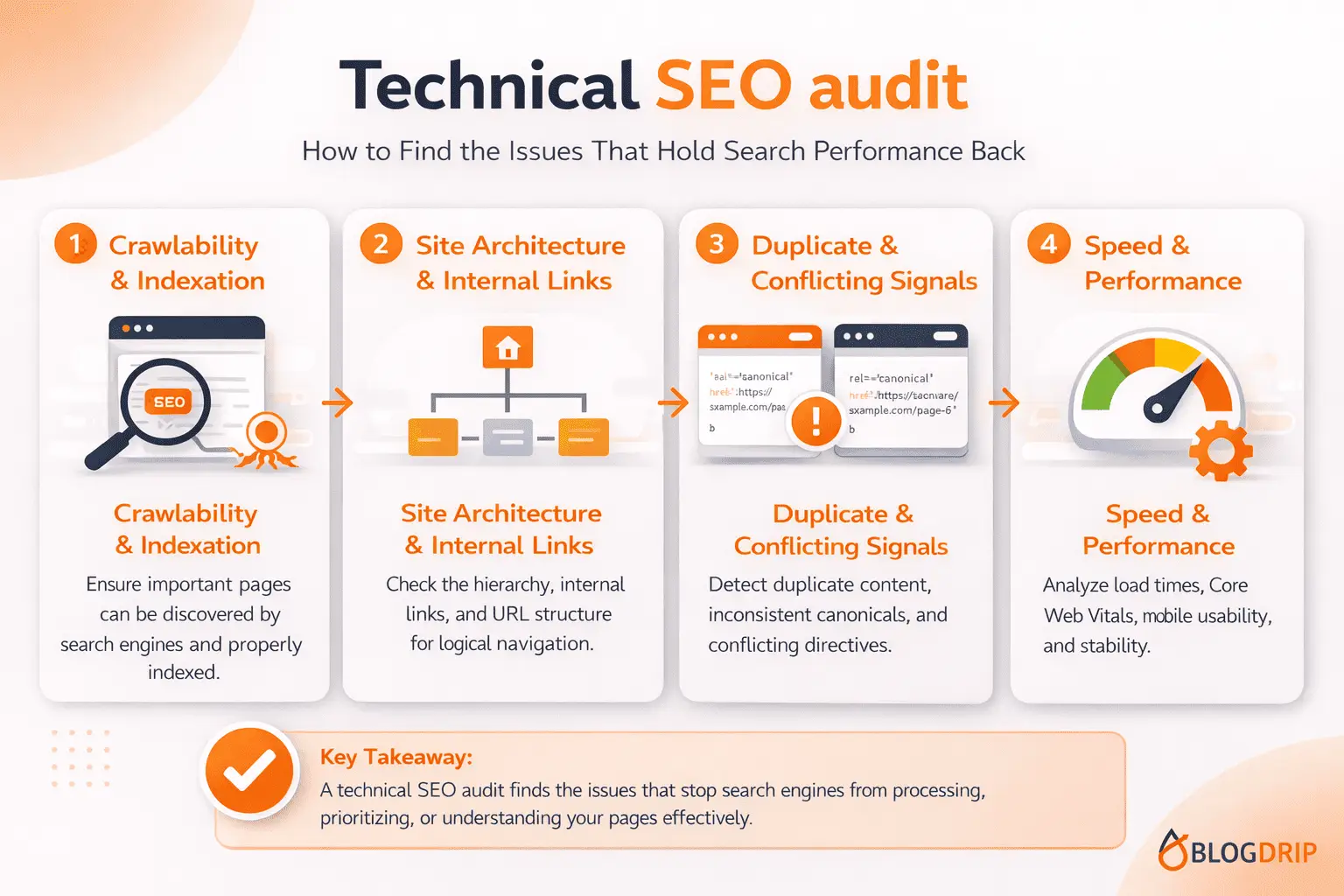
How to Find the Issues That Hold Search Performance Back
A technical SEO audit is not a generic checklist exercise. Done properly, it is a structured review of how a website is crawled, indexed, rendered, and maintained. Its purpose is to identify the technical issues that limit visibility, waste crawl attention, weaken page experience, or create confusion around which pages should rank.
That is why a technical SEO audit matters so much in a pillar-and-cluster content model. A site can publish strong content and still underperform if technical signals are mixed, important pages are hard to discover, or duplicate URLs dilute the structure. In those cases, the problem is not the topic coverage. It is the infrastructure around it.
This cluster page explains what a technical SEO audit is, why it matters, how it works, what it should include, common mistakes, and how to approach it strategically. It should also sit naturally beneath a broader technical SEO pillar page, with internal links to related cluster articles on crawlability, indexation, XML sitemaps, canonical tags, URL structure, Core Web Vitals, and robots.txt.
What Is a Technical SEO Audit?
A technical SEO audit is a structured review of a website’s technical setup to identify issues that affect crawling, rendering, indexation, site performance, and search engine understanding.
In practical terms, it answers questions like these:
- Can search engines discover the right pages?
- Are important URLs crawlable and indexable?
- Are duplicate signals being handled correctly?
- Is the site structure helping or hurting visibility?
- Are performance or rendering issues creating friction?
A technical SEO audit is not only about finding errors in tools. It is about understanding which technical patterns are limiting search performance and which fixes will have the highest impact.
What a technical SEO audit is not
A technical SEO audit is not a list of every warning a crawler can produce. That approach usually creates noise, not strategy.
It is also not a one-time exercise that guarantees stable performance forever. Websites change constantly through CMS updates, new templates, migrations, publishing workflows, plugins, and development releases. A technical audit gives you a current picture, but technical SEO requires ongoing attention.
Why a Technical SEO Audit Matters
A technical SEO audit matters because search engines cannot rank pages well if they cannot process them clearly and efficiently.
It protects the value of your content
Content can only perform if it is discoverable, accessible, and properly indexed. A technical SEO audit helps uncover the issues that prevent good pages from competing fully.
That is why this topic connects naturally to supporting pages on crawling and indexing and XML sitemap SEO.
It reduces wasted crawl activity
Many sites create low-value or duplicated URLs through filters, parameters, archives, internal search pages, or inconsistent path rules. A technical SEO audit helps identify where search engines may be spending time on the wrong pages.
This is especially important on larger websites where crawl inefficiency compounds quickly.
It improves signal clarity
Search performance depends on consistency. Canonical tags, internal links, sitemaps, redirects, robots directives, and preferred URLs should reinforce one another. A technical SEO audit helps reveal where these signals conflict.
That is why cluster pages on canonical tags, robots.txt SEO, and URL structure SEO should support this page.
It supports long-term site health
Technical problems often grow quietly. A small template issue can spread across hundreds of pages. A careless migration can create redirect chains. A plugin can introduce duplicate archives. A technical SEO audit helps catch those issues before they become deeply embedded.
How a Technical SEO Audit Works
A technical SEO audit works by reviewing the website from the perspective of both search engines and users.
That means looking at crawl paths, rendered output, indexation behavior, URL patterns, performance, internal linking, and technical consistency across the site.
Start with site-wide patterns
The most useful audits begin at the pattern level. Instead of reviewing random pages one by one, look at templates, sections, and recurring URL behaviors.
For example, if product pages all share one performance problem or category pages all contain conflicting canonicals, that is more important than a single isolated warning.
Compare what the site intends with what search engines see
A good technical SEO audit compares the intended structure of the site with the actual signals being sent.
If a page is meant to rank, is it internally linked, included in the XML sitemap, self-canonicalized, mobile-friendly, and returning the correct status code? If not, the technical setup is undermining its role.
Prioritize by impact
Not every issue deserves equal attention. A technical SEO audit should sort problems by likely impact on crawl efficiency, indexation, visibility, and business value.
This is where experience matters. A hundred minor warnings are often less important than one indexing rule affecting a core section of the site.
What a Technical SEO Audit Should Include
A technical SEO audit should cover the core systems that influence search engine access, interpretation, and page quality.
Crawlability and Indexation
This is usually the foundation of the audit. Review whether important pages can be discovered, crawled, and indexed correctly.
That includes checking:
- crawl access
- noindex behavior
- orphan pages
- blocked paths
- duplicate URL patterns
- sitemap inclusion
- canonical logic
This section should naturally link to a cluster article on crawling and indexing.
URL Structure and Canonicalization
A technical SEO audit should assess whether the site has one clear preferred version of each important page. Look for parameter duplication, inconsistent slashes, mixed protocol versions, alternate category paths, and weak canonical implementation.
This supports related cluster pages on URL structure SEO and canonical tags.
Internal Linking and Site Architecture
Internal linking is often underestimated in technical audits. A technically accessible page can still struggle if it sits too deep in the site, receives weak contextual links, or exists in a confusing hierarchy.
For a pillar-and-cluster structure, the audit should confirm that pillar pages support cluster pages properly and that related pages reinforce each other naturally.
A useful internal link here would be to site architecture for SEO.
XML Sitemaps and Robots Controls
Sitemaps and robots rules should reflect the real priorities of the site. A technical SEO audit should check whether the sitemap includes only preferred, indexable URLs and whether the robots.txt file is supporting crawl efficiency without blocking important content.
This connects naturally to XML sitemap SEO and robots.txt SEO.
Performance and Core Web Vitals
Performance is a technical SEO issue because slow, unstable pages create friction for both users and search engines. The audit should review site speed, mobile experience, layout stability, heavy scripts, and weak templates.
Related supporting pages here would be website speed SEO and Core Web Vitals.
Structured Data and Rendering
A technical SEO audit should also review whether structured data matches visible content and whether critical content is accessible without rendering problems. This is particularly important on JavaScript-heavy sites.
This section can connect to structured data SEO.
Common Mistakes in Technical SEO Audits
One common mistake is treating the audit like a spreadsheet of tool warnings. That usually produces an overwhelming backlog without strategic order.
Another is reviewing only a handful of pages without looking at the templates or systems behind them. Most technical issues are pattern-based, not page-specific.
Some audits also focus too much on minor compliance details while missing high-impact structural problems. For example, improving a secondary markup field matters far less than discovering that important pages are buried too deep or canonicalized incorrectly.
It is also common to separate technical SEO too sharply from content strategy. In reality, a technical audit should reflect page purpose. The question is not only whether a page is crawlable, but whether the site is technically supporting the right pages.
Practical Guidance
The best way to approach a technical SEO audit is to start with the pages and sections that matter most.
Review the templates that drive organic traffic, conversions, and core topic authority. Make sure those pages are:
- crawlable
- indexable where appropriate
- internally linked
- technically consistent
- fast enough to support a good experience
- aligned with preferred canonical and sitemap signals
Then move to system-level review. Look at duplication patterns, filtered URLs, archive behavior, redirect logic, mobile rendering, and crawl controls.
Focus on priorities, not volume
A strong audit usually identifies a manageable set of high-impact issues rather than cataloging every possible warning. The goal is not to produce the longest report. The goal is to improve search performance.
Audit before and after major site changes
A technical SEO audit is especially important before migrations, redesigns, CMS changes, or major content expansions. It is also valuable after launch, because technical losses often appear once real crawling behavior begins.
Keep the cluster structure in mind
For a site using a pillar-and-cluster model, your audit should confirm that the broader technical SEO pillar page and the surrounding cluster pages are supported by the architecture. Pillar pages should be easy to discover and cluster pages should reinforce the structure without duplication or crawl waste.
Timing and Expectations
A technical SEO audit can reveal issues quickly, but the effects of fixing those issues vary.
Some changes produce visible improvement relatively fast, especially when they resolve crawl blocks, indexation errors, broken canonicals, or serious performance bottlenecks. Others take longer because search engines need time to recrawl, reprocess, and reassess the site.
It is also important to be realistic. A technical SEO audit does not create rankings on its own. It improves the conditions under which good content can perform. That is why it is most valuable when combined with strong topical coverage, internal linking, and search intent alignment.
Conclusion
A technical SEO audit is not just a diagnostic exercise. It is a way to understand whether your website is technically helping or hindering the pages that matter most.
When done well, it reveals the structural issues that dilute crawl efficiency, confuse indexation, weaken page experience, and reduce the visibility of strong content. It helps turn technical SEO from a vague concept into a practical set of priorities.
As a cluster page, this article should support a broader technical SEO pillar page and connect naturally to related topics such as crawling and indexing, XML sitemaps, canonical tags, URL structure, robots.txt, website speed, Core Web Vitals, and structured data. That is the right role for a technical SEO audit in a pillar-and-cluster strategy: not as a one-off checklist, but as a disciplined review of the systems that make search growth possible.