
Robots.txt SEO: How to Control Crawling Without Blocking the Wrong Pages
Robots.txt is one of the simplest technical SEO files on a website, but it is also one of the easiest to misuse. A few lines can help guide crawlers more efficiently, yet a small mistake can block important content and damage search visibility.
That is why robots.txt SEO matters. It is not a tool for ranking pages directly, and it is not a substitute for better site structure, canonicalization, or indexation controls. Its real role is narrower and more strategic: helping search engines understand which areas of a site should or should not be crawled.
For websites building topical authority through a pillar-and-cluster model, robots.txt should support a clean technical foundation. It should reinforce crawl efficiency, protect low-value areas from unnecessary crawler attention, and avoid interfering with pages that deserve visibility.
This article explains what robots.txt is, why it matters for SEO, how it works, common mistakes, and how to use it properly as part of a broader technical SEO strategy.
What Is Robots.txt SEO?
Robots.txt is a plain text file placed at the root of a domain. It gives instructions to search engine crawlers about which parts of a website they are allowed or disallowed to crawl.
In practical terms, robots.txt SEO means using that file to improve crawl behavior without creating conflicts that hurt discovery or visibility.
It is important to understand what robots.txt does and does not do.
What robots.txt does
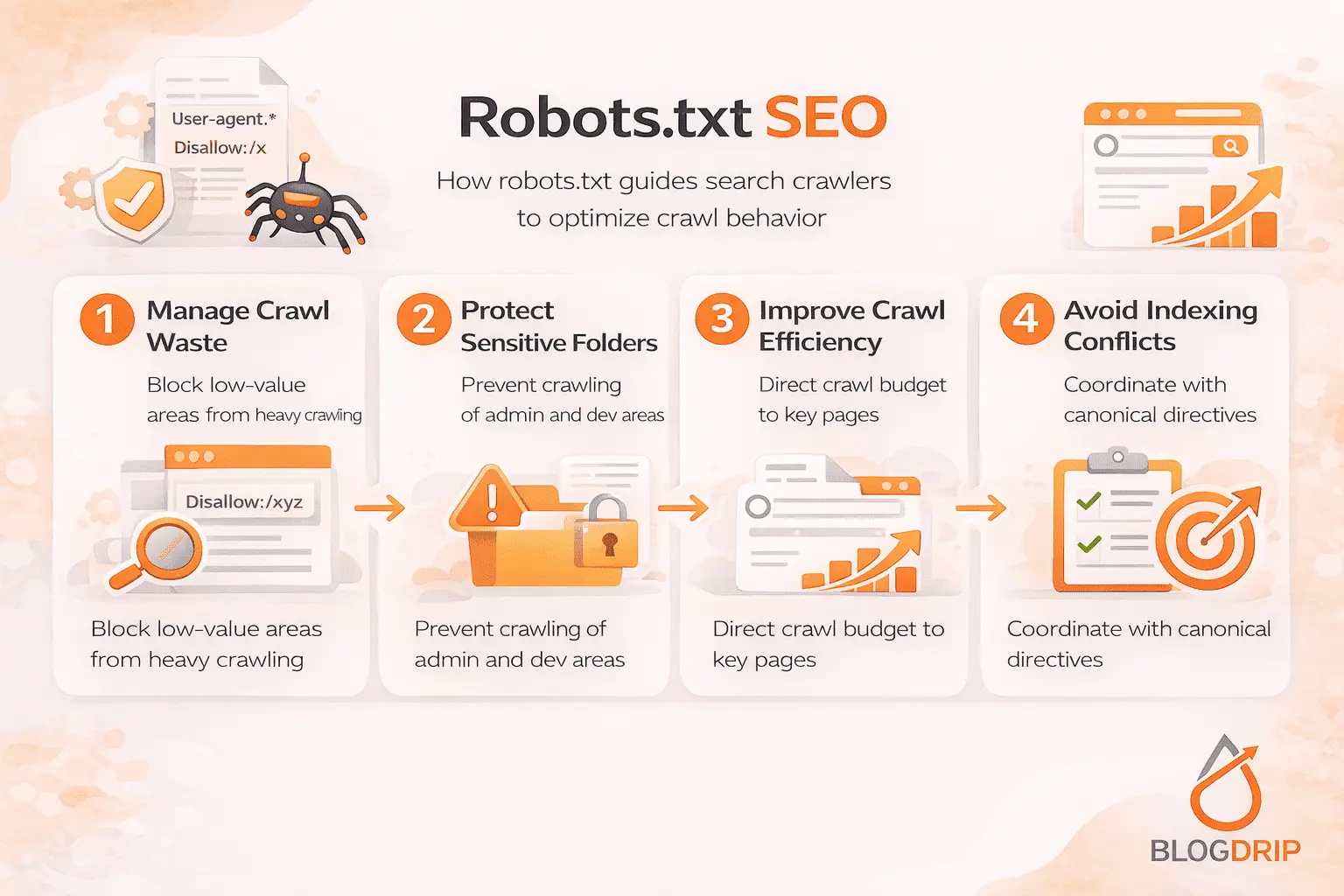
Robots.txt tells compliant crawlers whether certain paths should be crawled. For example, it can discourage crawlers from spending time on low-value sections such as internal search results, duplicate filtered pages, staging areas, or admin paths.
That makes it relevant to crawlability and crawl efficiency, which are core cluster topics within technical SEO.
What robots.txt does not do
Robots.txt does not remove pages from the index by itself. If a blocked URL is linked externally or already known to search engines, it may still appear in search results without full page content being crawled.
That is a critical distinction. If the goal is to prevent a page from being indexed, robots.txt is often the wrong tool on its own. In many cases, a meta robots noindex directive or other indexation control is the better solution.
Why Robots.txt SEO Matters
Robots.txt SEO matters because search engines do not crawl every URL equally. Websites often generate more crawlable URLs than they actually want search engines to spend time on.
It helps reduce crawl waste
Many sites create low-value URLs through filters, session parameters, internal search pages, faceted navigation, or utility sections. If crawlers spend too much time on those areas, discovery of higher-value pages may become less efficient.
A well-written robots.txt file can help reduce that waste and support stronger crawling across the site.
This is where a supporting article on crawling and indexing fits naturally in the cluster.
It protects sensitive or irrelevant sections
Robots.txt can be useful for keeping crawlers away from areas that are not meant for search, such as admin paths, test environments, or duplicate functional sections of the site.
That said, it should not be treated as a security tool. Blocking a path in robots.txt does not make it private. It only gives crawl instructions.
It supports broader technical clarity
On a technically mature site, robots.txt is not doing all the work. It supports other signals such as internal linking, canonical tags, XML sitemaps, and indexation directives. When these systems align, search engines get a clearer picture of which pages matter most.
That makes robots.txt SEO part of a wider technical SEO framework, not an isolated fix.
How Robots.txt Works
A robots.txt file contains rules written for specific user agents, which are names used by crawlers. These rules typically use directives such as User-agent and Disallow, and sometimes Allow.
For example, a file can block a crawler from a folder such as /search/ while leaving the rest of the site open.
How search engines use the file
When a crawler visits a site, it usually checks the robots.txt file first. If the file includes rules for that crawler, it follows them when deciding which paths to request.
This affects crawl access, not necessarily indexation.
Why placement matters
The file must be placed in the root directory of the domain, such as example.com/robots.txt. If it is placed elsewhere, search engines will not treat it as the site’s robots file.
How it connects to sitemaps
Robots.txt can also reference the XML sitemap. That does not change crawl permissions, but it helps search engines discover the sitemap more easily.
A related supporting article here would be XML sitemap SEO.
Important Robots.txt SEO Use Cases
Robots.txt should be used selectively. Its value comes from guiding crawler attention, not from blocking large parts of the site by default.
Low-Value URL Management
One of the most common uses of robots.txt is reducing crawl access to URLs that add little SEO value. These may include internal search results, certain faceted combinations, duplicate parameter paths, or non-essential utility sections.
When used carefully, this can make crawl behavior more efficient.
Staging and Development Areas
Robots.txt is often used on development environments to discourage crawling. That can help prevent accidental crawl activity, but it should not be your only safeguard. Staging environments should also be protected properly through authentication or access controls.
Resource Management on Large Sites
Larger websites often benefit most from robots.txt improvements because they usually generate more crawl waste. Ecommerce sites, marketplaces, publishers, and large content hubs can all produce thousands of URLs that are technically crawlable but not strategically useful.
In those cases, robots.txt SEO becomes more operationally important.
Robots.txt and Indexation: A Common Point of Confusion
One of the biggest misunderstandings in technical SEO is treating crawl blocking and index blocking as the same thing.
They are not.
If a page is blocked in robots.txt, search engines may not crawl its content. But that does not guarantee it will stay out of the index. If the URL is discovered through links or prior crawl history, it may still appear in results.
If your real goal is to keep a page out of search results, you usually need a solution focused on indexation, such as a noindex directive, proper canonical handling, or removal of the page entirely.
That is why robots.txt should sit close to related cluster pages on indexation control and canonical tags for SEO.
Common Robots.txt SEO Mistakes
The most damaging mistakes tend to come from using robots.txt too aggressively or for the wrong purpose.
Blocking important content
A surprisingly common error is disallowing folders that contain valuable pages, templates, or resources needed for proper rendering. This can happen during redesigns, migrations, or hurried staging-to-live launches.
When important paths are blocked, search visibility can drop quickly.
Using robots.txt to solve indexation problems
Blocking a page from crawling is not the same as removing it from the index. If a page should not appear in search, robots.txt alone is often insufficient.
This is one of the clearest examples of why technical SEO requires nuance. Different tools solve different problems.
Blocking CSS or JavaScript unnecessarily
Modern search engines need access to important resources to render pages properly. Blocking CSS, JavaScript, or image resources without a clear reason can make pages harder to interpret.
Forgetting to update the file after site changes
Robots.txt is often edited during development or migration work and then forgotten. Over time, those temporary rules may conflict with the live site structure.
That is why robots.txt deserves periodic review, especially after major technical changes.
Practical Guidance
The best way to approach robots.txt SEO is with restraint. Start by asking whether a section truly needs to be blocked from crawling.
If the answer is yes, make sure the reason is clear. Common valid reasons include low-value crawl traps, duplicate utility areas, or non-public technical sections. If the answer is no, leave the path crawlable and manage visibility in other ways if needed.
A good process usually includes these steps:
- keep the file simple and intentional
- block only sections with a clear crawl-efficiency reason
- never block important landing pages, service pages, product pages, or key resources by accident
- use meta robots or canonical signals when the real issue is indexation, not crawling
- review the file during migrations, redesigns, and CMS changes
- make sure the sitemap reference is present and accurate
For a pillar-and-cluster site, your important pillar pages and cluster articles should never rely on robots.txt for visibility management. They should be easy to crawl, strongly linked internally, and fully accessible to search engines.
Timing and Expectations
Changes to robots.txt can affect crawl behavior relatively quickly, but the SEO impact depends on what was changed.
If the file was blocking important pages or resources, fixing it can lead to meaningful improvement once search engines recrawl the site. If the update simply improves crawl focus on a large site, the benefits may be more gradual.
It is also important to stay realistic. Robots.txt is a crawl management tool, not a ranking strategy. It supports better technical efficiency, but it does not replace content quality, internal linking, or authority.
Conclusion
Robots.txt SEO matters because it helps guide crawler behavior and reduce unnecessary crawl activity across a site. Used well, it supports crawl efficiency and strengthens the technical foundation behind search performance.
Used poorly, it can block valuable pages, confuse search engines, and create visibility problems that are entirely avoidable.
As a cluster page, this article should support a broader technical SEO pillar page and connect naturally to related topics such as crawling and indexing, XML sitemaps, canonical tags, and indexation control. That is the right role for robots.txt within a topical SEO cluster: not as a shortcut, but as a precise tool for managing crawl behavior without getting in the way of pages that should rank.