
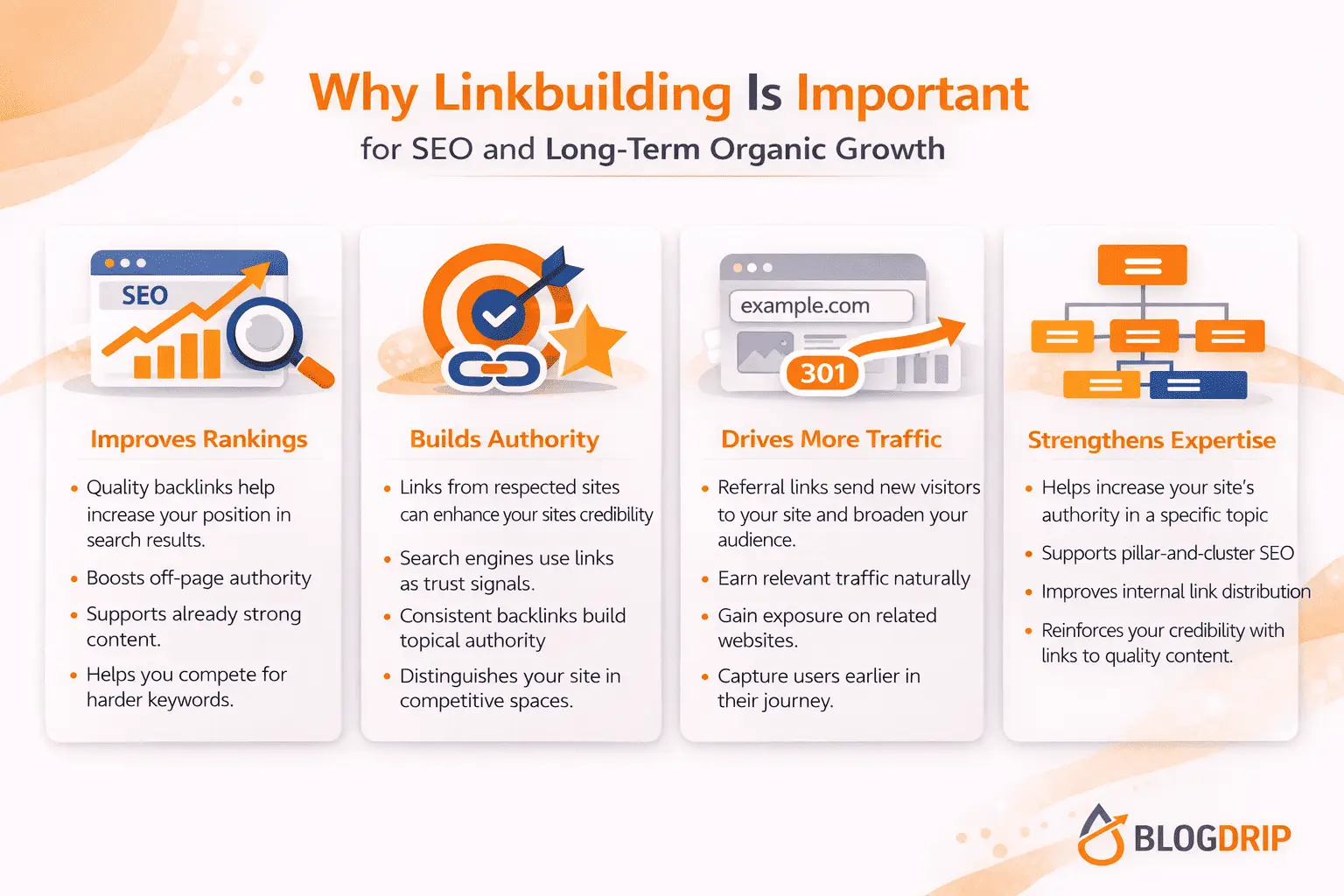
Why Linkbuilding Is Important for SEO and Long-Term Organic Growth
Many businesses understand that backlinks matter, but fewer understand why linkbuilding is important in a broader SEO strategy. That gap matters because linkbuilding is often approached the wrong way. Some treat it as a shortcut to rankings. Others dismiss it as outdated or too risky. Both views miss the real point.
Linkbuilding matters because search engines do not evaluate websites based only on what those websites say about themselves. They also look at external signals. When relevant websites link to your content, they help confirm that your pages are useful, credible, and worth surfacing in search.
That does not mean linkbuilding works in isolation. Strong backlinks cannot compensate for poor content, weak site structure, or pages that fail to match search intent. But when the fundamentals are in place, linkbuilding can be one of the clearest ways to strengthen authority and improve competitive visibility.
This article explains why linkbuilding is important, how it supports SEO, what businesses often misunderstand, and how to approach it strategically.
What Is Linkbuilding?
Linkbuilding is the process of earning links from other websites to your own website. In SEO, these inbound links are usually called backlinks.
A backlink is more than a technical connection between two pages. It is also a signal. When another site links to your content, search engines may interpret that link as evidence that the page has value, relevance, or authority.
In practical terms, linkbuilding is about increasing the number of high-quality, relevant external references pointing to your site. The emphasis there is important. Quality matters more than raw volume. Relevance matters more than vanity metrics. Context matters more than simply “getting a link.”
That is why serious linkbuilding is not about buying random placements or sending generic outreach at scale. It is about earning links that make editorial sense and support your wider SEO goals.
Why Linkbuilding Is Important
The simplest answer to why linkbuilding is important is that backlinks remain one of the clearest off-page authority signals in SEO.
Search engines use many factors to rank pages. Content quality, intent alignment, internal linking, crawlability, site structure, and user experience all matter. Backlinks are part of that mix. They help search engines understand how your site is viewed beyond its own domain.
It helps search engines evaluate authority
If several sites cover the same topic well, search engines still need ways to understand which sources are more established or more trusted. Backlinks help provide that context.
A page that earns relevant links from respected websites sends a stronger trust signal than a page that exists in isolation. This is especially important in competitive industries where many pages target similar keywords.
It improves ranking potential
Linkbuilding does not guarantee rankings, but it often affects how competitive a page can become.
For lower-difficulty keywords, strong on-page SEO may be enough. For more competitive terms, especially commercially valuable ones, backlinks often help separate average pages from pages that consistently perform well.
This is one of the main reasons why linkbuilding is important: it can support the authority needed to compete where content alone is not enough.
It strengthens topical authority
Linkbuilding is not only about individual pages. Over time, it can reinforce your site’s credibility around a topic.
If your website consistently earns links to useful content in a clear subject area, that helps build topical authority. In a pillar-and-cluster model, this becomes even more important. A strong pillar page can attract links, and internal linking can help distribute that value to related cluster pages.
That creates a stronger overall topic ecosystem rather than a set of disconnected articles.
It supports brand trust and visibility
Backlinks are not only about algorithms. When your brand is cited by relevant publications, industry blogs, or trusted resources, that can improve visibility beyond search rankings.
Good links can drive referral traffic, increase brand awareness, and reinforce your positioning in the market. In that sense, linkbuilding supports both SEO and broader digital credibility.
How Linkbuilding Supports SEO in Practice
To understand why linkbuilding is important, it helps to look at what it actually does inside a broader SEO strategy.
It gives strong content more ranking power
A well-written page that fully matches search intent may still struggle if competing pages have stronger off-page authority. Backlinks help close that gap.
This is why linkbuilding works best when it supports already-strong pages. It amplifies quality rather than replacing it.
It makes pillar content more valuable
In a cluster model, certain pages are naturally better link targets than others. Deep guides, original resources, research-driven articles, and strong explanatory content tend to attract links more easily than direct service pages.
When those linked pages connect logically to related content, their authority can support the rest of the cluster. That is one of the strongest strategic reasons to invest in linkbuilding.
It creates a competitive edge
SEO is often relative. A page does not need to be perfect; it needs to be stronger than the alternatives in the search results.
If competing sites have similar technical quality and content depth, backlinks can become one of the deciding factors. That makes linkbuilding especially important in mature or crowded markets.
Important Linkbuilding Subtopics
Why linkbuilding is important becomes clearer when you understand the supporting concepts around it.
Link relevance
Not all backlinks are equally useful. A link from a relevant industry site often has more strategic value than a link from an unrelated source.
Relevance helps search engines understand that the connection makes sense within a topical context.
Link quality
Quality usually matters more than quantity. A small number of trusted editorial links can outperform a large number of low-value placements.
That is why strong campaigns focus on credible sources, real context, and useful destination pages.
Internal linking
External links create authority, but internal linking helps distribute it. If your strongest backlinks point to pages that are disconnected from the rest of your site, the wider SEO benefit may be limited.
This is why linkbuilding and internal linking should be planned together.
Content strategy
The best linkbuilding usually starts with pages that deserve links. Strong content gives publishers, editors, and site owners a reason to reference your work.
Without that foundation, linkbuilding becomes much harder and much less efficient.
Common Mistakes
Many businesses understand that backlinks matter, but still misunderstand why linkbuilding is important in the first place.
Treating it as a numbers game
The goal is not to collect as many links as possible. The goal is to earn the right links from the right sites.
A smaller number of relevant, trustworthy backlinks is often more valuable than a large number of weak ones.
Expecting links to fix weak pages
If a page is thin, outdated, or poorly aligned with search intent, backlinks alone will not turn it into a strong asset. Linkbuilding works best when it supports content that already deserves to rank.
Separating linkbuilding from site structure
Linkbuilding becomes much more effective when linked pages sit inside a clear topic structure. Without that structure, the benefits are often isolated instead of compounding across the site.
Focusing only on homepage links
Many businesses default to building links to the homepage or direct commercial pages. In practice, informational assets are often more effective at earning links. Those pages can then support more commercial sections through internal linking.
Practical Guidance
If you want to use linkbuilding well, start by identifying which pages on your site are most worth promoting. In most cases, these are not your weakest pages or the pages you wish ranked better by default. They are the pages with the clearest value.
A practical approach usually includes:
- improving high-potential content before outreach
- choosing pages that support the wider cluster
- targeting relevant sites rather than chasing volume
- using internal linking to spread earned authority
- evaluating results in terms of visibility and rankings, not just link count
This is the strategic answer to why linkbuilding is important. It is not just about link acquisition. It is about creating authority that strengthens your broader SEO system.
Think in terms of earned credibility
A useful question is: would a credible website genuinely want to reference this page?
That question usually leads to better decisions than asking how many backlinks you can get.
Timing and Expectations
Linkbuilding is important, but it is rarely fast.
Even after earning strong backlinks, SEO impact usually takes time. Search engines need to crawl and process those links, evaluate them in context, and reflect that value across rankings.
The timeline depends on the quality of the destination page, the competitiveness of the topic, the relevance of the linking sites, and the overall authority of your domain.
The realistic expectation is gradual improvement. Stronger authority builds over time, especially when linkbuilding supports a consistent content strategy.
Conclusion
Why is linkbuilding important?
Because search engines need signals beyond your own website to understand whether your content deserves visibility. Relevant backlinks help reinforce authority, improve competitive ranking potential, and strengthen topical credibility across your site.
That does not make linkbuilding a shortcut. It works best when it supports strong content, clear site architecture, and realistic long-term SEO goals.
For websites using a pillar-and-cluster model, linkbuilding is especially valuable because it can strengthen not just one page, but an entire topic area. That is the real strategic value. Good linkbuilding does not just help you get links. It helps your best content earn the authority it needs to perform.