
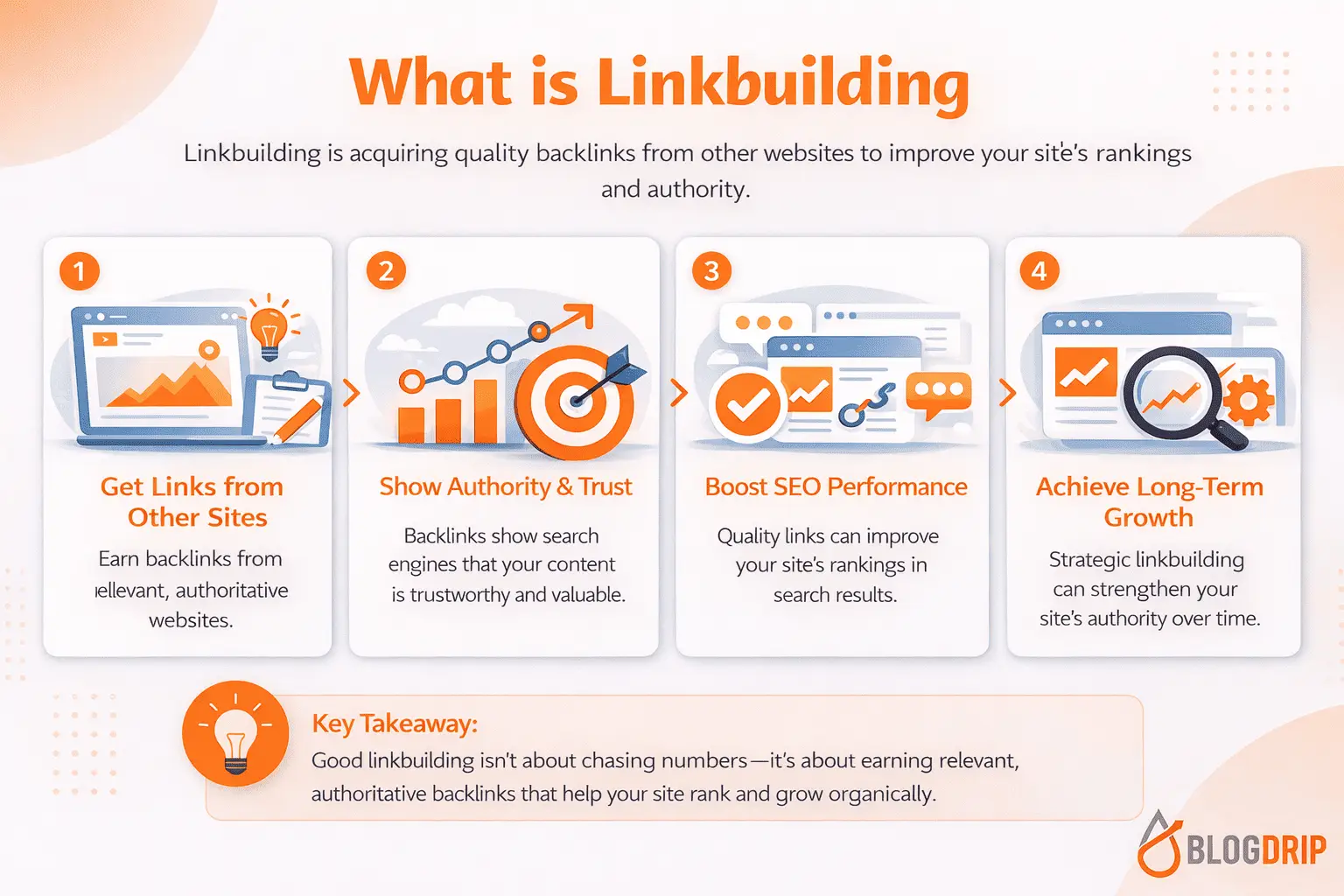
What Is Linkbuilding? A Clear Guide to How It Works and Why It Matters
If you are new to SEO, one question comes up quickly: what is linkbuilding, and why does it matter so much?
The short answer is that linkbuilding is the process of getting other websites to link to your website. In SEO, those links help search engines understand whether your pages are credible, useful, and worth ranking. But that simple definition does not tell the full story.
In practice, linkbuilding is one of the most misunderstood parts of SEO. Some businesses treat it as a numbers game. Others avoid it completely because it sounds risky or overly technical. The reality sits in the middle. Good linkbuilding is not about chasing random backlinks. It is about earning relevant references from other websites in a way that supports authority, visibility, and long-term organic growth.
This article explains what linkbuilding is, how it works, why it matters, and what businesses should realistically expect from it. As part of a broader cluster, this page focuses on the core concept. For the wider strategy, see our complete guide to linkbuilding.
What Is Linkbuilding?
Linkbuilding is the process of acquiring hyperlinks from external websites to your own website.
A hyperlink, usually called a backlink in SEO, connects one page to another. When another website links to your page, it creates a signal that your content may be useful, relevant, or trustworthy.
That does not mean every link is valuable. Search engines do not treat all backlinks equally. A relevant editorial link from a respected industry website is very different from a low-quality link placed on an unrelated site. Context matters. Relevance matters. Intent matters.
In practical terms, linkbuilding means creating or promoting content that other websites want to reference. Sometimes that happens through outreach. Sometimes through digital PR. Sometimes because a page is genuinely useful enough to attract links naturally.
A practical definition
For most businesses, linkbuilding means:
- publishing pages worth citing
- identifying relevant websites in the same market or topic area
- earning backlinks that strengthen authority and visibility
That is why linkbuilding is not just a technical SEO tactic. It sits between content strategy, brand credibility, and off-page SEO.
Why Linkbuilding Matters
Linkbuilding matters because backlinks remain one of the clearest off-page signals in search engine optimization.
Search engines use many signals to rank pages, including relevance, content quality, internal linking, user experience, and technical health. Backlinks are one part of that picture, but often an important one. When two websites publish similar-quality content, the one with stronger authority signals often has the advantage.
It helps search engines evaluate trust
When reputable websites link to a page, they provide a form of validation. That does not guarantee high rankings, but it can support search engines’ understanding that the page deserves consideration.
This is especially important in competitive search results where many pages cover similar topics.
It supports rankings for valuable keywords
For low-competition queries, a well-optimized page may rank without many backlinks. But for competitive terms, especially commercial or industry-defining keywords, authority often becomes a deciding factor.
That is where linkbuilding supports stronger SEO performance.
It strengthens topical authority
Linkbuilding is also connected to topical authority. If a website consistently earns links to high-quality content around one subject area, that can reinforce the site’s perceived expertise in that niche.
This is one reason cluster structures work well. A strong pillar page can attract links, and internal links can help distribute that value to related pages such as anchor text best practices, guest posting, or digital PR for SEO.
How Linkbuilding Works
To understand what linkbuilding is, it helps to look at the basic mechanics behind it.
A website publishes content. Another website decides that content is useful enough to reference. It links to the page. Search engines then crawl that link and interpret it as part of the broader relationship between pages on the web.
That sounds simple, but successful linkbuilding usually depends on three things:
- a page that deserves links
- relevant websites that might reasonably reference it
- a strategy for earning attention or editorial placement
Start with something worth linking to
The first mistake many businesses make is trying to build links to weak pages. If a page adds little value, outreach alone will not fix that.
Pages that attract links most naturally tend to be:
- in-depth guides
- original research
- useful resources
- expert commentary
- data-led content
- strong pillar pages
If you are asking what is linkbuilding from a strategic perspective, this is the first answer: it starts with value, not outreach.
Then create visibility
Even strong pages do not always earn links on their own. In many cases, promotion is needed. That may include outreach to publishers, journalists, bloggers, industry websites, or resource pages that cover related topics.
The goal is not to force a backlink. It is to show why your page is useful in a context where a link makes editorial sense.
Authority builds over time
Linkbuilding is cumulative. One strong backlink can help, but real authority usually comes from a pattern of relevant, trustworthy references over time.
That is why sustainable SEO campaigns treat linkbuilding as an ongoing process rather than a one-time task.
Important Linkbuilding Subtopics
A clear answer to what is linkbuilding should also explain the supporting concepts around it. Linkbuilding is not one tactic. It includes several connected areas.
Link quality
Not all backlinks are good backlinks.
Quality depends on factors such as:
- relevance of the linking website
- editorial context of the link
- trustworthiness of the source
- natural placement within the content
- usefulness for real readers
A smaller, niche-relevant website can be more valuable than a larger but unrelated one.
Anchor text
Anchor text is the clickable text used in a hyperlink. It helps users and search engines understand what the linked page is about.
Natural anchor text profiles usually include a mix of branded terms, partial-match phrases, generic text, and plain URLs. Over-optimized exact-match anchors can make a backlink profile look artificial.
If you want to go deeper into this area, our article on anchor text strategy explores it in more detail.
Outreach
Outreach is the process of contacting relevant websites and introducing content that may be useful to their audience.
Good outreach is specific, relevant, and editorially credible. Weak outreach is generic, self-serving, and easy to ignore.
Effective linkbuilding outreach usually works best when the pitch solves a problem, adds useful context, or offers a genuinely strong resource.
Digital PR
Digital PR is a more brand-led approach to earning backlinks. Instead of simply asking for links, it focuses on creating stories, insights, commentary, or research that publishers want to cover.
For many brands, digital PR is one of the strongest ways to earn high-quality editorial backlinks at scale.
Internal linking
External links matter, but internal linking shapes how their value moves through your site. If your most linked pages are isolated from your commercial pages or core topic pages, the wider benefit can be limited.
That is why a cluster model matters. A pillar page can attract authority, then pass relevance and context to supporting cluster content through internal links.
Common Mistakes People Make
A lot of confusion around what is linkbuilding comes from bad examples. Businesses often see the wrong tactics first.
Thinking linkbuilding means buying as many links as possible
This is one of the biggest misconceptions. Volume does not equal quality. A large number of weak or irrelevant backlinks is not the same as earning authoritative references.
Low-quality link schemes may create short-term movement in some cases, but they rarely build durable authority.
Ignoring relevance
A backlink should make sense in context. If the linking website has no topical connection to your content, the strategic value is usually low.
Strong linkbuilding focuses on relevance before raw numbers.
Building links to pages with little value
If the destination page is thin, outdated, or poorly aligned with search intent, backlinks will not turn it into a strong asset. Linkbuilding amplifies quality. It does not replace it.
Treating linkbuilding as separate from content strategy
Linkbuilding works best when it supports a site architecture built around topics, intent, and authority. When it is disconnected from content planning, the results are usually fragmented.
This is why businesses often benefit from pairing linkbuilding with a broader SEO content strategy and clear topical clustering.
Practical Guidance for Businesses
If your goal is to understand what linkbuilding means in a practical business context, focus on the basics first.
Create pages that genuinely deserve attention. Build a clear topical structure. Identify which pages matter most commercially and strategically. Then look for opportunities to earn relevant links that support those pages.
A sensible starting point is:
- identify your strongest informational assets
- review competitors’ backlink profiles
- improve weak pages before promoting them
- target relevant websites rather than high-volume lists
- connect linkbuilding with internal linking and cluster content
This approach is slower than shortcut tactics, but it is much stronger long term.
What good linkbuilding looks like
Good linkbuilding usually feels consistent with how reputable websites operate. A strong article gets cited. A useful guide is referenced. A unique research piece earns coverage. A brand expert is quoted in industry content.
In other words, the best linkbuilding often looks like earned credibility rather than artificial placement.
Timing and Expectations
Linkbuilding is not instant.
Even when you earn strong backlinks, the SEO impact may take time to appear. Search engines still need to crawl those links, process them, and evaluate them in the context of your site as a whole. Results also depend on the quality of your content, the competitiveness of the niche, and the strength of your existing authority.
For newer websites, linkbuilding is often part of a longer trust-building process. For more established sites, it can help push already-strong pages into more competitive positions.
The realistic expectation is gradual progress, not overnight transformation.
Conclusion
So, what is linkbuilding?
At its core, linkbuilding is the process of earning backlinks from other websites to improve your site’s authority, relevance, and visibility in search. But the useful definition goes further than that. Good linkbuilding is not about collecting links for the sake of it. It is about building the kind of content, reputation, and topical strength that other websites naturally want to reference.
For businesses taking SEO seriously, linkbuilding should support a wider system: strong pages, clear site structure, useful content, and strategic internal linking.
That is why this topic belongs inside a cluster model. Once you understand the basics of what linkbuilding is, the next step is learning how to apply it well. From there, the broader linkbuilding pillar page can guide you into tactics, risks, and supporting subtopics in more depth.