
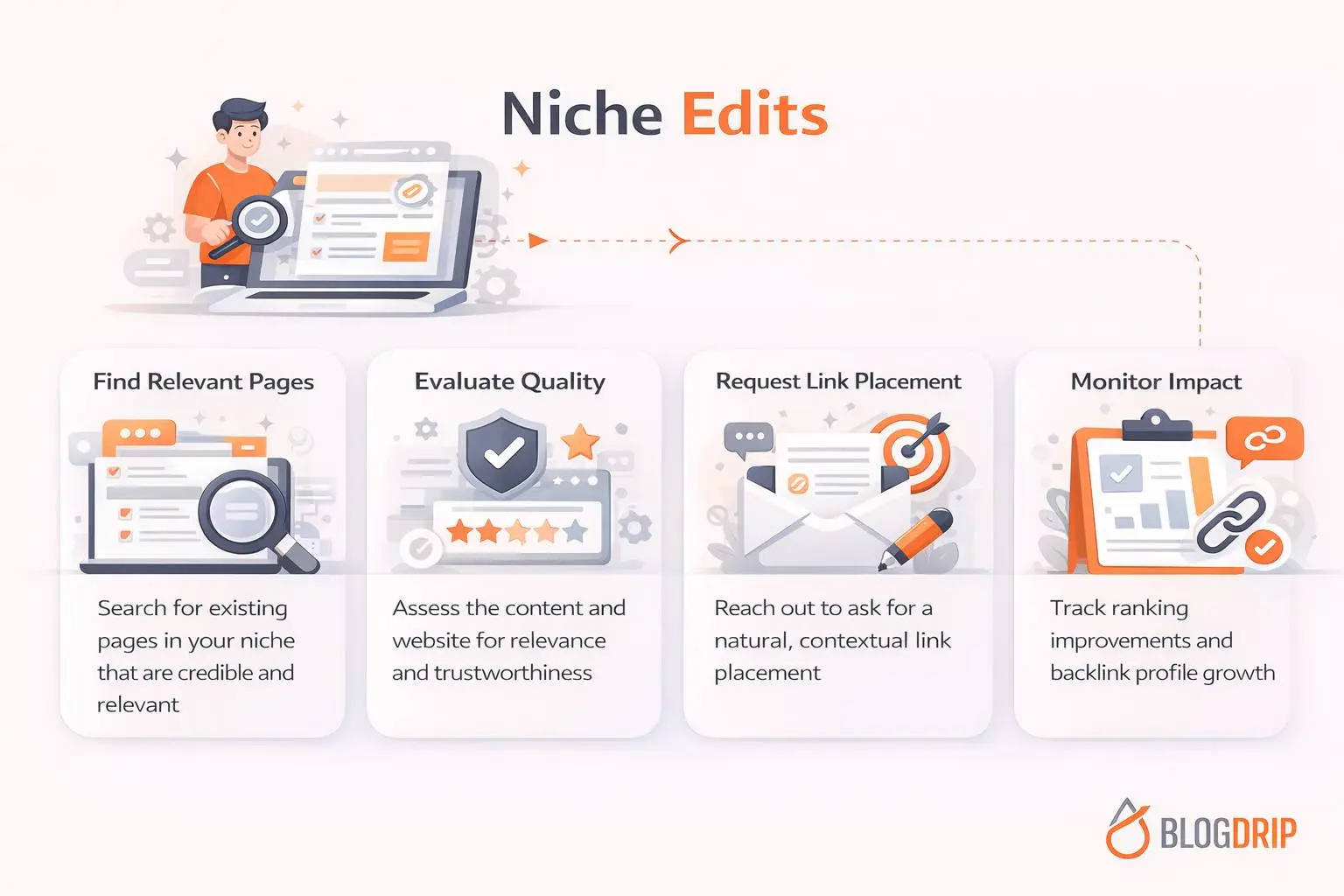
Niche Edits
Niche edits are a linkbuilding tactic where a backlink is placed into an existing piece of content on another website rather than being earned through a newly published guest post or editorial feature. The idea is straightforward: identify a relevant page that already exists, then secure a contextual link to your own content where it fits naturally.
That simplicity is also why niche edits are often misunderstood. Many people talk about them as if they are an easy shortcut to better rankings. In practice, the value of niche edits depends almost entirely on relevance, editorial quality, and the reason the link exists. A contextual link on a strong, relevant page can be useful. A forced link placed into weak or low-quality content usually adds little strategic value and can create risk.
For a website building topical authority through a pillar-and-cluster model, niche edits should be viewed as one possible part of a broader linkbuilding strategy, not as a standalone solution. They are most useful when they strengthen pages that already deserve more authority and when those pages sit inside a clear internal linking structure.
What Are Niche Edits?
Niche edits are backlinks inserted into existing content on third-party websites. Instead of writing a new article for placement, the link is added to a page that has already been published and, in some cases, is already indexed, ranking, and receiving traffic.
In practical terms, a niche edit usually involves:
- finding an existing page on a relevant website
- deciding whether your page genuinely adds value to that content
- reaching out to request or negotiate link placement
- placing the link within existing copy or lightly updating the content around it
That makes niche edits different from guest blogging. Guest blogging creates a new article around a topic. Niche edits work with an article that already exists.
The logic behind the tactic is clear. If the page already has authority, visibility, or trust signals, a contextual backlink from that page may help pass value more quickly than starting from scratch with a new article. But that only holds true when the placement is editorially sensible and the page itself is worth being associated with.
Why Niche Edits Matter
Niche edits matter because they can provide access to relevant contextual backlinks from pages that are already established. That can make them appealing to SEO teams looking for efficient ways to strengthen priority pages.
They can leverage existing page authority
An existing article may already have backlinks, rankings, or steady indexing history. If a link is added to a page like that, the backlink may carry more practical value than a link from a brand-new page with no authority of its own.
They fit naturally into contextual content
When done properly, niche edits appear within the main body of relevant content. Contextual links often carry more value than links hidden in sidebars, footers, or author bios because they sit inside topical discussion.
They can support targeted pages efficiently
Niche edits are often used to strengthen guides, cluster articles, research assets, or commercial pages that need more external authority. On a site with good internal linking, a backlink to one strong page can also support related pages in the same topic cluster.
They appeal to SEO teams looking for faster execution
Because they work with existing content, niche edits can sometimes be faster to secure than full guest post placements. That speed is one reason they are popular. But speed alone is not a good reason to use them. The underlying quality still matters more than convenience.
How Niche Edits Work
Niche edits are most effective when they are built on relevance and editorial fit rather than pure placement volume.
Start with relevant pages
The first step is identifying existing pages where a backlink would make sense. That means looking for content that is:
- topically relevant to your destination page
- credible and useful in its own right
- active or at least still current enough to be worth citing
- written in a way that allows a supporting resource to fit naturally
A niche edit on an unrelated page rarely has much strategic value, even if the website has strong metrics. Relevance is what makes the link coherent to both readers and search engines.
Evaluate the quality of the site and page
Not every existing article is worth targeting. A good niche edit opportunity should be evaluated at both the site level and the page level.
Questions worth asking include:
- Is the website credible in its niche?
- Does the page have real substance?
- Is the content still current?
- Does the site publish excessive sponsored or manipulative links?
- Would this page still be worth reading if no backlink were involved?
This is important because a niche edit on a poor-quality site can do little for rankings and may weaken the overall credibility of your backlink profile.
Match the destination page carefully
The page you are linking to matters just as much as the page you are linking from. A niche edit works best when the destination genuinely deepens the discussion.
For example, a contextual reference to a detailed guide on linkbuilding outreach, guest blogging, or competitor analysis may make sense within an article discussing SEO authority tactics. A thin landing page with little educational value is often much harder to place credibly.
Place the link naturally
The strongest niche edits do not feel inserted. They fit the sentence, support the surrounding paragraph, and improve the article for the reader.
That often means one of two things:
- the existing text already mentions a concept your page covers well
- the content can be lightly updated to include a useful supporting reference
If the placement feels forced, the edit is probably weak.
Important Subtopics Within Niche Edits
Relevance and topical fit
Relevance is the core principle behind useful niche edits. The linking page, the anchor text, and the destination page should all relate to the same subject area.
A relevant contextual link can reinforce topical authority. An irrelevant one usually looks artificial and offers less SEO value.
Existing content quality
Because niche edits rely on published pages, the quality of that existing content matters a great deal. If the article is thin, outdated, or written primarily for search engines rather than readers, the link placement becomes weaker by association.
This is one of the biggest differences between theoretical value and real-world value. A page may have metrics, but if the content is poor, the placement is still questionable.
Anchor text
Anchor text in niche edits should be natural and varied. Over-optimized exact-match anchors used repeatedly across multiple placements can make a link profile look manufactured.
Branded anchors, partial matches, and descriptive phrases are usually safer and more realistic. The goal is to support clarity and relevance, not to squeeze a target keyword into every link.
Paid placements vs editorial value
Many niche edits are effectively paid placements, even if they are not always described that way. That does not automatically mean they are useful or useless, but it does mean they should be judged carefully.
The key question is not simply whether money changed hands. It is whether the link still makes editorial sense, appears on a relevant page, and supports a credible backlink profile over time.
Common Niche Edit Mistakes
Prioritizing metrics over relevance
A common mistake is choosing placements based only on domain-level metrics while ignoring topical fit. A relevant link on a modest but credible site can be more valuable than a misplaced link on a stronger but unrelated domain.
Adding links to weak or outdated content
If the article is old, thin, or poorly maintained, the backlink may bring little benefit. Existing content is only useful if it is still worth referencing.
Forcing unnatural placements
A niche edit should read as though the link belongs there. If the sentence has clearly been bent around the destination URL, the placement is weak and obvious.
Using the same anchor text repeatedly
Repetition creates a footprint. A healthy backlink profile usually includes anchor diversity. Reusing the exact same keyword anchor too often is a common and unnecessary mistake.
Sending links to poor destination pages
Even a decent placement can be wasted if it points to a page with little depth or little relevance. Niche edits work better when the target page is genuinely useful and connected to the broader site structure.
Treating niche edits as a complete strategy
Niche edits can contribute to SEO, but they should not replace other forms of authority-building such as strong content, internal linking, editorial mentions, guest contributions, and naturally earned backlinks.
Practical Guidance for Using Niche Edits Well
A good niche edit strategy should be selective, page-focused, and realistic.
Choose link targets that deserve authority
Start by deciding which pages on your site are worth strengthening. These are often:
- strong informational resources
- cluster pages tied to an important pillar topic
- original research or data assets
- high-value commercial pages supported by strong supporting content
A niche edit is more defensible when it points to a page with real substance.
Review pages manually, not just by spreadsheet
Metric filters can help narrow a list, but manual review is essential. Read the page. Check the site. Look at how it handles outbound links. Make sure the opportunity is genuinely relevant.
Prefer context over scale
A smaller number of strong, relevant placements is usually better than a large volume of low-fit links. Linkbuilding quality compounds more effectively than link count alone.
Keep anchor text natural
Choose anchor text that fits the sentence and sounds editorial. This supports readability and reduces the risk of building an overly optimized link profile.
Use niche edits to support broader topic clusters
On a site using a pillar-and-cluster structure, niche edits can work well when they point to a strong cluster page or pillar asset that then links internally to related content. That helps one backlink support a wider topic area instead of a single isolated URL.
Measure outcomes beyond acquisition
Do not judge niche edits purely by how many links are placed. Better measures include:
- relevance of the linking pages
- ranking movement for linked pages
- growth in referring domains
- support for connected topic clusters
- overall backlink profile quality
Timing and Expectations
Niche edits can sometimes show impact relatively quickly because the linking pages are already published and often already indexed. But that does not mean results are immediate or guaranteed.
Several factors influence the outcome:
- the quality of the linking page
- the relevance of the placement
- the strength of the destination page
- the competitiveness of the target query
- the site’s overall SEO foundation
A good niche edit can help support rankings, but it will not compensate for poor content, weak internal linking, or a confused site structure. Like most linkbuilding tactics, it works best as an amplifier rather than a substitute for core SEO quality.
Conclusion
Niche edits are a practical linkbuilding tactic when they are used carefully. Their real value comes from placing relevant contextual backlinks on credible existing pages where the link genuinely improves the content.
That makes niche edits less about convenience and more about judgment. The strongest placements are relevant, natural, and connected to useful destination pages that deserve more authority.
For a website building topical authority, niche edits should support the broader architecture of the site rather than operate as isolated link acquisitions. When they strengthen good content inside a well-structured cluster, they can contribute meaningfully to long-term SEO performance.