
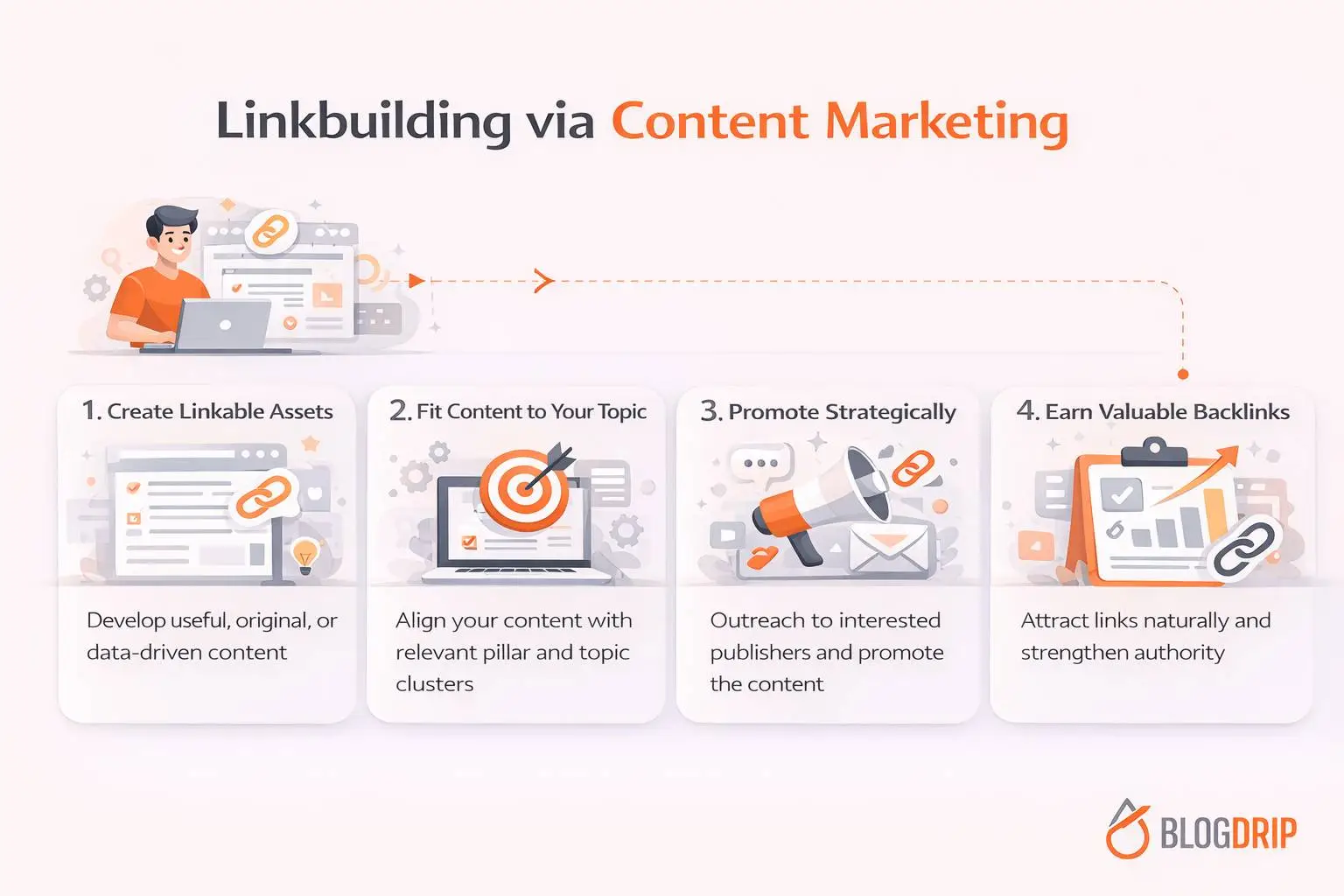
Linkbuilding via Content Marketing
Linkbuilding content marketing is the practice of creating content specifically designed to attract backlinks because it is useful, original, relevant, or worth citing. Instead of relying only on direct outreach requests or transactional link tactics, this approach earns links by publishing content that other websites naturally want to reference.
That distinction matters. Many linkbuilding tactics focus on acquiring placements first and thinking about content second. Linkbuilding via content marketing works the other way around. It starts with creating something strong enough to deserve attention, then promoting it strategically so relevant publishers, bloggers, journalists, and industry websites can discover it.
For a website building topical authority through a pillar-and-cluster model, this is especially valuable. Content marketing can help strengthen pillar pages, standout cluster pages, research assets, and educational resources that support broader SEO goals. When those assets earn backlinks, the benefits can extend beyond a single URL through clear internal linking and site structure.
What Is Linkbuilding via Content Marketing?
Linkbuilding via content marketing is the process of earning backlinks by publishing content that provides enough value for other websites to cite, mention, or share.
In practical terms, it means using content as the engine of link acquisition. Rather than treating a backlink as something that must be negotiated into existence, you create resources that make linking feel natural.
This can include:
- in-depth guides
- original research
- industry statistics pages
- templates and tools
- thought leadership pieces
- visual assets
- comparison resources
- practical how-to content
The core idea is simple. Good content marketing supports linkbuilding when the content fills a real need better than what already exists.
That does not mean every blog post becomes a linkable asset. Some content is written mainly to rank for search queries. Some is built to convert visitors. Some is designed to attract citations and backlinks. The strongest SEO strategies understand the difference and plan content accordingly.
Why Linkbuilding via Content Marketing Matters
This approach matters because it creates a more durable path to earning backlinks. Instead of chasing links one by one without a compelling reason, you build assets that can attract links repeatedly over time.
It creates stronger reasons to link
Most editors and publishers do not want to link to content that adds little value. Content marketing solves that problem by giving them something worth referencing.
A detailed guide, original dataset, or genuinely useful resource creates a credible reason for another site to include a backlink. That makes link acquisition more sustainable than relying only on direct requests.
It supports long-term link earning
A good content asset can keep attracting links long after it is published. This is one of the biggest advantages of content-led linkbuilding. Instead of producing one backlink from one tactic, the same asset may generate citations over time through search visibility, outreach, sharing, and ongoing relevance.
It aligns with topical authority
Search engines increasingly reward websites that cover topics in depth. Content marketing helps support that broader structure by producing strong pages within a topic cluster, while linkbuilding helps those pages gain authority externally. The two approaches work better together than in isolation.
It improves the return on content investment
When content earns backlinks, it can do more than rank for its target keyword. It can also attract referral traffic, reinforce expertise, strengthen connected pages through internal links, and improve the overall authority of the site. That makes a strong content asset more valuable than a page designed only for one narrow purpose.
How Linkbuilding via Content Marketing Works
Linkbuilding through content marketing is not just about publishing more articles. It is about creating content with clear citation potential, then making sure the right audience sees it.
Start with content that deserves links
The first step is identifying what kind of content is worth linking to. This usually means asking a tougher question than “Can this rank?”
You also need to ask:
- Does this add something original?
- Is it more useful than competing pages?
- Would another publisher cite it?
- Does it solve a real problem clearly?
- Is there a reason to reference it in an article, guide, or resource page?
Not every page should be a linkable asset. But every serious content-led linkbuilding strategy needs some pages that are built with this purpose in mind.
Choose formats with citation value
Some formats are more likely to attract backlinks than others. Common examples include:
- original data or surveys
- statistics hubs
- detailed reference guides
- calculators or tools
- templates and checklists
- examples and frameworks
- expert commentary roundups
- visual explainers
These formats work because they help another content creator support a claim, explain a topic, or improve a resource for their own readers.
Match the asset to the topic cluster
For a site using a pillar-and-cluster model, content-led linkbuilding works best when the asset fits into the broader architecture of the site.
A linkable asset should not sit awkwardly outside the rest of the content strategy. It should support an important topic area and connect internally to relevant pillar and cluster pages. This makes the authority it earns more useful across the site.
Promote the content strategically
Even excellent content often needs promotion. Publishing alone is rarely enough.
Promotion may include:
- targeted outreach to relevant publishers
- sharing with journalists or editors
- internal distribution through email or social channels
- inclusion in digital PR campaigns
- outreach to pages linking to outdated resources
- relationship-driven promotion within the niche
This is where content marketing and linkbuilding overlap most clearly. The content creates the value. Promotion creates the visibility.
Important Subtopics Within Linkbuilding Content Marketing
Linkable assets
A linkable asset is a page or resource designed to attract backlinks because it is unusually useful, original, or reference-worthy.
This is one of the most important concepts in content-led linkbuilding. Without clear linkable assets, content marketing often produces traffic but not many backlinks.
A strong linkable asset is usually:
- highly useful
- easy to reference
- relevant to the niche
- better or more current than alternatives
- clearly connected to a known audience need
Originality and differentiation
Content earns more links when it offers something distinct. That does not always mean collecting original data. It can also mean:
- explaining a topic more clearly
- organizing information better
- updating outdated content
- offering stronger examples
- presenting a better framework
- combining depth with usability
If the page says nothing new and improves nothing, it is harder to justify as a citation target.
Content promotion and outreach
Even the best asset may need proactive promotion. That is why content marketing does not replace outreach. It makes outreach more effective.
When outreach is tied to a genuinely useful asset, the message becomes more credible. You are not just asking for a link. You are presenting a resource that may actually improve the recipient’s content.
This makes content marketing a strong foundation for linkbuilding outreach, guest contributions, and resource-based link acquisition.
Internal linking and authority flow
Backlinks earned through content marketing become more valuable when the site distributes that authority well. If the linked page connects logically to relevant supporting content and commercial pages, the benefit does not stay isolated.
This is why internal linking is such an important part of a content-led SEO strategy. A strong asset can attract external authority, then help reinforce the rest of the cluster through internal structure.
Common Mistakes in Linkbuilding via Content Marketing
Publishing content with no clear reason to cite it
Many sites produce large volumes of content that may target keywords but do not offer anything worth linking to. Ranking content and linkable content are not always the same thing.
Confusing content production with content strategy
Publishing frequently does not automatically create link opportunities. Without a clear plan for what content should attract backlinks, teams often create assets that are informative but not especially reference-worthy.
Ignoring promotion
A useful asset that no one sees will struggle to earn backlinks. Content marketing still needs distribution and visibility.
Creating assets disconnected from site goals
Some sites build flashy assets that earn attention but have little connection to their main topic areas or business goals. This limits the strategic value of the backlinks they attract.
Failing to integrate internal linking
If a linked asset does not connect well to relevant pages on the site, much of its authority remains trapped. That weakens the broader SEO benefit.
Chasing links without content quality
No promotion strategy can fully compensate for mediocre content. If the asset is weak, generic, or dated, the linkbuilding potential will stay limited.
Practical Guidance for Doing It Well
A strong linkbuilding content marketing strategy should be selective, structured, and tied to the wider site architecture.
Build a small set of high-value assets
Instead of trying to make every article a link magnet, focus on creating a smaller number of standout resources that are genuinely worth citing.
Choose topics with natural citation potential
Some topics lend themselves better to linkable content than others. Prioritize areas where people regularly need supporting references, examples, or explanations.
Improve what already exists in the search landscape
Review competing content and ask where you can add more value. Better structure, better examples, stronger clarity, fresher information, or deeper coverage can all increase linkability.
Connect assets to pillar and cluster strategy
Make sure each major asset strengthens a broader topic area on the site. This helps backlinks support topical authority rather than sitting on isolated pages.
Pair content creation with promotion
Plan distribution from the beginning. That might include outreach lists, journalist angles, resource page targets, or supporting campaigns tied to publication.
Measure more than link count
Useful indicators include:
- relevance of referring domains
- growth in backlinks over time
- rankings for the linked page
- authority gains across connected pages
- referral traffic
- visibility improvements within the wider cluster
This gives a more accurate view of whether the content is supporting SEO in a meaningful way.
Timing and Expectations
Linkbuilding via content marketing is rarely immediate. Some assets attract links slowly over time, especially as they gain visibility in search or are discovered through promotion.
Results depend on several factors:
- the quality of the asset
- how distinct it is
- the competitiveness of the niche
- how well it is promoted
- how strong the site already is
- how effectively the page is integrated into the wider site structure
A well-made asset can compound in value over time. But that does not mean every content piece will attract links on its own. Realistic expectations matter. Content-led linkbuilding works best as a repeatable system, not as a one-off hope that a post will go viral.
Conclusion
Linkbuilding via content marketing is one of the most sustainable ways to earn backlinks because it starts with value rather than with the link request itself. By creating resources that other websites genuinely want to cite, you make link acquisition more credible, more durable, and more strategically useful.
The strongest approach is not to turn every page into a linkable asset. It is to identify which pages should attract backlinks, build them to a higher standard, and connect them to the wider pillar-and-cluster structure of the site.
For a website focused on topical authority, this approach helps content do more than rank. It helps content earn trust, attract citations, and strengthen the broader SEO system over time.