
Linkbait Content
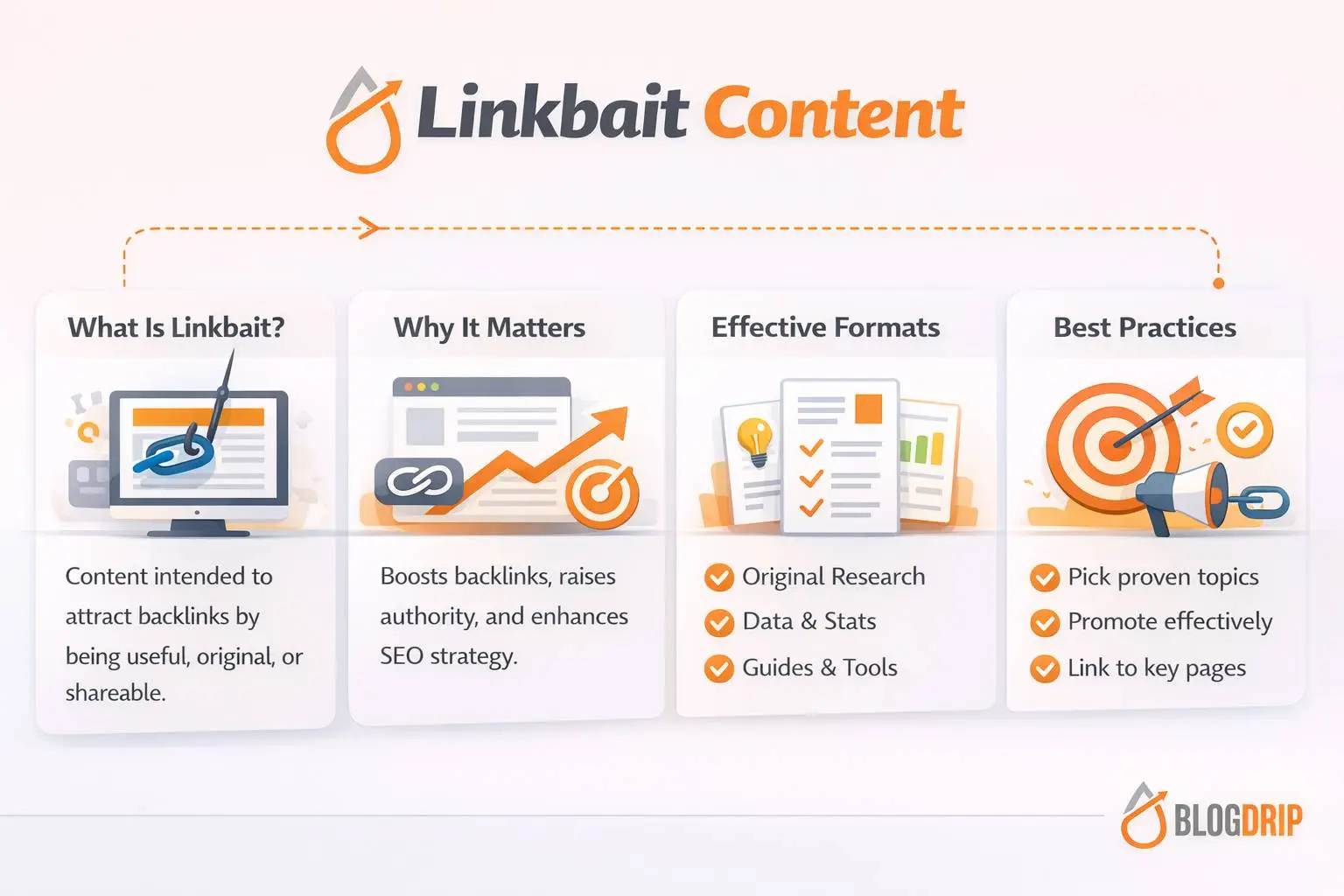
Linkbait content is content created with the specific goal of attracting backlinks because it is unusually useful, surprising, original, or shareable. In SEO, the term often gets used loosely, but the core idea is simple: publish something that other websites naturally want to reference.
That does not mean linkbait content has to be sensational or manipulative. In fact, the strongest versions usually are not. Effective linkbait is less about click-driven hype and more about publishing something that genuinely deserves attention within a topic. That could be original research, a strong data story, a useful resource, a clear visual asset, a contrarian expert perspective, or a guide that solves a problem better than existing content.
For a website building topical authority through a pillar-and-cluster model, linkbait content can play a strategic role. It can attract external links to pages that strengthen broader topic clusters, support internal linking, and raise the authority of important parts of the site. Used well, it is not just “content made to go viral.” It is content designed to earn attention and links in a way that supports long-term SEO goals.
What Is Linkbait Content?
Linkbait content is content designed to attract backlinks because it offers a compelling reason for other publishers to cite it, discuss it, or share it.
In practical terms, linkbait content usually does at least one of these things:
- presents original information
- explains something unusually well
- packages a topic in a highly useful format
- offers a strong or distinctive perspective
- makes a complex topic easier to understand
- gives writers, editors, or researchers something worth referencing
The key point is that linkbait content is built with citation potential in mind. It is not just content that targets a keyword. It is content that another website might reasonably link to in an article, guide, resource page, or news story.
That makes it closely related to linkable assets and content marketing. The difference is mainly one of emphasis. Linkbait content is intentionally engineered to attract links, while still needing to remain credible and genuinely useful.
Why Linkbait Content Matters
Linkbait content matters because it creates stronger reasons for backlinks to happen naturally. Instead of treating every link as a direct request, it gives other sites something they actually want to reference.
It increases the likelihood of natural backlinks
A page with no distinctive value usually needs heavy promotion to attract links. A strong linkbait asset has a better chance of earning links because the content itself creates interest.
That does not mean outreach becomes unnecessary. It means outreach becomes easier because the asset is more compelling.
It supports scalable authority building
One good linkbait asset can attract links from multiple domains over time. That makes it more scalable than tactics that require one separate negotiation per backlink.
It strengthens content-led SEO
Linkbait content fits naturally into a broader content strategy because it combines usefulness with link acquisition. A strong asset may rank, attract backlinks, generate mentions, and support internal linking all at once. That makes it strategically efficient when connected to the right topic area.
It can reinforce topical authority
If the content is tied to a core SEO topic, the links it attracts can help strengthen the broader cluster around that subject. This is especially valuable for pillar-and-cluster websites, where authority gained by one strong asset can help related pages through internal linking.
How Linkbait Content Works
Linkbait content works by giving people a strong reason to mention and link to a page. That reason may be practical, informational, emotional, or strategic.
Start with a topic that can attract citations
Not every topic lends itself equally well to linkbait. The strongest topics usually have one or more of these characteristics:
- people often cite them in articles
- there is a gap in existing resources
- the topic can benefit from fresh data or stronger examples
- publishers regularly cover it
- the subject invites comparison, opinion, or analysis
A topic can be important for SEO and still be a poor fit for linkbait if there is no natural reason for others to reference it.
Choose a format with link potential
The format matters almost as much as the topic. Some formats are more likely to attract backlinks because they are easy to cite or especially useful.
Common linkbait formats include:
- original studies
- statistics pages
- detailed guides
- industry benchmarks
- calculators and tools
- templates
- visual explainers
- expert roundups
- controversial but credible opinion pieces
The best format depends on the audience and the kind of sites you want links from.
Build something better than what already exists
Linkbait content has to compete for attention. That means it usually needs to improve on what is already available.
Better can mean:
- more current information
- clearer structure
- stronger examples
- original data
- sharper insight
- more practical usefulness
- easier reference value for writers and editors
If the page feels interchangeable with ten others already ranking, its link attraction potential is limited.
Promote it after publication
Even strong linkbait often needs distribution. Content does not become effective linkbait just because it is published.
Promotion can include:
- outreach to relevant publishers
- digital PR angles
- social amplification
- email distribution
- journalist outreach
- resource page targeting
- promotion to sites linking to weaker or outdated alternatives
The content creates the reason to link. Promotion helps the right people discover it.
Important Subtopics Within Linkbait Content
Linkable assets
Linkbait content overlaps heavily with the idea of a linkable asset. In both cases, the goal is to build something with clear reference value.
A strong linkable asset is usually specific, useful, and easy to cite. Linkbait content often succeeds when it functions as a high-quality asset rather than as a gimmick.
Originality
Originality matters because publishers are more likely to link to something they cannot easily get elsewhere.
This does not always require new research. Originality can also come from:
- a distinctive framework
- a clearer explanation
- a better visual presentation
- a stronger expert viewpoint
- a more useful synthesis of existing ideas
The goal is to offer something that feels worth referencing.
Emotional pull vs practical value
Some linkbait relies on surprise, controversy, or novelty. That can work, but practical value is often more durable.
A page that earns links because it is useful tends to support long-term SEO better than a page that earns attention only because it is provocative. Strong linkbait usually balances interest with substance.
Content promotion
Linkbait content is not a substitute for outreach. It improves outreach by making it more credible.
When you show someone a genuinely useful study, guide, or tool, the pitch becomes more compelling than a generic request for a backlink. This is why linkbait content often works best as part of a wider content promotion and linkbuilding strategy.
Common Mistakes With Linkbait Content
Confusing hype with value
A flashy headline or controversial angle may attract attention, but if the page lacks substance it will struggle to earn meaningful backlinks from credible sites.
Creating content with no strategic fit
Some assets attract attention but have little connection to the main topic areas of the site. That makes the links less useful in supporting topical authority.
Chasing virality instead of relevance
Going viral is not the same as earning good backlinks. A smaller number of relevant links from authoritative sites is usually more valuable than broad attention with little SEO relevance.
Ignoring promotion
Even excellent linkbait can fail if no one relevant sees it. Promotion is part of the process, not an optional extra.
Publishing content that is not distinctive enough
If the asset does not improve on competing resources, there is little reason for others to link to it instead.
Failing to connect the asset to internal structure
When a linkbait page sits in isolation, much of its authority stays trapped. It becomes more valuable when it links naturally to relevant cluster pages and pillar content.
Practical Guidance for Creating Linkbait Content Well
A good linkbait strategy should be selective, credible, and tightly aligned with wider SEO goals.
Pick topics with natural reference value
Focus on subjects that writers, editors, and marketers genuinely cite. This improves the odds that the content earns useful backlinks.
Choose formats that fit your niche
A B2B SEO site may do better with original research, benchmarks, and in-depth guides than with purely entertainment-driven formats.
Improve on what already exists
Look at current content in the space and identify where you can be more useful, more current, or more distinctive.
Make the asset easy to cite
Clear structure, strong headings, concise summaries, charts, and quotable insights can all make a page more link-friendly.
Connect linkbait to pillar and cluster strategy
The best linkbait content should support an important topic area on the site. When it earns links, those links should strengthen connected pages through internal linking and site architecture.
Plan promotion from the start
Do not wait until the content is live to think about visibility. Build outreach and distribution into the content plan so the asset has a clear path to discovery.
Timing and Expectations
Linkbait content can perform well, but it rarely works instantly. Some assets attract attention quickly through outreach or social sharing, while others build links gradually as they are discovered and referenced over time.
Results depend on several factors:
- the quality of the content
- how distinctive it is
- the relevance of the topic
- the credibility of the site
- the strength of the promotion
- how well the asset is connected to the wider site structure
Not every asset will become a major link magnet. Realistic expectations are important. Linkbait content is best treated as part of a repeatable content and authority strategy, not as a shortcut to instant rankings.
Conclusion
Linkbait content is content designed to earn backlinks because it gives other websites a real reason to cite it. The strongest versions are not built around gimmicks. They are built around usefulness, originality, and strategic fit.
For a site focused on topical authority, linkbait content can be highly effective when it strengthens core subject areas rather than sitting outside them. A well-made asset can attract attention, earn relevant backlinks, and help support an entire content cluster through internal linking.
That is what makes linkbait content valuable in SEO. It does more than chase links. It helps create the kind of content that deserves them.