
Internal vs External Links: A Practical SEO Guide
When people discuss links in SEO, they often focus on backlinks. That is understandable, because external links from other websites can help build authority. But internal links matter just as much in a different way. They shape your site structure, help users move between pages, and influence how search engines understand your content.
That is why understanding internal vs external links matters. These link types are not interchangeable. Each supports SEO differently, and both are important in a strong pillar-and-cluster strategy.
This article explains what internal and external links are, how they differ, why they matter, and how to use them more strategically.
What Is Internal vs External Links?
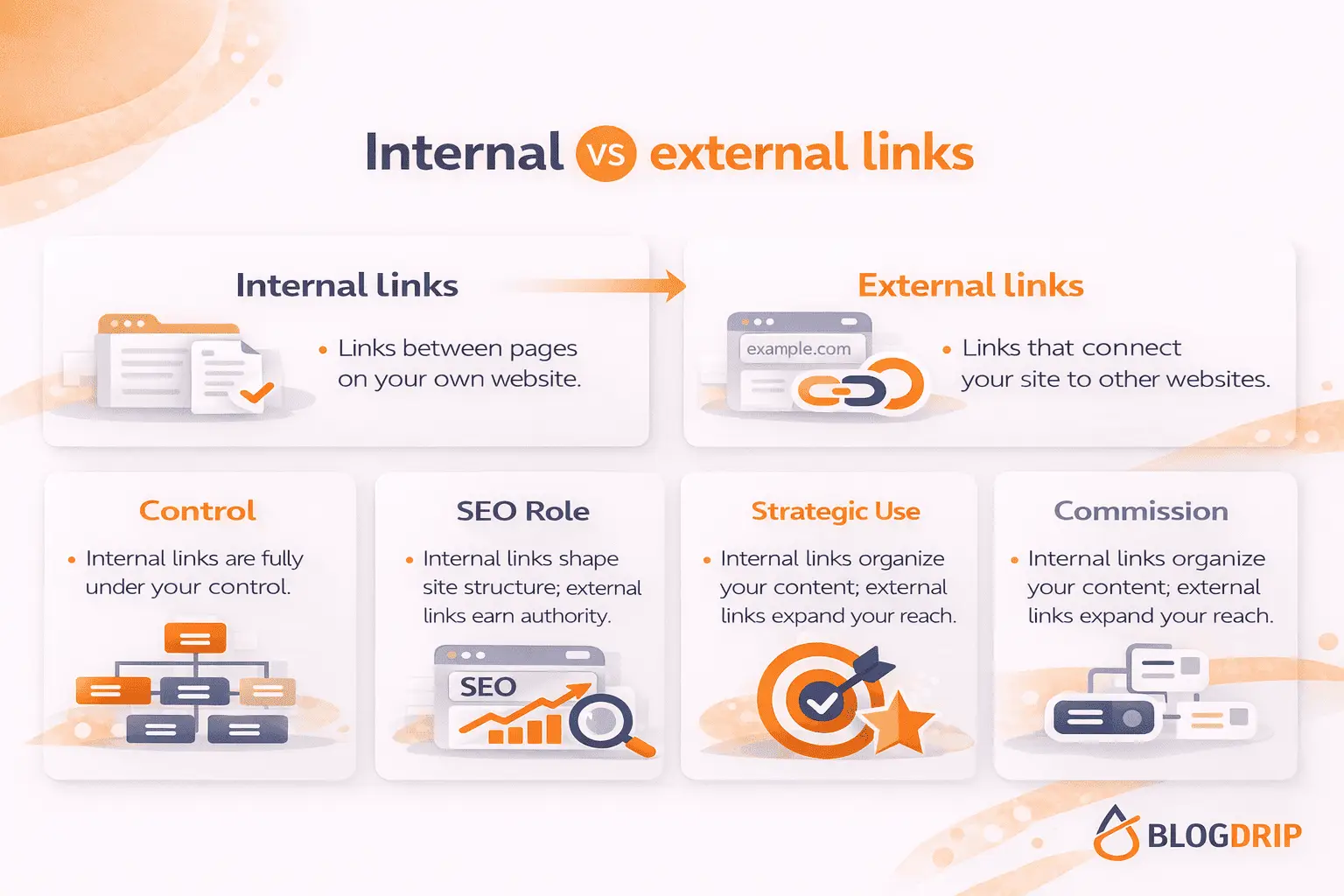
The phrase internal vs external links compares two types of hyperlinks.
An internal link points from one page on your website to another page on the same website.
An external link connects your website to a different domain. That may mean a link from your site to another site, or a link from another site to yours.
In simple terms:
- internal links stay within your own site
- external links cross domain boundaries
What is an internal link?
An internal link helps connect your pages.
For example, if one article on your site links to another related article, that is an internal link. It helps users discover more content and helps search engines understand how your pages relate to each other.
What is an external link?
An external link connects one domain to another.
If your article links to a trusted industry source, that is an outbound external link. If another website links to your content, that is an inbound external link, often called a backlink.
Why Internal vs External Links Matters
Internal and external links both matter for SEO, but for different reasons.
Internal links help shape your website from the inside. They improve crawlability, support hierarchy, and distribute authority across your content.
External links connect your site to the broader web. Outbound links can improve context and trust. Inbound external links can strengthen authority and ranking potential.
A site with weak internal linking often wastes its own content value. A site with no external authority often struggles to compete. That is why a strong SEO strategy needs both.
How Internal and External Links Work
How internal links work
Internal links create pathways between pages on your own site. Search engines use those pathways to crawl your content and understand which pages are connected.
They also help distribute authority. If one page earns strong backlinks, internal links can help some of that value flow to related pages. In a pillar-and-cluster model, this is especially useful because pillar pages and cluster pages can support each other directly.
Internal links also improve user experience by guiding visitors to the next relevant page.
How external links work
External links connect your website to other websites.
Outbound external links can add context, support claims, and improve usefulness for readers when they point to credible sources.
Inbound external links, or backlinks, act as off-page signals. They can help search engines understand that other websites consider your content useful or trustworthy.
This is one of the clearest differences in internal vs external links: internal links organize your own website, while external links help position your website within the wider web.
Important Differences Between Internal and External Links
Control
Internal links are fully under your control. You choose the destination, placement, and anchor text.
External backlinks are different. You can influence them through good content and outreach, but you do not fully control who links to you.
SEO role
Internal links support site architecture, crawling, and topical relationships.
External links, especially backlinks, are more closely tied to authority, trust, and competitiveness in search.
Strategic use
Internal links are used to connect related topics, reinforce clusters, and guide users toward deeper or more commercial pages.
External links are used to cite relevant sources or earn credibility when other websites link back to you.
Important Subtopics
Anchor text
Anchor text is the clickable text in a link. It matters for both internal and external links because it gives context to users and search engines.
For internal links, anchor text should be clear, natural, and descriptive. For external links, the same principle applies, although you usually control only the anchor text of links going out from your site.
Link equity
Link equity refers to the SEO value that can flow through links.
Backlinks often bring authority into your site. Internal links help distribute that authority across related pages. This is one reason internal linking is so important in topic clusters.
Topic clustering
Internal links are essential in a cluster model. They connect supporting articles back to a pillar page and help search engines understand the depth of your topic coverage.
External links support this indirectly by helping important pages earn authority from outside your domain.
Common Mistakes
Treating internal links as optional
Some websites publish new pages without linking them properly into the rest of the site. That leaves useful content isolated and makes it harder for search engines and users to find.
Linking externally without a reason
Outbound external links should help the reader. Linking to weak or irrelevant pages does not improve trust or quality.
Confusing backlinks with all external links
Not every external link is a backlink. A backlink is specifically an inbound link from another website to yours. That distinction matters in SEO discussions.
Overusing exact-match anchors internally
Internal links should read naturally. Repeating the same keyword-heavy anchor text over and over can feel forced and weaken readability.
Practical Guidance
A good way to think about internal vs external links is to focus on function.
Internal links should organize your site, strengthen topic relationships, and guide users to the next useful page.
External links should improve credibility, context, and authority, depending on whether they are outbound references or inbound backlinks.
A strong internal linking approach usually includes:
- linking new pages to relevant existing pages
- connecting cluster pages to pillar pages
- supporting important commercial pages from relevant informational content
- avoiding isolated pages with little internal support
A strong external link approach usually includes:
- linking to credible sources when it improves the content
- earning backlinks to pages that genuinely deserve visibility
- avoiding low-quality or manipulative link practices
Use internal links deliberately
Internal linking is one of the most controllable SEO tools you have. Used well, it can improve site structure and help stronger pages support weaker but relevant ones.
Use external links selectively
Outbound links should add value, not just exist for appearance. Link out when it helps the reader verify a point, explore a topic, or understand context better.
Timing and Expectations
Internal linking improvements can sometimes have a faster impact because they are fully within your control. You can update structure, add relevant links, and improve crawl paths immediately.
External link impact often takes longer, especially when it depends on earning backlinks. Search engines need time to crawl and evaluate those links, and the outcome depends on the quality of the referring sites.
That is why internal and external links should work together. Internal links improve structure now. External authority often builds more gradually.
Conclusion
The difference between internal vs external links is simple, but strategically important.
Internal links connect pages within your own site. They improve crawlability, strengthen topic relationships, guide users, and distribute authority.
External links connect your site to the wider web. Outbound links can improve context and trust, while inbound external links can strengthen authority and ranking potential.
Strong SEO needs both. Internal links make your site more effective. External links help your site earn credibility beyond itself.
For websites using a pillar-and-cluster model, that combination is especially powerful. External links can bring authority into the site, and internal links can help spread that value where it matters most.