
How Linkbuilding Works: A Clear SEO Process for Building Authority
Many businesses know backlinks matter, but fewer understand how linkbuilding works in a practical SEO context. That misunderstanding leads to poor decisions: chasing random links, promoting weak pages, or expecting fast results from low-quality tactics.
In reality, linkbuilding works when other websites link to pages on your site in a way that strengthens authority, relevance, and trust. Those links can help search engines evaluate your content more favorably, especially when the links come from relevant, credible sources.
This article explains how linkbuilding works, why it matters, what affects results, and how to approach it realistically. As a cluster page, it focuses on the process itself rather than trying to cover every tactic in full detail.
What Is How Linkbuilding Works?
When people ask how linkbuilding works, they are usually asking what actually happens between publishing a page and earning backlinks that support SEO performance.
At a basic level, linkbuilding works like this: another website links to your content, search engines crawl that link, and the link becomes part of the signals used to evaluate your page’s authority and relevance.
That sounds simple, but the value of a backlink depends on context. A relevant editorial link from a trusted website can be meaningful. A weak link from an unrelated site may do very little.
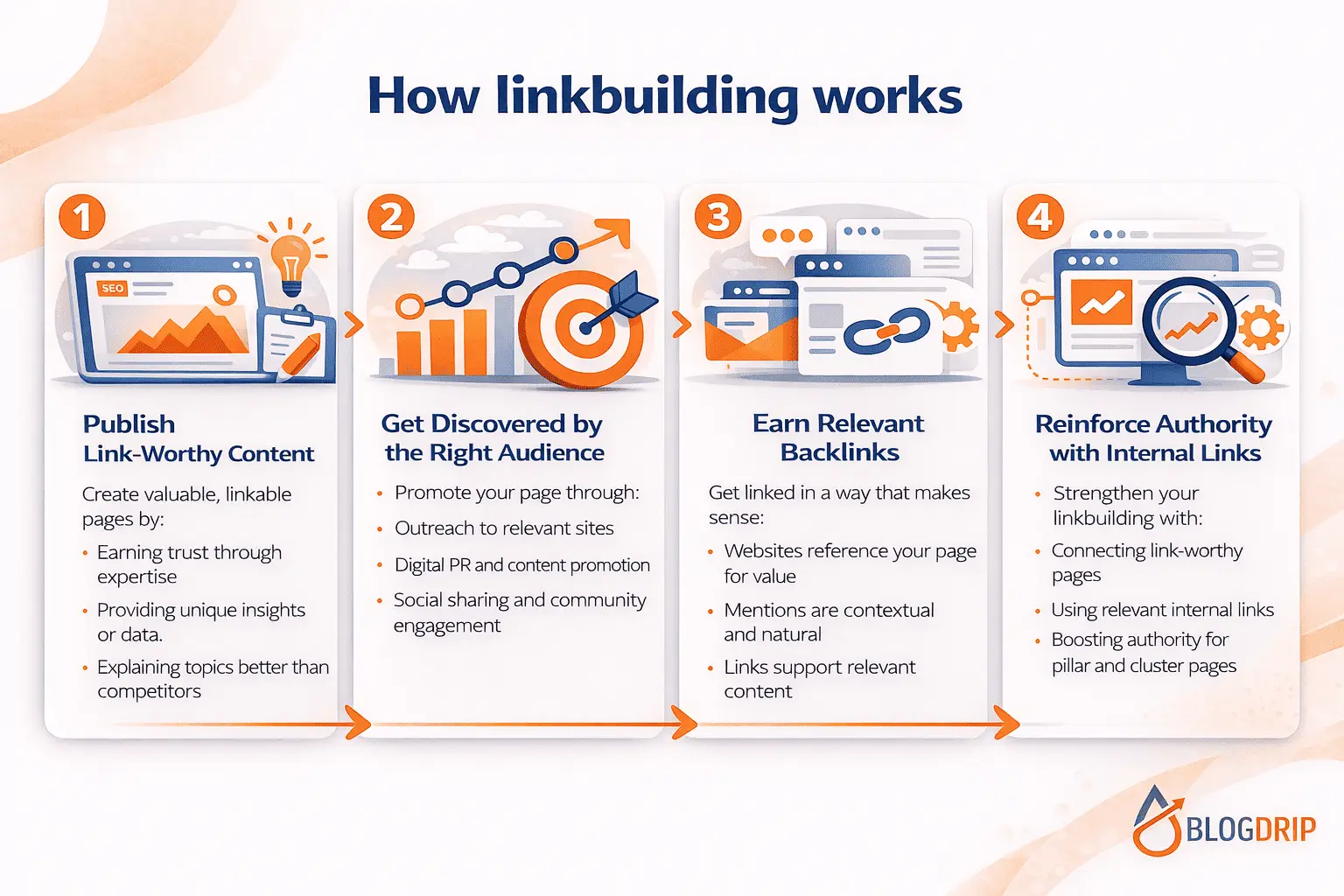
In practical terms, how linkbuilding works comes down to a sequence:
- you publish something worth linking to
- the right people discover it
- they decide it is useful enough to reference
- search engines process that link as part of your broader backlink profile
That is why linkbuilding is not just about acquiring links. It is about earning the right links to the right pages.
Why Linkbuilding Matters
Linkbuilding matters because backlinks remain one of the main off-page signals in SEO. They help search engines understand whether other websites consider your content worth citing.
It supports authority
Strong backlinks can reinforce trust in your content. They suggest that your page has value beyond your own website, which is especially important in competitive search results.
It improves ranking potential
When several pages target the same topic with similar on-page quality, backlinks often help separate stronger pages from weaker ones. They are rarely the only ranking factor, but they are often part of the difference.
It strengthens topical SEO
Linkbuilding also supports topical authority. When a site earns links across a well-structured topic cluster, it sends a stronger signal that the site is credible in that subject area.
That is why linkbuilding tends to work best when it supports a broader content structure rather than isolated pages.
How Linkbuilding Works in Practice
To understand how linkbuilding works, it helps to break the process into clear stages.
It starts with a page worth linking to
A page has to give people a reason to link. That is the foundation.
Pages that attract backlinks most naturally usually do at least one of the following:
- explain a topic clearly and thoroughly
- offer original insight or useful examples
- solve a practical problem
- provide strong data, commentary, or frameworks
- act as a reliable resource on a topic
If the page is generic, shallow, or outdated, linkbuilding becomes much harder. Outreach can create visibility, but it cannot turn a weak asset into a strong one.
Then relevant people need to see it
Publishing useful content is not enough on its own. Linkbuilding works when the people most likely to reference your page actually discover it.
That discovery can happen through outreach, digital PR, partnerships, industry visibility, newsletters, or organic sharing over time.
The point is simple: good pages still need promotion.
The link has to make editorial sense
The strongest backlinks are usually editorial. That means the linking website includes your page because it improves their content, supports a point, or helps their audience.
This is where relevance becomes critical. A link from a topically related website is usually more valuable than one from an unrelated source, even if the unrelated site looks stronger on paper.
Search engines treat the link as a signal
Once the link exists, search engines can crawl it and evaluate it in context. They look at factors such as the quality of the linking page, the relevance of the domain, the surrounding content, and the overall link pattern pointing to your site.
No single backlink defines performance. What matters more is the broader profile your site builds over time.
Internal linking helps distribute value
External backlinks do not work in isolation. Internal linking influences how that authority flows through your website.
If a well-linked page connects to relevant cluster pages, service pages, or a central pillar page, the SEO benefit can support more than one URL. That is one reason topic clusters are useful: they help turn earned authority into wider site value.
Important Subtopics That Influence Results
Understanding how linkbuilding works also means understanding the factors that shape outcomes.
Relevance
Relevance often matters more than volume. Links from websites that cover related topics, audiences, or industries tend to carry more strategic value than random placements.
Anchor text
Anchor text helps provide context about the linked page. A natural backlink profile includes branded, partial-match, and general anchor text rather than aggressive exact-match repetition.
Placement
A link placed naturally inside useful content is usually stronger than a link dropped into a weak or irrelevant section of a page.
Link target selection
Not every page should be a direct link target. In many cases, strong informational pages attract backlinks more naturally than commercial pages. Those links can then support other sections of the site through internal linking.
Common Mistakes
A lot of businesses misunderstand how linkbuilding works because they focus on shortcuts instead of strategy.
Assuming more links always means better SEO
More links do not automatically mean better results. A handful of relevant, editorial backlinks can outperform a much larger number of weak placements.
Treating outreach as the whole strategy
Outreach matters, but it is only one part of the process. If the page is poor or the targeting is weak, outreach alone will not fix the problem.
Building links to weak pages
Backlinks work best when they support strong content. If the destination page is thin or poorly aligned with search intent, the results will usually disappoint.
Ignoring site structure
Linkbuilding is more effective when linked pages connect logically to related content. Without internal structure, some of the broader SEO value is lost.
Practical Guidance
If you want a realistic approach to linkbuilding, start with the pages on your site that genuinely deserve links. Those are often high-quality guides, useful resources, or strong educational content.
Then make sure those pages are part of a clear internal linking structure. After that, identify relevant sites, publications, or industry sources that might reasonably reference them.
A practical workflow usually looks like this:
- identify linkable assets
- improve weak pages before promotion
- research relevant prospects
- create a clear outreach or promotion angle
- support earned links with internal linking
This approach is less flashy than buying placements or chasing volume, but it is far more sustainable.
Think in terms of citation value
A useful test is to ask: would a credible website genuinely want to reference this page?
That question usually leads to better decisions than focusing only on link count.
Timing and Expectations
Linkbuilding is not immediate. Even after a strong backlink is earned, it can take time for search engines to crawl, process, and reflect that value in rankings.
The timeline depends on the authority of the linking site, the quality of the destination page, the competitiveness of the topic, and the strength of your overall website.
For newer sites, progress is often gradual. For stronger sites, good backlinks can help lift pages already close to better rankings.
The realistic expectation is steady improvement, not instant results.
Conclusion
How linkbuilding works is not complicated in theory, but it does require strategic execution. Strong pages earn relevant backlinks, those backlinks reinforce authority and trust, and internal linking helps spread that value across the site.
That is why effective linkbuilding is never just about getting more links. It is about earning credible references that support a wider SEO structure.
For websites building topical authority, the goal is not only to attract backlinks. It is to build the kind of content and site architecture that makes those backlinks matter.