
Guest Blogging for Linkbuilding
Guest blogging linkbuilding is the practice of contributing content to another website in order to earn a relevant backlink and build authority. It has been part of SEO for many years, but it is often misunderstood because people tend to frame it either as a shortcut or as an outdated tactic. In reality, neither view is particularly useful.
Guest blogging can still support SEO when it is approached strategically. The value does not come from publishing articles anywhere that will accept them. It comes from contributing genuinely useful content to relevant websites where your expertise fits the audience and where the backlink makes editorial sense. When done well, guest blogging can help strengthen authority, expand reach, and support a broader linkbuilding strategy.
For a website building topical authority through a pillar-and-cluster model, this matters because guest blogging should reinforce the wider structure of the site. A backlink earned through a guest post is more valuable when it points to a strong resource page, a useful cluster article, or a well-structured pillar page rather than a weak or purely promotional URL. That is what turns guest blogging from a publishing tactic into a strategic SEO activity.
What Is Guest Blogging for Linkbuilding?
Guest blogging for linkbuilding is the process of writing an article for another website with the goal of earning a backlink to your own site.
The backlink may appear in the author bio, inside the body of the article where editorially appropriate, or occasionally in supporting references. But the link itself is only one part of the value. The stronger purpose is to place useful content on a relevant third-party site in a way that benefits their audience and supports your authority.
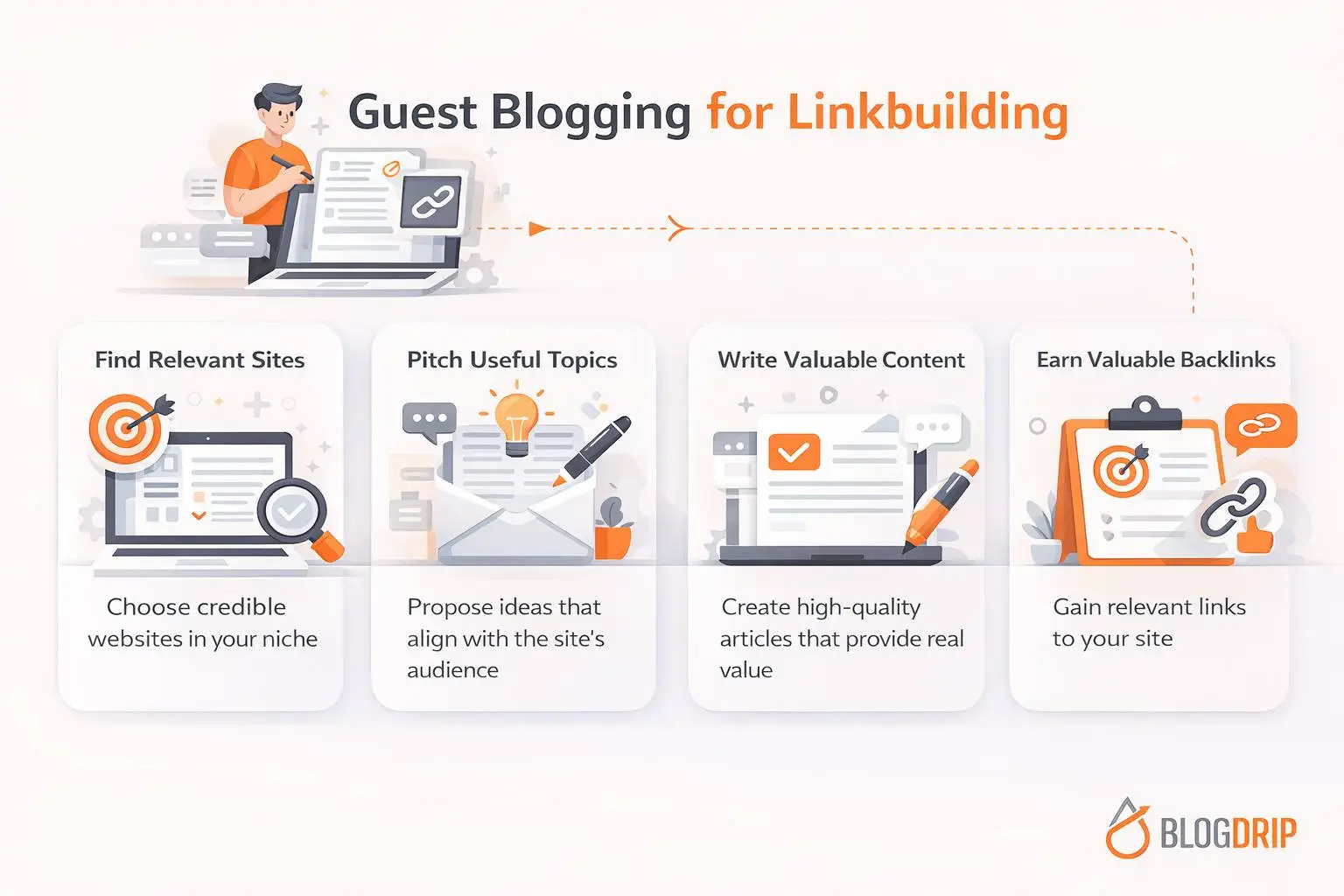
In practical terms, guest blogging involves several decisions:
- choosing websites that are relevant and credible
- proposing topics that match the host site’s audience
- writing content that meets the publication’s standard
- linking only where it is useful and natural
- using the placement to support wider SEO and brand goals
That means guest blogging is not simply a link insertion exercise. It is a content and relationship activity that happens to include link acquisition when there is a legitimate reason for it.
Why Guest Blogging for Linkbuilding Matters
Guest blogging still matters because it can help a site earn relevant backlinks from real publications within its topic area. Those links can support rankings, strengthen perceived expertise, and improve visibility when they point to pages that deserve authority.
It can earn relevant backlinks
One of the main reasons guest blogging remains useful is that it gives you a structured way to earn links from sites that are topically aligned with your own. Relevance is one of the most important factors in linkbuilding. A backlink from a website in the same industry or subject area usually carries more value than a link from an unrelated source.
It helps build authority beyond your own site
Publishing on relevant external websites can expand your visibility and reinforce your credibility. A thoughtful contribution to a respected industry site does more than generate a backlink. It also helps position your brand or team as a useful voice within the broader topic.
It supports link diversity
A healthy backlink profile usually comes from different types of sources and strategies. Guest blogging can be one part of that mix alongside editorial mentions, resource links, digital PR, and naturally earned citations. Used carefully, it can diversify the way a site earns authority rather than relying on a single tactic.
It complements outreach and content strategy
Guest blogging works best when it is connected to a wider content and outreach plan. It can support important commercial pages indirectly by linking to educational resources, cluster articles, or pillar content that then distribute authority internally across the site. This is especially useful in a topical cluster structure.
How Guest Blogging for Linkbuilding Works
Guest blogging works when the host site benefits from receiving strong content and your site benefits from a relevant backlink and broader exposure.
Start with the right target sites
The first step is choosing websites that make strategic sense. Not every site that accepts guest posts is worth pursuing. In fact, many are not.
A strong target site is usually:
- relevant to your niche or a closely related topic
- editorially active
- credible to its audience
- selective enough that publication still has value
- the kind of site where a backlink would make contextual sense
This is where many guest blogging campaigns go wrong. They focus too heavily on easy placement rather than fit. A link from a weak site that publishes low-quality guest content at scale is unlikely to support long-term authority.
Pitch topics that match the publication
A successful guest blogging pitch is not about what you want to publish. It is about what the target site’s audience would actually find useful.
That means researching the publication first:
- what topics it already covers
- what tone and depth it prefers
- which topics are missing or outdated
- how your expertise can add something useful
The strongest pitches usually suggest specific, relevant ideas rather than vague offers to “write a guest post.”
Create content that deserves publication
If the article reads like a vehicle for a backlink, it will usually perform poorly with editors and readers alike. A good guest post should stand on its own as a genuinely useful piece of content.
That means it should:
- address a relevant problem clearly
- match the host site’s standard
- avoid sales language
- contribute expertise rather than filler
- include links only where they improve the reader’s experience
This is one reason guest blogging and content quality cannot be separated. Weak content makes weak linkbuilding.
Use links selectively and naturally
In many cases, the best link in a guest post is not a homepage or service page link. It is a link to a useful supporting resource that actually helps the reader go deeper on a topic.
For example, a guest article on SEO strategy might reference a detailed guide on keyword research, competitor analysis, or linkbuilding outreach if those resources genuinely support the point being made. That kind of linking is more natural than forcing a commercial page into the article.
Important Subtopics Within Guest Blogging Linkbuilding
Relevance and editorial fit
Relevance is central to guest blogging success. The site, the topic, the audience, and the linked page should all fit together logically.
A backlink from a relevant guest post is more valuable because it sits within an editorial context that makes sense. That is better for readers, more credible to editors, and more consistent with sustainable linkbuilding.
Author bios vs contextual links
Guest post links often appear in author bios, but contextual links inside the article can sometimes be more valuable when they are genuinely useful.
That said, contextual links should not be forced. If the article does not naturally support one, a clean author bio link may be the better option. The goal is not to maximize link placement at all costs. The goal is to earn links that feel editorially justified.
Anchor text
Anchor text in guest blogging should be natural and restrained. Repetitive exact-match anchors can make a backlink profile look manufactured. Branded terms, partial matches, and descriptive natural anchors are usually healthier over time.
This matters because guest blogging is one of the areas where over-optimization can become obvious very quickly.
Link targets
The page you choose to link to matters as much as the site you publish on. A useful educational page often makes a better destination than a direct sales page.
For a site using pillar-and-cluster architecture, good targets often include:
- broad pillar resources
- strong cluster pages
- original research
- useful guides
- supporting tools or templates
These kinds of destinations tend to fit editorially and help distribute value across the site through internal links.
Common Guest Blogging Mistakes
Publishing on low-quality sites
One of the biggest mistakes is chasing any website that accepts guest content. If the site exists mainly to sell placements or publish thin guest posts, the SEO value is weak and the reputational risk is higher.
Treating the post as a link vehicle
A guest post that exists only to place a backlink is usually obvious. Editors notice it, readers feel it, and the content adds little long-term value.
Forcing commercial links
Trying to insert direct service or product links where they do not belong often weakens the article and reduces acceptance rates. The better approach is usually to link to genuinely useful supporting content.
Using generic pitches
Editors receive many low-effort outreach emails. Broad, impersonal pitches are easy to ignore. Strong guest blogging outreach is specific, relevant, and based on a clear understanding of the site.
Ignoring topical strategy
Guest blogging should not happen in isolation. If the linked page does not support the broader architecture of your site, much of the strategic value is lost. A backlink is more useful when it strengthens a clear topic cluster rather than pointing to a disconnected page.
Practical Guidance for Guest Blogging Linkbuilding
A strong guest blogging strategy is selective, editorial, and aligned with wider SEO goals.
Build a target list based on fit
Start with websites that are genuinely relevant to your subject area. Focus less on scale and more on whether the site is credible, active, and contextually aligned.
Pitch ideas, not vague offers
Editors are more likely to respond when the pitch includes thoughtful topic ideas that fit their audience. Show that you understand their publication rather than sending a generic template.
Write for the host site first
A guest article should solve a problem for the host site’s readers. When the content is genuinely useful, the backlink feels earned rather than inserted.
Link to pages that add value
Choose destinations that improve the article. In many cases, a strong cluster page or pillar guide is a better target than a commercial page because it is easier to justify editorially and more useful to readers.
Connect guest blogging to internal linking
If a guest post earns a backlink to one of your educational resources, make sure that resource links sensibly to related articles and priority pages on your site. This helps the value of the backlink support the wider topic area.
Measure quality, not just volume
The success of guest blogging should not be judged only by how many posts go live. More useful indicators include:
- relevance of the publishing sites
- quality of the backlinks earned
- ranking improvements for linked pages
- referral traffic from those placements
- contribution to broader authority in the topic cluster
Timing and Expectations
Guest blogging linkbuilding rarely produces immediate results. Even after a post goes live, it can take time for search engines to crawl the page, process the backlink, and reflect any ranking impact.
The pace also depends on several factors:
- how strong the host site is
- how relevant the backlink is
- which page is being linked to
- how competitive the target topic is
- how well your internal linking supports the destination page
Guest blogging should be treated as a steady authority-building activity rather than a quick ranking fix. A few strong placements on relevant sites often matter more than a large number of weak ones. That is why patience and selectivity are so important.
Conclusion
Guest blogging for linkbuilding still has a place in SEO when it is approached with editorial judgment and strategic discipline. Its value does not come from publishing content anywhere that will take it. It comes from contributing useful content to relevant websites and earning backlinks that make sense for readers and search engines alike.
The best guest blogging strategies focus on fit, quality, and usefulness. They link to pages that deserve authority, support broader topical goals, and strengthen site architecture through sensible internal linking.
For a website building topical authority, guest blogging should be part of a wider linkbuilding system, not a standalone shortcut. When used that way, it can help earn relevant links, expand credibility, and support durable organic growth.