
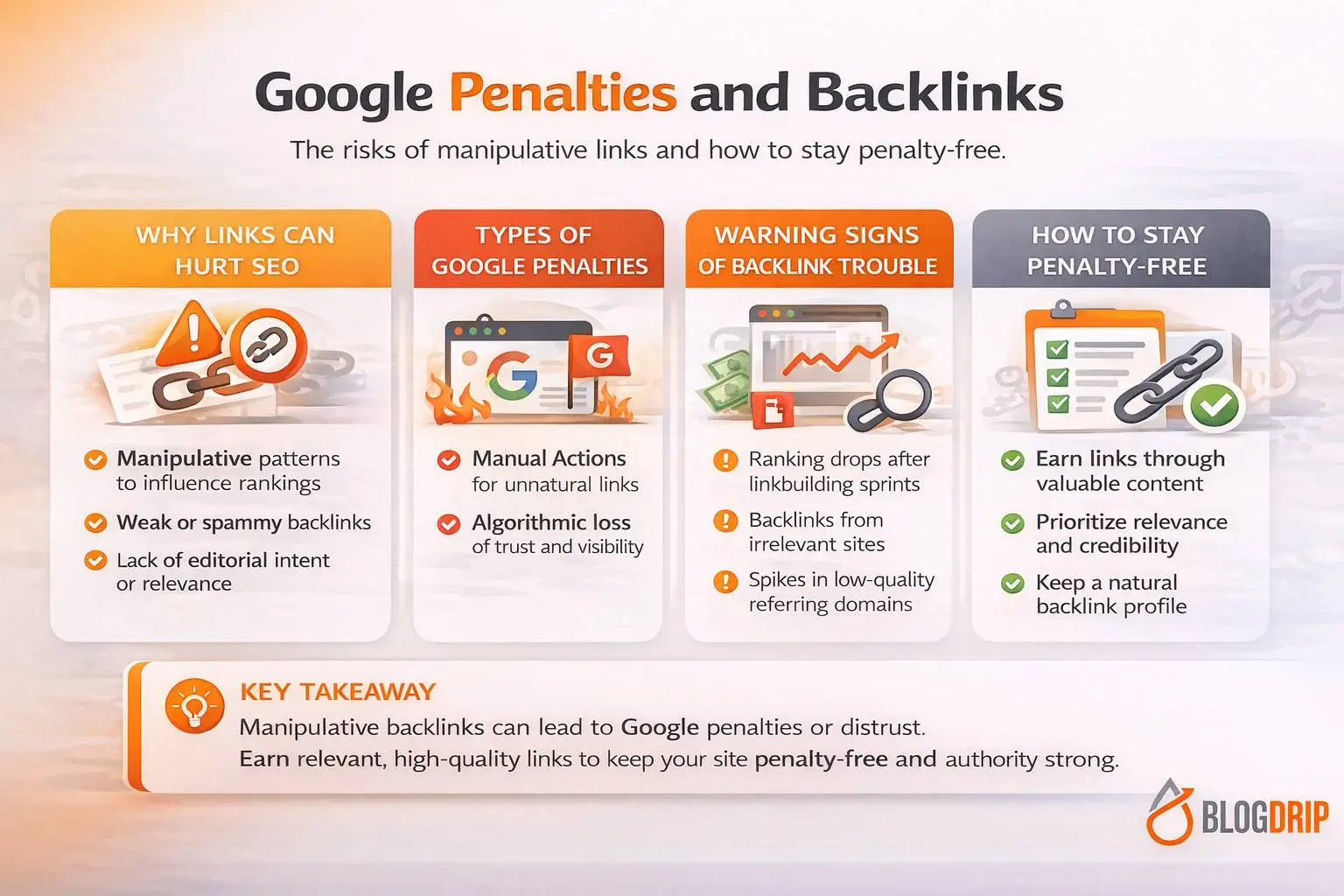
Google Penalties and Backlinks
Google penalties and backlinks are closely connected because backlinks remain one of the strongest off-page signals in SEO. When a site’s backlink profile looks manipulative, low quality, or artificially inflated, it can create serious problems for organic visibility. That is why many site owners ask whether bad links can trigger ranking losses, manual actions, or longer-term trust issues.
The short answer is that backlinks can absolutely become part of an SEO penalty problem, but the issue is usually not just the existence of links. It is the pattern behind them. Google penalties backlinks concerns typically arise when links are built to manipulate rankings rather than earned through relevance, value, and editorial credibility.
This distinction matters because not every weak backlink leads to a penalty, and not every ranking drop means Google has taken action. But a poor backlink strategy can still damage performance, whether through formal penalties, algorithmic distrust, or a general inability to compete with cleaner, more credible sites. For a website building topical authority through a pillar-and-cluster model, backlinks should strengthen trust, not introduce avoidable risk.
What Are Google Penalties Related to Backlinks?
Google penalties related to backlinks refer to negative SEO consequences that happen when a site’s backlink profile appears manipulative, spam-heavy, or designed primarily to influence rankings unfairly.
In practical terms, this usually falls into two broad categories:
- manual actions related to unnatural links
- algorithmic devaluation or distrust tied to poor link patterns
A manual action means human reviewers have identified a link-related problem serious enough to warrant direct intervention. An algorithmic issue is different. In that case, the site may simply fail to benefit from bad links, or it may lose visibility because the backlink profile appears low quality compared with competitors.
This is an important distinction. Many people use the word “penalty” for any ranking decline. In reality, some backlink-related problems are formal actions, while others are broader quality signals that reduce performance without an explicit warning.
Why Backlinks Can Lead to SEO Problems
Backlinks matter because they help search engines evaluate authority, trust, and relevance. But when links are built through manipulation rather than genuine endorsement, they stop functioning as reliable signals.
They can distort ranking signals
A backlink is supposed to suggest that another site found a page worth referencing. If links are bought, inserted unnaturally, placed on low-quality networks, or scaled through spam, that signal becomes less trustworthy.
They can weaken the credibility of the backlink profile
Even if some manipulative links appear to help temporarily, they can create patterns that make the site’s authority look manufactured rather than earned. That is often where trouble begins.
They can distract from real SEO foundations
Sites that chase backlink shortcuts often underinvest in the assets that actually deserve links. Over time, that weakens content quality, topical depth, and internal structure. The site becomes more dependent on off-page manipulation and less competitive on its own merits.
They can undermine long-term growth
A backlink profile built on weak tactics is rarely stable. Even when it avoids a clear manual action, it often fails to support sustainable rankings. Serious SEO depends on compounding trust, not repeatedly forcing external signals.
How Google Penalties and Backlinks Interact
Backlink-related SEO problems usually happen when the quality, intent, and pattern of links point toward manipulation.
Manual actions for unnatural links
A manual action is the clearest type of Google penalty tied to backlinks. This happens when Google determines that a site is participating in link practices designed to manipulate search results.
Typical causes include:
- buying links for ranking value
- participating in private blog networks
- large-scale manipulative guest posting
- hidden paid placements
- excessive exact-match anchor manipulation
- spam-heavy link schemes
A manual action is serious because it reflects a direct judgment that the linkbuilding strategy crossed a clear line.
Algorithmic distrust or devaluation
Not all bad links trigger a manual action. In many cases, Google may simply discount low-quality links or view the overall backlink profile as less trustworthy.
This can still hurt rankings because the site fails to gain the authority it expected, or because competing sites have stronger and cleaner external signals.
The pattern matters more than a single link
A single questionable link rarely defines an entire site. What matters more is the broader pattern:
- repeated paid placements
- clusters of links from irrelevant sites
- unnatural anchor repetition
- large numbers of low-value directory or profile links
- links from obvious link-selling environments
- backlink growth that looks engineered rather than earned
This is why backlink risk is best understood as a profile problem, not just a link-by-link problem.
Important Subtopics Within Google Penalties and Backlinks
Manual actions vs ranking drops
A manual action is explicit. A ranking drop is not always a penalty.
This matters because many site owners assume every traffic decline is caused by a penalty. In reality, ranking losses can also come from:
- stronger competitors
- weak content
- search intent mismatch
- poor technical SEO
- content cannibalization
- backlink devaluation rather than direct punishment
That is why diagnosis matters before any cleanup work begins.
Unnatural link patterns
Google penalties backlinks issues usually come back to unnatural patterns. These are signals that suggest the links exist mainly for SEO manipulation rather than genuine editorial reasons.
Examples include:
- backlinks from unrelated websites
- repetitive exact-match anchors
- large quantities of sponsored-looking placements
- links from thin content environments
- sudden spikes in low-quality referring domains
Not every pattern is automatically toxic, but the more engineered the profile looks, the weaker the strategic position becomes.
Paid backlinks and manipulative placements
Paid links are one of the most common concerns in backlink penalties. Paying for exposure, sponsorship, and promotion can exist within normal marketing activity. The issue is when payment is used mainly to acquire ranking value while the link is presented as if it were naturally earned.
This creates both quality risk and pattern risk, especially when repeated across many domains.
Anchor text over-optimization
Anchor text becomes a problem when it is too controlled. A natural backlink profile usually contains branded anchors, descriptive phrases, partial matches, and varied wording. A manipulative profile often leans too heavily on exact-match commercial keywords.
That kind of repetition can make the profile look artificial very quickly.
Common Backlink Practices That Increase Penalty Risk
Some backlink practices are much more likely to create problems than others.
Buying links for rankings
This is one of the clearest risk factors. Even if individual placements seem strong, building a strategy around purchased authority usually leads to lower-quality patterns over time.
Private blog networks
Networks built to pass link value artificially are a classic high-risk tactic because they simulate authority rather than earn it.
Spam-heavy automation
Forum spam, low-value profile links, comment spam, and mass directory links often create large volumes of weak signals with very little editorial credibility.
Scaled guest posting for links only
Guest posting can be legitimate, but when it is done mainly at scale for anchor-text control and placement volume, it starts to resemble manipulation rather than contribution.
Irrelevant niche edits
A link inserted into existing content without strong topical fit may look efficient, but repeated use of these placements can make the profile look forced.
Weak destination pages
Even a decent link source is not especially useful if the target page is thin, low value, or disconnected from the site’s broader structure. This is one reason strong content and site architecture matter so much.
Signs a Site May Have Backlink-Related Trouble
A site with backlink-related SEO issues may show several warning signs.
Rankings decline after aggressive linkbuilding
If performance drops after a heavy period of paid placements, manipulative outreach, or anchor-driven link acquisition, backlinks are worth reviewing.
The backlink profile looks inconsistent with the brand
A site earning links from unrelated, low-quality, or obviously promotional environments may be building a profile that looks less credible than its actual business.
Too many links point to the wrong pages
If a site’s backlinks are concentrated on awkward, low-value, or over-optimized pages, that can indicate a linkbuilding strategy built around manipulation rather than usefulness.
Referring domains look repetitive or low quality
A pattern of links from sites with thin content, little relevance, or heavy sponsored footprints is often a stronger warning sign than any individual domain on its own.
Practical Guidance for Avoiding Google Penalties From Backlinks
The safest and strongest approach is to build a backlink profile that reflects real value rather than manufactured authority.
Focus on earning links, not simulating them
Useful content, digital PR, relevant outreach, guest contributions with real editorial fit, and strong linkable assets are slower than shortcuts, but they build a healthier profile.
Build pages that deserve authority
A site is easier to promote safely when it has resources worth citing. Strong guides, original research, useful tools, and well-structured cluster pages create better opportunities for credible backlinks.
Prioritize relevance
A relevant backlink from a credible site is usually more useful than a stronger-looking metric from an unrelated source. Topical fit matters.
Keep anchor text natural
Let anchor distribution remain varied and editorial. Branded and descriptive anchors are usually healthier than aggressive exact-match repetition.
Connect backlinks to topic clusters
When a strong page earns links, internal linking should help distribute that value across the wider cluster. This makes every earned backlink more strategically useful and reduces the temptation to force links to isolated pages.
Avoid dependency on manipulative tactics
If a site needs constant artificial link support to remain competitive, the underlying strategy is likely too weak. Strong organic growth should be able to rest on better content and cleaner signals over time.
What to Do if Backlinks Are Causing SEO Problems
If a site appears to have backlink-related issues, the response should be careful and evidence-based.
Audit the backlink profile
Look for patterns, not just isolated bad links. Pay attention to:
- relevance of referring domains
- anchor text concentration
- placement quality
- clusters of suspicious link sources
- links pointing to overly optimized pages
Separate weak links from serious risk patterns
Not every low-quality link requires action. The bigger concern is whether the overall profile suggests manipulation.
Strengthen the site itself
Cleaning up links matters, but so does improving the site’s own authority signals through better content, clearer structure, and stronger internal linking.
Rebuild authority through safer methods
Long-term recovery usually depends on replacing manipulative tactics with more credible linkbuilding approaches. That means earning better links, not just removing bad ones.
Timing and Expectations
Backlink-related penalties and recovery are rarely immediate. If a site has a weak link profile, the negative effects may build over time rather than appear on a single day. In the same way, recovery usually takes patience.
Results depend on:
- how serious the backlink issue is
- whether there is a manual action
- how much of the profile looks manipulative
- the quality of the site’s content and structure
- how effectively the strategy changes going forward
This is why the best approach is prevention. It is usually easier to build a clean backlink profile from the start than to repair a damaged one later.
Conclusion
Google penalties and backlinks are connected because backlinks remain a powerful signal of authority, and any signal strong enough to influence rankings can also create risk when it is manipulated.
The real problem is not simply “bad links.” It is backlink strategies built around shortcuts, artificial patterns, and weak editorial logic. Those tactics may create temporary gains, but they often weaken long-term trust and leave the site more vulnerable.
For a website building topical authority, the stronger path is clear: create content that deserves links, promote it intelligently, earn relevant mentions, and use internal linking to make those backlinks support the wider cluster. That approach is slower, but it builds authority that is far more likely to last.