
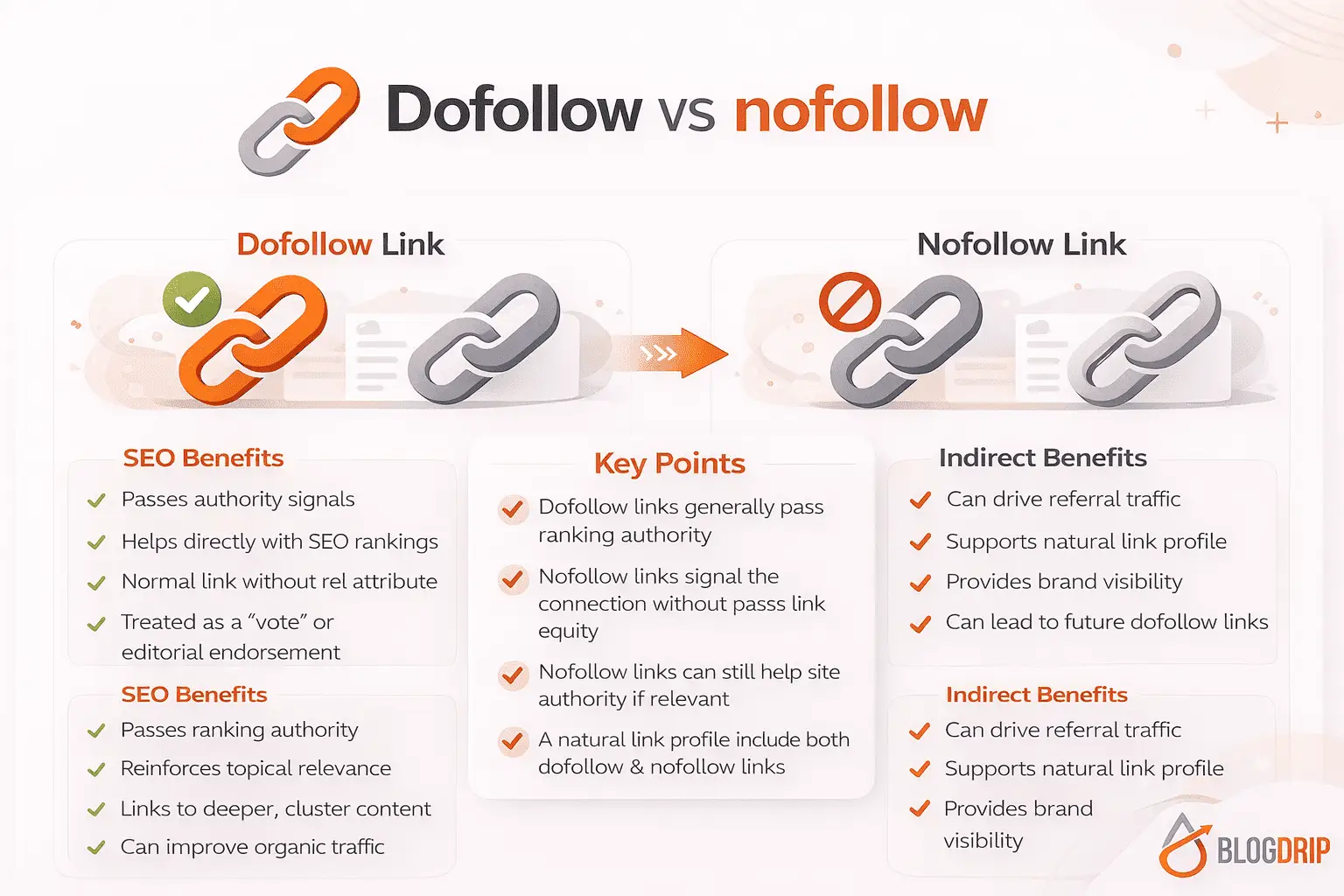
Dofollow vs Nofollow: What Matters for SEO
The difference between dofollow and nofollow links is still relevant in SEO, but not for the simplistic reasons many people assume. Too often, the conversation is reduced to “dofollow links help rankings, nofollow links do not.” That is directionally true in some cases, but it leaves out the bigger strategic picture.
A backlink is never valuable because of its attribute alone. Its impact depends on relevance, editorial placement, the authority of the linking page, the quality of the destination page, and the broader pattern of links pointing to your site. For websites building topical authority through a pillar-and-cluster model, that distinction matters. Poor link evaluation leads to poor SEO decisions.
This cluster page explains dofollow vs nofollow in practical terms, why the difference matters, and how to approach both link types strategically.
What Is Dofollow vs Nofollow?
A dofollow link is simply a normal hyperlink. In most cases, there is no special dofollow tag in the code. It is just the default type of link that search engines can crawl and use as a ranking signal.
A nofollow link includes the attribute rel="nofollow". This tells search engines that the linking site does not want to pass the same kind of editorial endorsement through that link as it would with a standard link.
In practical terms:
- a standard link may pass authority and relevance signals
- a nofollow link is treated more cautiously
That said, search engines do not always treat nofollow as an absolute instruction. In modern SEO, it is better understood as a hint than a hard rule. That is why a rigid “follow good, nofollow bad” mindset is too narrow.
Why It Matters
The dofollow vs nofollow distinction matters because links still help search engines understand trust, relevance, and authority.
A strong dofollow backlink from a relevant page can support rankings more directly. That is why followed editorial links remain an important part of link building.
Nofollow links usually do not pass the same direct SEO value, but they can still contribute in meaningful ways. They may drive qualified referral traffic, improve brand visibility, support a natural backlink profile, and lead to secondary links when other publishers discover your content through them.
That is the key strategic point: a nofollow link may not be useless just because it does not pass traditional link equity in the same way.
How It Works
Search engines use links to discover content and interpret relationships between pages. When one page links to another, that link can act as a signal of reference or endorsement.
A standard followed link can help in three ways:
- It supports discovery.
- It reinforces topical relevance.
- It may contribute to authority signals.
A nofollow link changes how that signal is interpreted. Instead of being treated as a conventional editorial vote, it is flagged more cautiously.
Why nofollow exists
Nofollow was introduced largely to reduce spam and manipulative linking, especially in blog comments, forums, and other areas where anyone could add links without editorial review.
Over time, that made nofollow a common choice for user-generated content, paid placements, and links that publishers did not want to fully endorse.
Other link attributes also matter
Nofollow is no longer the only attribute used in SEO. Two others often appear:
rel="sponsored"for paid or sponsored linksrel="ugc"for user-generated content
These help search engines understand the nature of the link more accurately. For SEO teams, this means proper link labeling matters just as much as link acquisition.
Important Subtopics
Dofollow links usually matter more for rankings
If your goal is to strengthen organic visibility directly, dofollow links are generally more important. A relevant editorial backlink with no restrictive attribute is still one of the clearest signals of external trust a page can earn.
That is especially useful when you are trying to rank core commercial or informational pages within a topic cluster.
Nofollow links still have real value
A nofollow link from a respected publication, industry site, or community can still be worthwhile. It may send highly qualified traffic, improve brand awareness, or lead to future followed backlinks from other sources.
This happens often in digital PR. A major mention may not pass strong direct equity, but it can create visibility that leads to more valuable editorial coverage later.
A healthy backlink profile includes both
Natural backlink profiles usually contain a mix of followed and nofollowed links. That is how real brands are mentioned online.
If every backlink is keyword-rich, dofollow, and pointed at commercial pages, the profile can look engineered. A more varied profile is usually more credible and more sustainable.
Common Mistakes
Treating nofollow as worthless
This is one of the most common mistakes. Businesses sometimes ignore strong press, editorial, or community opportunities because the link is nofollow.
That is often too narrow a view. Some nofollow links bring more real business value than weak followed links from irrelevant sites.
Chasing any dofollow link
The reverse mistake is pursuing followed links without considering context. A dofollow link from a poor-quality page, irrelevant site, or obvious link scheme may add little value and can create long-term risk.
The attribute does not make the link good. The page and placement do.
Ignoring relevance
A relevant link on a smaller but credible site is often more useful than a link from a powerful but unrelated domain. Relevance should come before vanity metrics.
Sending links to the wrong pages
Many websites build links only to the homepage. That can help with brand signals, but it often fails to support the pages that actually need authority. In a cluster model, backlinks should also support pillar pages, cluster pages, and other high-value resources.
Practical Guidance
The best way to approach dofollow vs nofollow is to stop judging links by attribute alone.
Start by creating pages worth linking to. Strong link targets usually include original insights, useful resources, clear explanations, frameworks, and focused cluster content that satisfies a specific search intent.
Then assess opportunities using a broader lens.
Prioritize relevant followed links
Contextual, editorial dofollow links from topic-relevant pages should remain a priority. They are still among the most valuable external signals a page can earn.
Do not dismiss strong nofollow mentions
If a nofollow link comes from a respected site with the right audience, it may still be worth pursuing for visibility, trust, and referral traffic.
Align backlinks with your site architecture
Your backlink strategy should reflect your content structure. Some links should support your broad pillar pages. Others should strengthen specific cluster articles that target narrower informational queries.
Evaluate pages, not just domains
A strong domain metric is not enough. Look at the exact linking page, its topic, its quality, and whether the link makes sense editorially.
Timing and Expectations
Neither dofollow nor nofollow links should be viewed as quick fixes.
Dofollow links can support SEO more directly, but even strong links take time to be crawled, interpreted, and reflected in rankings. Nofollow links often create indirect value through exposure and secondary effects rather than obvious ranking gains.
This is why link building works best as a long-term authority strategy. Strong results come from consistently earning relevant mentions that support quality pages within a coherent site structure.
Conclusion
Dofollow vs nofollow still matters, but the real value of a link depends on context.
Dofollow links are usually more important for direct ranking impact because they are more likely to pass authority and relevance signals. Nofollow links, however, can still contribute to traffic, credibility, visibility, and a natural backlink profile.
The smarter SEO approach is not to divide links into “valuable” and “worthless” based only on attributes. It is to ask why the link exists, where it appears, what page it supports, and how it fits into your broader topical strategy.
For a cluster page like this, that is the main takeaway: good link evaluation is not about labels alone. It is about relevance, intent, editorial quality, and long-term authority building.