
Linkbuilding Cost
Linkbuilding cost is one of the most misunderstood parts of SEO because people often ask the wrong version of the question. Instead of asking what linkbuilding should cost in strategic terms, many teams ask how cheaply they can acquire links at scale. That usually leads to poor decisions.
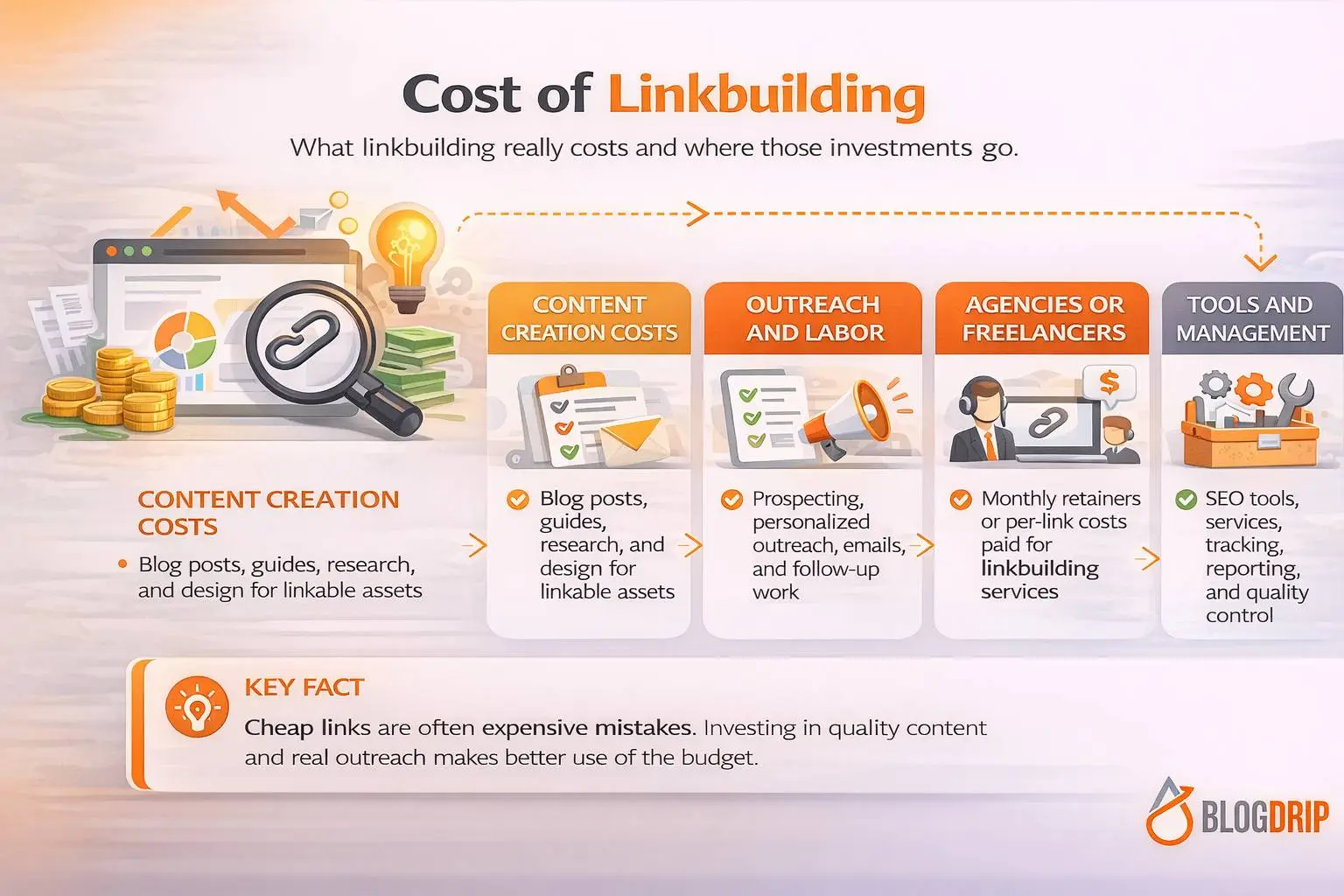
The real cost of linkbuilding is not just the price of a placement, an outreach campaign, or a monthly retainer. It includes the cost of content creation, prospecting, relationship-building, digital PR, tools, internal team time, and quality control. It also includes the hidden cost of doing linkbuilding badly. Cheap links that create weak authority or increase risk are not truly low-cost. They are often expensive mistakes.
For a website building topical authority through a pillar-and-cluster model, this matters even more. Linkbuilding should support pages that deserve authority and fit into a larger site structure. That means the cost should be evaluated against strategic value, not just link volume.
What Is Linkbuilding Cost?
Linkbuilding cost refers to the total investment required to earn backlinks that support SEO performance. That investment may be financial, operational, or both.
In practical terms, linkbuilding cost can include:
- internal team time
- agency retainers
- freelancer support
- content production
- outreach research
- digital PR execution
- prospecting tools
- reporting and quality control
- design or data work for linkable assets
This is important because linkbuilding is rarely just one line item. A business may not pay directly for each backlink, yet still spend heavily through labor, content, and campaign costs.
A useful way to think about linkbuilding cost is not “What does one backlink cost?” but “What does it cost to build authority safely and effectively in this niche?”
That question produces better decisions because it focuses on sustainability rather than shortcuts.
Why Linkbuilding Cost Matters
Cost matters because backlinks can influence rankings, authority, and organic growth, but they are also one of the easiest SEO investments to mismanage.
It affects strategy quality
A business with an unrealistic budget often ends up buying weak placements, chasing irrelevant links, or working with vendors who prioritize quantity over relevance. Low budgets do not automatically fail, but they do require sharper prioritization.
It shapes which tactics are realistic
Different budgets support different forms of linkbuilding. A company with budget for research, digital PR, and strong content assets can pursue higher-leverage strategies. A smaller site may need to focus on selective outreach, stronger internal linking, and a few high-value assets rather than broad campaigns.
It influences ROI expectations
If the linkbuilding cost is high, the business needs to understand what kind of return is realistic. That return may not be immediate revenue from a single link. It may show up through rankings, visibility, stronger topic clusters, improved authority, and future organic traffic growth.
It exposes bad decision-making quickly
Linkbuilding is one of the areas where cheap work often looks productive at first. Reports may show dozens of acquired links, but if those links come from irrelevant or weak pages, the cost was not actually efficient. It was just badly allocated.
What Drives Linkbuilding Cost?
Linkbuilding cost varies widely because not all links are equally difficult to earn and not all campaigns are equally resource-intensive.
Competition in the niche
The more competitive the niche, the more difficult it usually is to earn strong backlinks. Sites in software, finance, legal, health, and similar competitive spaces often need better content, stronger outreach, and more authority-building effort than sites in less contested areas.
This raises cost because the link targets are harder to win and the standards for content quality are higher.
Quality of the target links
A relevant editorial link from a credible publication is typically much more difficult to earn than a low-quality placement on a site that accepts almost anything. That difference in difficulty is one of the main reasons linkbuilding cost varies so much.
Higher-quality links usually require:
- better assets
- stronger outreach
- more research
- more selective targeting
- more follow-up
- better brand credibility
Type of linkbuilding strategy
Different strategies come with different cost structures.
For example:
- digital PR often has high campaign costs but stronger upside
- guest contributions require content creation and outreach time
- broken link building needs prospecting and replacement asset quality
- content-led linkbuilding depends on linkable asset creation
- reactive expert outreach depends on speed and subject expertise
The cost is not only about execution. It is also about what kind of asset or capability the strategy needs.
Strength of the destination page
If the page being promoted is weak, more effort is needed just to make outreach credible. Strong pages reduce friction. A high-quality guide, research asset, or cluster page is easier to promote than a thin landing page.
This is why content quality affects linkbuilding cost directly. Better content lowers the effort required to earn links and increases the chance that each campaign produces value.
Main Cost Models in Linkbuilding
Businesses usually encounter linkbuilding cost in a few common forms.
Internal team cost
Some companies handle linkbuilding internally through SEO teams, content marketers, PR staff, or founders. This avoids an external invoice per link, but the cost still exists in salaries, time allocation, tools, and opportunity cost.
Agency retainers
Many businesses pay agencies a monthly retainer for strategy, outreach, reporting, and campaign management. This model can be effective when the agency focuses on quality and aligns linkbuilding with the broader SEO strategy.
Per-link pricing
Some vendors price linkbuilding by individual link. This sounds simple, but it often encourages poor incentives. When the model rewards link quantity more than relevance or strategic fit, quality can drop quickly.
Campaign-based cost
Digital PR, asset promotion, research launches, and large outreach projects are often priced as campaigns. These can be expensive, but they may produce broader results if the assets are strong and the distribution is relevant.
Important Subtopics Within Linkbuilding Cost
Cost per link vs cost per outcome
This is one of the most important distinctions. A lower cost per link does not always mean better value.
A more useful question is:
- Did the links improve rankings?
- Did they strengthen an important topic cluster?
- Did they support long-term authority?
- Did they come from credible, relevant sites?
A campaign with fewer but better links can outperform a cheaper campaign with high link volume and low strategic value.
Linkable assets and content cost
Some of the best linkbuilding campaigns depend on assets such as:
- original research
- data pages
- statistics hubs
- useful guides
- calculators
- templates
- strong educational cluster pages
These assets take time and money to create, but they often improve link efficiency because they are easier to promote and more likely to earn editorial links. This is why content strategy and linkbuilding cost are closely connected.
Outreach labor
High-quality outreach is labor-intensive. It requires prospecting, qualification, personalization, follow-up, and judgment. Cheap outreach usually becomes template-heavy and low-fit, which reduces results and often pushes teams toward weaker link sources.
Risk-adjusted cost
A linkbuilding tactic that looks cheaper on paper may be more expensive in reality if it creates penalty risk, wasted spend, or low-quality authority signals. True cost should include the downside of poor methods, not just the upfront invoice.
Common Mistakes When Evaluating Linkbuilding Cost
Focusing only on cheap links
This is the most common mistake. Cheap links often come from weak sites, irrelevant pages, or obvious placement networks. They may look efficient, but they rarely build durable authority.
Ignoring content readiness
Many businesses try to reduce linkbuilding cost while sending outreach to pages that are not worth linking to. This increases waste because even good outreach cannot make weak content compelling.
Buying based on quantity promises
Vendors that promise large numbers of links for low cost often rely on tactics that do not align with long-term SEO quality. The reports may look impressive, but the strategic value is usually weak.
Separating linkbuilding from site architecture
A backlink is more valuable when it strengthens a page that contributes to a wider topic cluster. If the destination page is isolated, the business gets less from the investment.
Expecting instant ROI
Linkbuilding usually supports long-term authority rather than immediate direct return from each placement. Businesses that expect instant revenue attribution from every backlink often misread what they are actually buying.
Practical Guidance for Managing Linkbuilding Cost Well
A strong linkbuilding budget should be built around strategy, not just acquisition.
Invest in pages that deserve authority
Before spending heavily on outreach or campaigns, make sure the target pages are strong enough to justify promotion. High-value guides, pillar-supporting resources, and standout cluster pages usually provide better returns than thin pages.
Prioritize a smaller number of better opportunities
For many sites, especially those with limited budgets, a focused strategy works better than trying to build links everywhere. A few strong, relevant links to strategically important pages can outperform large volumes of weak placements.
Treat content as part of the cost
If the campaign requires research, design, or improved educational content, include that in the budget. It is not extra. It is part of what makes the links worth earning.
Choose tactics that fit the site’s stage
A newer site may need practical outreach, guest contributions with real value, and strong informational assets. A larger brand may be able to justify bigger digital PR or research campaigns. The right cost structure depends on the site’s authority and goals.
Measure value beyond link count
Useful evaluation points include:
- quality of referring domains
- relevance of linking pages
- ranking gains for promoted pages
- support for pillar and cluster architecture
- growth in organic visibility
- referral traffic from strong placements
This gives a more accurate sense of whether the spend is working.
Build internal linking around earned authority
When a page earns backlinks, its value increases when it passes relevance and authority through internal links to related pages. This improves the return on linkbuilding investment across the wider topic area.
Timing and Expectations
Linkbuilding cost should always be viewed alongside timing. Strong links are often expensive because they take time to earn. Good campaigns involve preparation, content refinement, prospecting, outreach, and follow-up. Rankings may move gradually rather than immediately.
This means businesses should avoid judging cost too early. A good campaign may look expensive in month one and efficient by month six if it supports sustainable gains in visibility and authority.
At the same time, not every campaign will produce dramatic results. Expectations should remain realistic. Linkbuilding helps strongest when it is paired with good content, clear search intent alignment, technical stability, and deliberate internal linking.
Conclusion
Linkbuilding cost is not just the price of acquiring a backlink. It is the total investment required to build external authority in a way that is relevant, credible, and strategically useful.
The cheapest option is rarely the most efficient one. Good linkbuilding usually costs more because it depends on better content, stronger outreach, more selective targets, and safer long-term methods.
For a site building topical authority, that investment is most valuable when it strengthens pages that already deserve visibility and supports a wider pillar-and-cluster structure through internal linking. That is how linkbuilding cost should be judged: not by how many links were bought or reported, but by how much real authority the investment helped build.