
Contextual Backlinks: What They Are and Why They Still Matter in SEO
Contextual backlinks remain one of the clearest signals of relevance and authority in SEO. Not because every link automatically improves rankings, but because links placed naturally within relevant content help search engines understand topical relationships, editorial trust, and subject depth.
For businesses and publishers building organic visibility, this matters for two reasons. First, not all backlinks carry the same value. Second, strong link acquisition today is less about volume and more about fit. A contextual backlink from a relevant page on a credible site is usually far more useful than a random link on a weak directory, footer, or author profile.
This is where many SEO strategies either become ineffective or drift into manipulation. Teams chase links without thinking carefully about placement, topic alignment, or whether the link actually helps a reader. Over time, that creates a weak backlink profile: technically large, strategically thin.
This cluster page focuses on one specific question: what contextual backlinks are, how they work, and how to approach them in a way that supports long-term rankings and topical authority. It is not a general link building guide. The goal here is to explain the strategic role of contextual backlinks within a modern SEO framework.
What Are Contextual Backlinks?
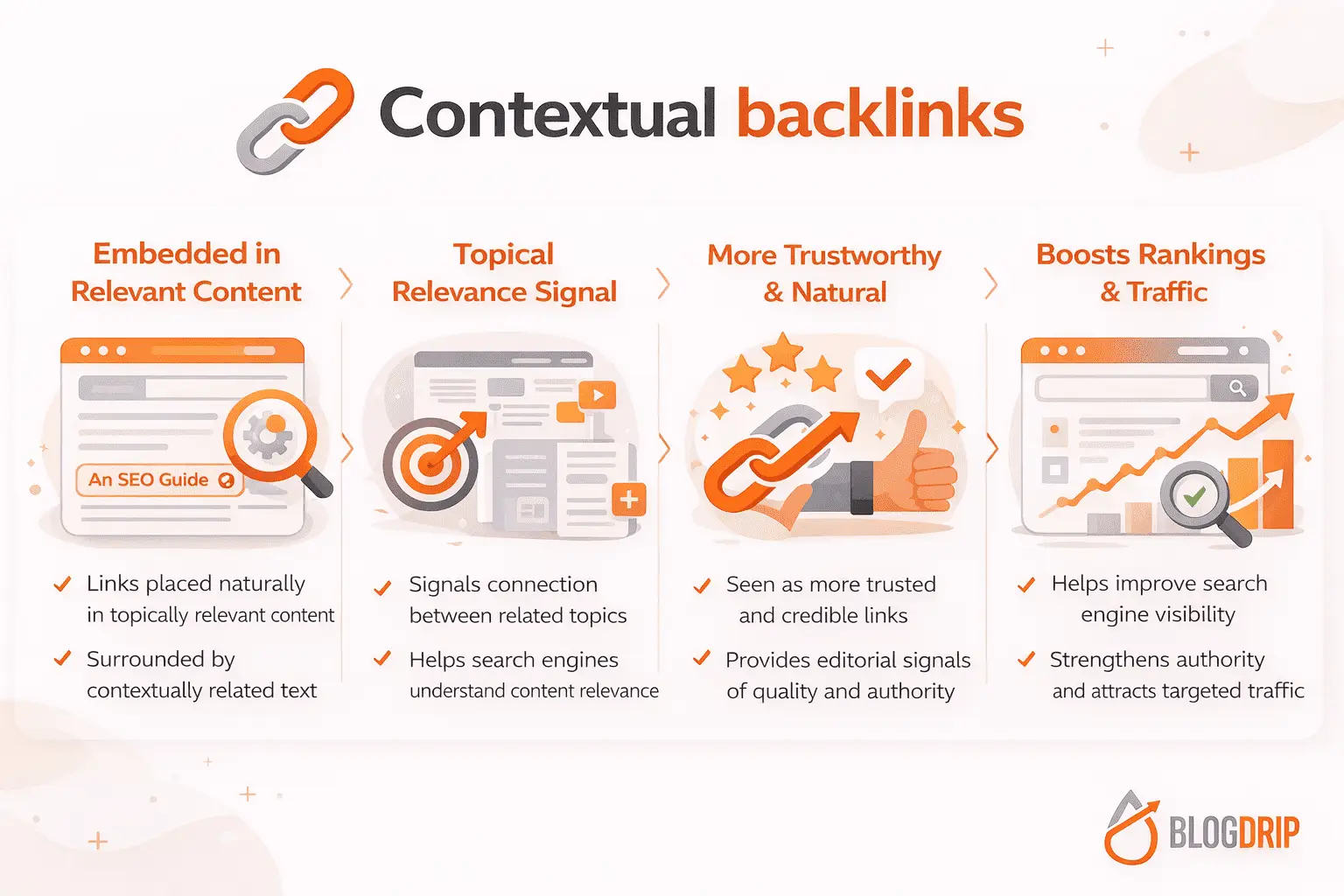
A contextual backlink is a hyperlink placed inside the main body content of a page, surrounded by text that is topically related to the destination page.
In practical terms, that means the link appears where a reader would naturally expect it: inside an article, guide, case study, or editorial page, as part of the explanation. It is not isolated in a sidebar, buried in a footer, or dropped onto a page that has no meaningful relationship to the linked topic.
For example, if a page about technical SEO links within its content to an article about crawl budget, that is a contextual backlink when the surrounding discussion makes that connection relevant and useful.
The key point is context, not just placement. A link inside a paragraph is not automatically valuable if the page itself is irrelevant or the anchor is forced. Search engines evaluate more than the existence of the link. They also interpret the topic of the linking page, the language around the link, the authority of the domain, and the broader editorial pattern.
Why Contextual Backlinks Matter
They strengthen topical relevance
Search engines use links to understand how topics connect across the web. When a relevant page links to another relevant page within a meaningful editorial context, that creates a stronger signal than a link placed in a generic or unrelated environment.
This is especially important for websites trying to build authority in a specific niche. A contextual backlink does not just pass equity. It helps reinforce that your page belongs in a recognized topic cluster.
They tend to carry more trust
Editorially placed links are generally harder to fake at scale. If a site owner or publisher chooses to reference your content within an article, that usually suggests some level of trust, usefulness, or subject relevance.
That does not mean every editorial link is powerful, and it does not mean all non-contextual links are worthless. But in most serious SEO strategies, contextual backlinks are preferred because they align more closely with how credible references work on the web.
They support rankings more naturally
Google does not rank pages because they have links alone. It ranks pages that demonstrate relevance, usefulness, and authority. Contextual backlinks contribute to that broader picture because they tend to support the right pages, with the right topical signals, from the right kinds of sources.
This is one reason they are central to a cluster-based SEO model. A strong pillar-and-cluster structure on your own site becomes more effective when external websites link contextually to the pages that deserve visibility.
How Contextual Backlinks Work
At a basic level, a contextual backlink helps in three ways: discovery, association, and authority transfer.
Search engines can use links to discover pages. That is the simplest function. But the more important role is association. The link tells search engines that the destination page is connected to the subject being discussed on the referring page.
If a page about ecommerce SEO links to a guide on product page optimization, the surrounding content helps define what that linked page is about. That context supports semantic understanding.
Authority transfer also matters, but it should be viewed carefully. A strong page can pass value through a link, yet that value is shaped by relevance, indexability, placement, and the overall quality of the referring site. A contextual backlink from a trusted, relevant page usually sends a more useful signal than a sitewide link from an unrelated domain.
Anchor text plays a supporting role
Anchor text still matters, but not in the simplistic way many older SEO guides suggest. Exact-match anchors can help when they occur naturally, but overuse becomes obvious and can weaken the editorial quality of the link profile.
In most cases, a healthy backlink profile includes a mix of:
- branded anchors
- partial-match anchors
- descriptive natural language anchors
- generic anchors used sparingly
The strongest contextual backlinks usually feel like citations, not SEO insertions.
The linking page matters as much as the link itself
A contextual backlink is only as useful as the page it sits on. If the referring page has weak topical relevance, low editorial quality, or no real organic value of its own, the backlink may add little.
This is why serious link evaluation should look beyond domain-level metrics. A relevant page on a modest but credible site can be more valuable than a link from a powerful domain on a page that has no topical alignment.
Important Subtopics That Influence Link Quality
Relevance is not optional
Topical relevance should be the first filter. If the referring page and destination page do not belong in the same conversation, the backlink is less convincing to both users and search engines.
For a site building topical authority, this matters even more. You want links that reinforce the themes your cluster structure is built around, not links that create noise.
Editorial placement matters more than template placement
Links in body content are generally more valuable because they are embedded in the editorial flow of the page. Template links in footers, blogrolls, author boxes, or sitewide widgets may still have some utility, but they rarely carry the same strategic weight.
The distinction is simple: was the link placed because the content genuinely benefited from it, or because space existed to insert a link?
Destination page quality affects results
Even a strong contextual backlink will underperform if it points to a weak page. The destination must be worth linking to. That means it should satisfy search intent, show clear expertise, and fit within the site’s internal architecture.
In a strong content cluster, backlinks should support pages with a clear purpose. Sometimes that is the pillar page. Other times it is a focused cluster article targeting a specific informational query.
Common Mistakes
Treating all in-content links as equal
Many link sellers and low-quality campaigns rely on the phrase “contextual backlinks” while placing links into thin articles with no real readership, no topical depth, and no editorial standards. Technically, the links are in content. Strategically, they add very little.
Over-optimizing anchor text
A backlink profile full of exact-match commercial anchors rarely looks natural. It also tends to reflect a campaign designed for ranking manipulation rather than editorial reference.
Natural variation is not just safer. It is more believable.
Prioritizing domain metrics over relevance
A high-authority domain can look attractive, but if the page context is weak, the backlink may be far less valuable than expected. Strong SEO decisions require page-level judgment, not just metric-based filtering.
Sending links to the wrong pages
Many websites build links almost exclusively to the homepage. That can help branding, but it often ignores the pages actually meant to rank for specific topics. In a cluster model, link targets should support the architecture: pillar pages for broad themes, cluster pages for specific search intent, and supporting articles where topical depth exists.
Practical Guidance for Earning Better Contextual Backlinks
The most reliable way to attract contextual backlinks is to publish pages that deserve to be cited within relevant content. That usually means original frameworks, detailed explanations, case-based insights, clear comparisons, or genuinely useful resources.
Outreach still has a role, but the approach should be selective. Look for websites already publishing within your topic area. Study the pages, not just the domains. Ask whether your content fills a real gap in their article or supports a point they are already making.
It also helps to align link building with content planning. If your site has a pillar page on link building strategy, for example, cluster pages on topics such as anchor text, topical relevance, or digital PR can become stronger link targets because they serve narrower informational intent. That makes them easier to reference naturally.
Contextual backlinks work best when they are part of a broader system:
- publish focused content with a clear search intent
- build internal links between related cluster pages
- identify pages that deserve external citations
- earn links from relevant editorial environments
- review whether backlinks are strengthening your topical coverage, not just increasing totals
Timing and Expectations
Contextual backlinks are not a shortcut. Even strong links may take time to influence visibility, especially in competitive spaces or on sites with limited existing authority.
Results depend on the quality of the linking page, the strength of the destination page, the competitiveness of the query, and the overall condition of your site. In practice, contextual backlinks tend to work best as compounding assets. One good link may help. A consistent pattern of relevant, editorially earned links is what usually shifts authority over time.
This is also why patience matters. If the underlying content is weak, link acquisition alone will not solve the problem. Links amplify strong pages more effectively than they rescue poor ones.
Conclusion
Contextual backlinks matter because they combine relevance, editorial trust, and topical alignment in a way that fits how search engines evaluate authority.
The real value is not that they are “powerful” in the abstract. It is that they help search engines connect your pages to the right topics, from the right sources, in a natural and credible way. For websites building a pillar-and-cluster content model, that makes them strategically important.
The most effective approach is not to chase contextual backlinks as isolated wins. It is to build link-worthy pages, support them with clear internal architecture, and earn references from sites that genuinely belong in the same subject area. That is how contextual backlinks contribute to long-term SEO performance rather than short-term noise.