
Broken Link Building
Broken link building is a linkbuilding tactic that involves finding broken outbound links on other websites and suggesting your own relevant content as a replacement. The logic is simple: if a page already links to a resource that no longer works, a better alternative may improve the page for both the site owner and their readers.
That sounds straightforward, but in practice broken link building is often handled poorly. Many campaigns rely on generic outreach, weak replacement pages, or low-quality prospects. As a result, the tactic gets treated either as an easy win or as something that no longer works. The more accurate view is that broken link building can still be useful, but only when it is grounded in relevance, editorial value, and realistic expectations.
For a website using a pillar-and-cluster model, broken link building is most effective when it supports strong content assets that already fit the site’s broader topic structure. A replacement page should not exist just to collect links. It should contribute to the wider authority of the site and connect naturally to related cluster content and core pillar pages.
What Is Broken Link Building?
Broken link building is the process of identifying dead links on other websites and offering a relevant live page from your own site as a substitute.
A broken link usually points to a page that has been removed, redirected badly, expired, or returns an error. If that link sits inside an article, guide, resource page, or blog post, it creates a weaker user experience. The site owner may be open to updating it if a suitable replacement exists.
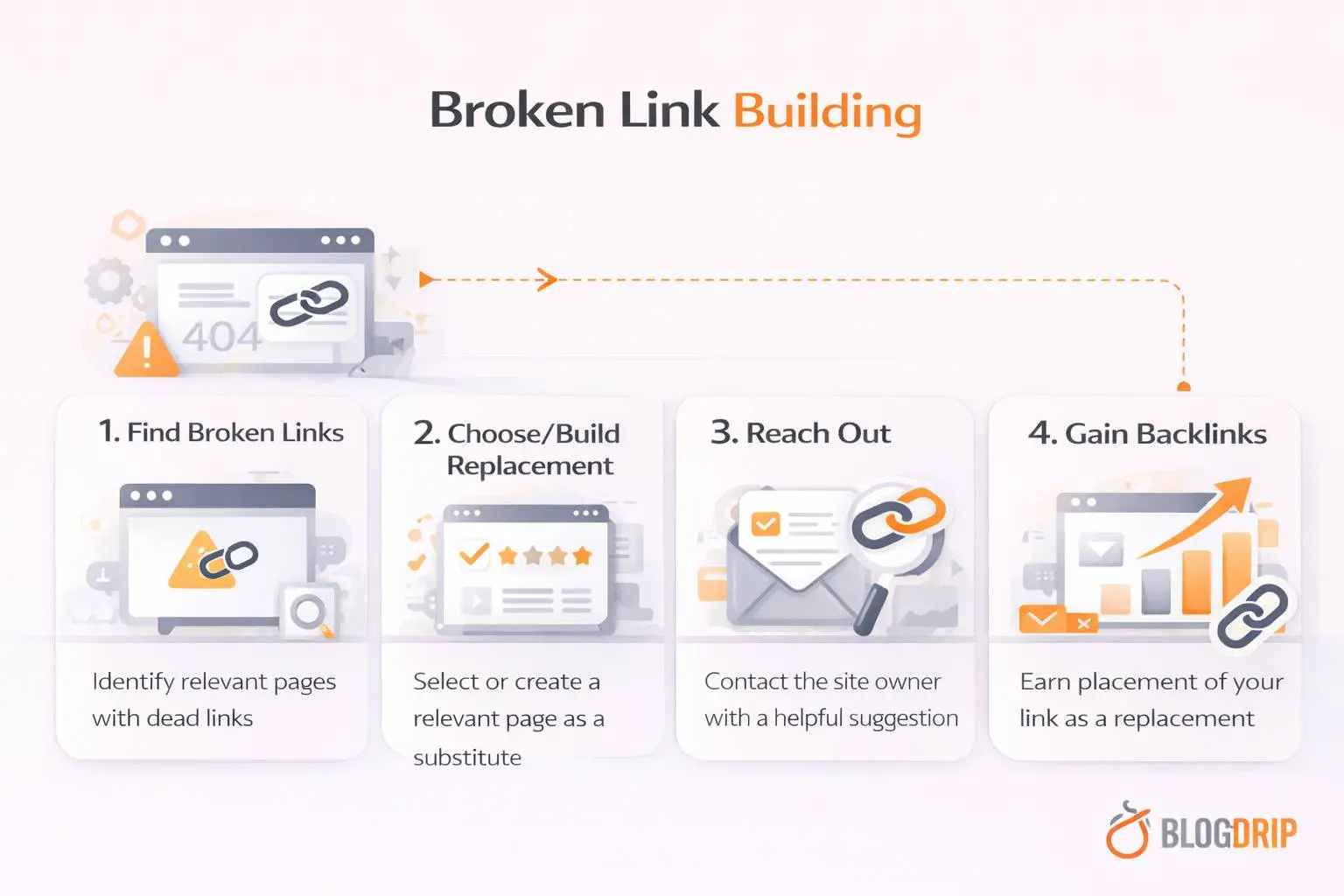
In practical terms, broken link building usually includes:
- finding relevant pages with broken outbound links
- reviewing the original context of the dead resource
- identifying or creating a replacement asset
- contacting the site owner with a clear suggestion
- tracking placements and outcomes
This is important because the tactic is not simply about locating broken URLs. The real challenge is whether your page is a credible editorial replacement.
Why Broken Link Building Matters
Broken link building matters because it aligns link acquisition with usefulness. Instead of asking for a backlink without context, you are helping a publisher fix an issue on their page.
It gives outreach a practical reason
A good broken link building email is easier to justify because it points out a real problem. You are not only promoting your own content. You are helping improve the target page by identifying a dead resource.
It can earn relevant contextual backlinks
When the fit is strong, broken link building can produce backlinks inside existing content that is already topically aligned. Contextual links from relevant pages are often more useful than links placed in low-visibility areas such as footers or generic profiles.
It works well with educational assets
This tactic is especially effective for detailed guides, definitions, resource pages, statistics pages, and other content types that make sense as replacements for informational links. That makes it a natural fit for SEO content built around pillar topics and cluster support pages.
It supports long-term authority building
A well-earned broken link placement can help strengthen a page that then distributes authority through internal links to related content. That makes it more useful than an isolated backlink pointing to a disconnected page.
How Broken Link Building Works
Broken link building works best when the process is selective and page-focused rather than automated and volume-driven.
Find relevant pages with broken links
The first step is locating pages in your niche that contain broken outbound links. These are often:
- old blog posts
- resource pages
- curated guides
- educational articles
- list posts
- glossary or reference content
Relevance matters from the start. A broken link on a site outside your topic area is usually not worth pursuing, even if the domain looks strong. A smaller but closely aligned site can be a much better opportunity.
Understand what the broken page used to be
Before suggesting your own content, you need to understand the role the dead resource originally played.
Ask:
- What topic did it cover?
- Was it a guide, tool, definition, or research source?
- Why was it linked in that paragraph?
- What problem did it solve for the reader?
This matters because a broken link replacement needs to match the original intent. A page that only partially overlaps may not be persuasive enough.
Choose or create the right replacement
Sometimes you already have a page that works as a replacement. In other cases, you may need to improve an existing article or create a new asset that better fits the opportunity.
The replacement page should be:
- topically relevant
- genuinely useful
- complete enough to deserve citation
- aligned with the context of the linking page
- integrated into your broader site architecture
If the page is weak, the broken link angle will not save it.
Reach out with a clear, helpful pitch
A strong broken link building email is usually simple. It points out the broken link, explains where it appears, and offers a relevant replacement.
The best outreach in this context feels practical rather than promotional. The message should make it easy for the recipient to understand the issue and evaluate the suggested page quickly.
Important Subtopics Within Broken Link Building
Relevance of the replacement page
This is the most important factor in broken link building. Your content should be a real replacement, not just a loosely related page you hope to promote.
A poor match reduces your chances of success and weakens the editorial value of the link even if it is accepted.
Linkable assets
Broken link building works especially well when you have assets that are naturally reference-worthy. These may include:
- in-depth educational guides
- original research
- statistics pages
- glossaries
- templates
- tools
- evergreen how-to content
This overlaps strongly with linkbuilding through content marketing. The stronger your linkable assets, the easier it becomes to use them in broken link opportunities.
Outreach quality
Broken link building still depends on outreach quality. A generic message sent at scale may mention a broken URL, but it will not perform well if it ignores context or fails to explain why your page is a fit.
A concise, useful email works better than a pushy one.
Internal linking
If a broken link opportunity strengthens one of your major educational pages, that page should also support related articles and priority pages through internal links. This helps the earned authority benefit the wider topic cluster rather than staying isolated.
Common Broken Link Building Mistakes
Treating any broken link as an opportunity
Not every broken link deserves outreach. If the page is irrelevant, low quality, outdated, or rarely maintained, the opportunity is weak from the start.
Offering a poor replacement
A frequent mistake is trying to use a vaguely related article or a commercial landing page as the substitute. Site owners are far less likely to update a dead link if the replacement clearly exists for self-promotion.
Relying on automation without judgment
Tools can help find broken pages, but they cannot determine whether the opportunity is strategically good. Manual review is still essential.
Ignoring the context of the original link
A broken link inside a paragraph about a specific concept needs a replacement that fits that exact point. Broad topical similarity is not always enough.
Using weak outreach
Even a good opportunity can be wasted by outreach that is too long, too generic, or too obviously template-driven.
Failing to connect the tactic to site strategy
Broken link building becomes more valuable when the replacement page strengthens a broader topic area on your site. Without that connection, the backlink may help only marginally.
Practical Guidance for Doing Broken Link Building Well
A good broken link building strategy is selective, content-led, and realistic.
Start with strong replacement pages
Before prospecting heavily, identify which pages on your site would make credible replacements. These are often informational assets that already serve an educational purpose.
Focus on topical fit
Prospect within your niche and closely related subject areas. Relevance improves both acceptance rates and SEO value.
Review opportunities manually
Check the quality of the target page, the condition of the site, and the role the original resource played. This saves time and filters out weak prospects.
Improve existing content when needed
If your page is close but not strong enough, update it before outreach. Better depth, structure, and clarity can make the difference between rejection and a successful placement.
Keep outreach simple
Point out the issue, mention the broken URL location, and offer your replacement resource. A helpful tone usually works better than a sales-style pitch.
Use the tactic to support topic clusters
Broken link building is especially useful when it points to a strong cluster page or pillar-supporting resource that then links internally to related articles. That helps the backlink strengthen a wider section of the site.
Timing and Expectations
Broken link building can work, but it is rarely fast at scale. Many site owners do not respond, some pages are no longer actively maintained, and not every broken link will have a good replacement angle.
Results depend on:
- the quality of your replacement page
- how relevant the opportunity is
- the quality of the target site
- how well the outreach is written
- how competitive the broader topic is
Because the tactic depends on editorial updates by other site owners, response rates can be uneven. A small number of high-fit placements is often a better outcome than a large list of weak prospects.
Broken link building should be treated as one part of a wider authority-building strategy, alongside content marketing, outreach, guest contributions, and strong internal linking.
Conclusion
Broken link building remains a useful SEO tactic when it is approached with care. Its strength comes from solving a real problem on another website while earning a contextual backlink to content that genuinely deserves to be cited.
That means success depends less on the broken link itself and more on the quality of the replacement page, the relevance of the opportunity, and the usefulness of the outreach.
For a website building topical authority, broken link building works best when it supports strong educational assets inside a clear pillar-and-cluster structure. When used that way, it can help earn relevant backlinks, strengthen core topic areas, and contribute to long-term SEO growth.