
Are Paid Backlinks Allowed in SEO?
Paid backlinks are one of the most debated topics in SEO because they sit at the point where ranking ambition, linkbuilding pressure, and search engine guidelines collide. Many site owners, marketers, and agencies ask the same practical question: are paid backlinks allowed in SEO, or do they create unnecessary risk?
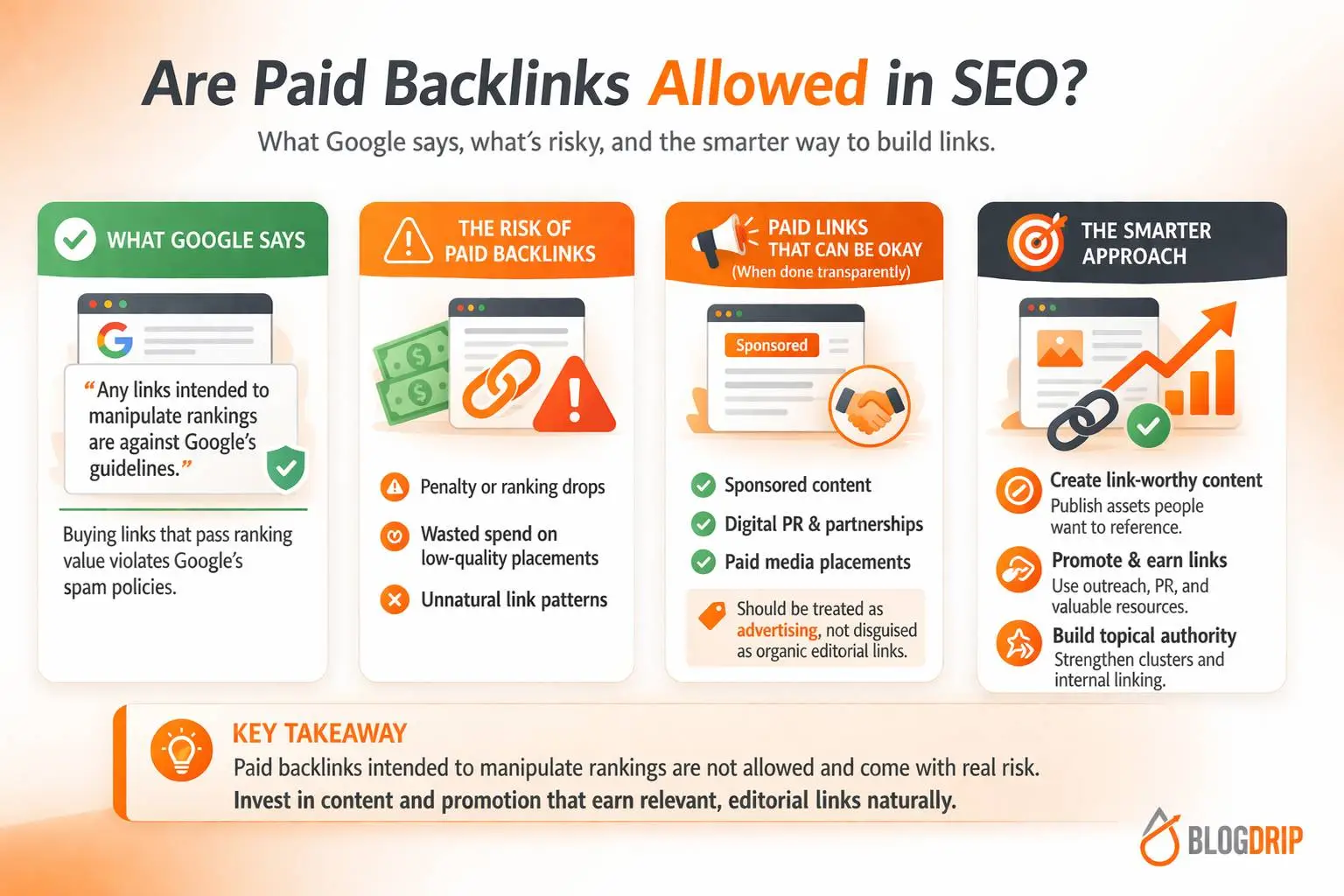
The most accurate answer is that paid backlinks SEO is not a simple yes-or-no topic. Paying for visibility, sponsorship, advertising, and digital PR placements can all be legitimate marketing activities. The problem begins when a paid link is intended to pass ranking value in a way that manipulates search results rather than serving a clear editorial or advertising purpose.
That distinction matters because many backlinks that involve money are not equal. Some are clearly advertisements or sponsorships and should be treated as such. Others are covert link placements designed mainly to influence rankings. Understanding that difference is essential for anyone trying to build authority without damaging long-term SEO performance.
For a website using a pillar-and-cluster model, this matters even more. Short-term link gains are rarely worth much if they undermine trust, weaken the backlink profile, or distract from building authority through stronger content, relevant outreach, and useful linkable assets.
What Are Paid Backlinks in SEO?
Paid backlinks are links acquired in exchange for money, products, services, discounts, or another form of compensation. In practical SEO terms, the key issue is not just whether payment happened, but why the link exists and how it is treated.
A backlink may involve payment in several ways:
- direct payment for a link insertion
- sponsored article placements
- paid guest posts
- niche edits purchased on existing pages
- affiliate or partnership arrangements
- product exchanges or compensation for coverage
Not all of these are automatically the same from an SEO perspective. A clearly disclosed sponsored placement that uses the correct link treatment is different from a hidden paid backlink placed specifically to manipulate rankings.
That is why the real question is not only “Was the link paid for?” but also:
- Is the placement editorially transparent?
- Is it intended as advertising or as ranking manipulation?
- Does the link use the appropriate attributes?
- Would the placement still make sense to a reader if SEO were removed from the equation?
Those questions matter because SEO risk comes less from the existence of payment alone and more from the attempt to disguise promotional links as organic editorial endorsements.
Why Paid Backlinks Matter in SEO
Paid backlinks matter because links remain one of the most important off-page SEO signals. When websites struggle to earn links naturally, buying them can look like an attractive shortcut.
They appear to offer faster authority gains
A site can spend months building content, pitching publishers, and earning mentions the hard way. Paid placements can seem faster because they reduce uncertainty. Instead of waiting for a link to be earned, someone simply buys access to an existing page or publication.
That perceived speed is one reason paid backlinks remain common in SEO discussions.
They introduce strategic and quality risks
The problem is that paid backlinks often prioritize acquisition over fit. A backlink might be purchased from a site that looks strong by metrics but is topically weak, editorially poor, or overloaded with sponsored placements.
A backlink profile built this way may look impressive at a glance but be strategically fragile underneath.
They can distort linkbuilding decisions
When a team relies too heavily on buying links, it often stops investing in the assets that actually deserve links. That weakens content strategy over time. Instead of creating useful guides, research, and resources that support topical authority, the site starts depending on placement buying to maintain visibility.
They affect long-term trust
SEO works best when authority compounds through relevance, usefulness, and credibility. Paid backlinks can interrupt that if they create patterns that look manufactured rather than earned. For serious websites, this is often the bigger issue than any single link itself.
Are Paid Backlinks Allowed?
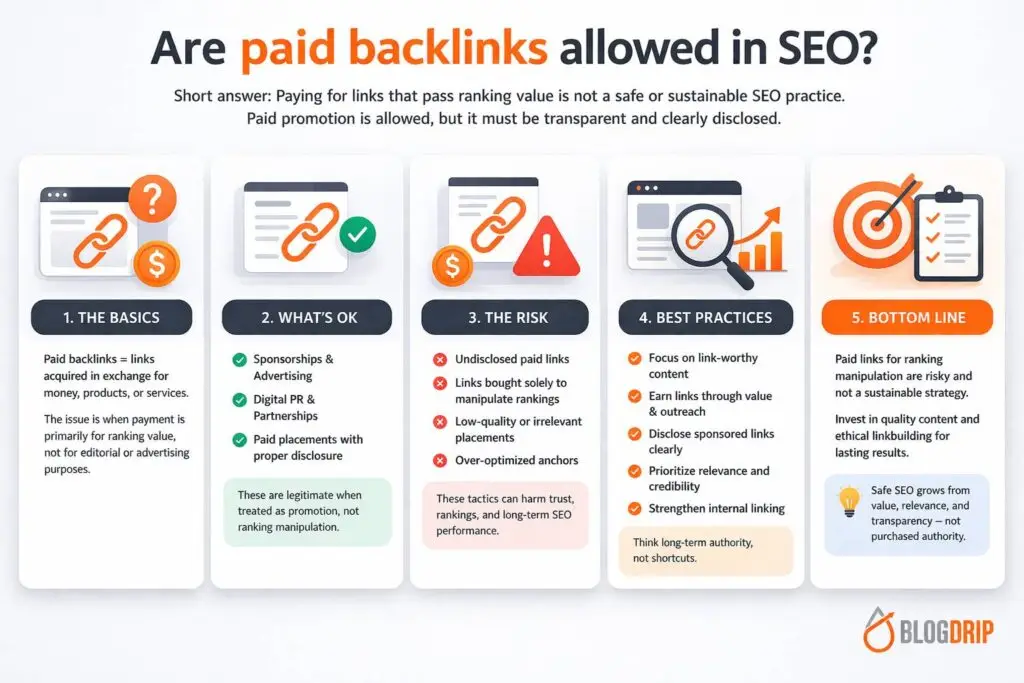
From a strategic SEO perspective, paid backlinks intended to pass ranking value are not a safe foundation for long-term organic growth.
The important distinction is between paid promotion and manipulative link acquisition.
Paid promotion can be legitimate
Businesses can absolutely pay for exposure. This includes:
- sponsorships
- digital PR campaigns
- paid media
- sponsored content
- influencer partnerships
- advertising placements
These are normal marketing activities. But when those links are promotional, they should be treated transparently and in a way that does not try to disguise them as organic editorial endorsements.
Hidden paid links create the real problem
The risky version of paid backlinks SEO is when money is exchanged specifically for a link that is meant to pass ranking authority while appearing natural.
This often includes:
- undisclosed link insertions
- paid guest posts published mainly for backlinks
- purchased niche edits on unrelated pages
- networks of sites selling contextual links
- “editorial placements” that are functionally just paid links
These tactics may produce short-term movement, but they are difficult to defend as a durable SEO strategy because they depend on manufactured signals rather than real editorial trust.
Why the distinction matters
A sponsored mention that exists for brand visibility is not the same as a backlink quietly bought for ranking manipulation. One is marketing. The other is an SEO shortcut that can weaken the overall quality of the backlink profile.
That is why the better question is not simply whether paid backlinks are “allowed,” but whether they fit a sustainable organic strategy.
How Paid Backlinks Work in Practice
Paid backlinks usually work because they place a site’s URL on a domain that already has some authority, topical relevance, or existing rankings. In theory, that can help pass value to the destination page.
But in practice, the results depend on more than payment.
The site quality still matters
A paid backlink from a weak site, irrelevant page, or network built primarily to sell links may add little meaningful value. In many cases, the websites selling links most aggressively are exactly the kinds of placements serious brands should avoid.
The page context matters
A contextual link inside a strong, relevant article looks more natural than a link dropped awkwardly into generic copy. But even contextual placement loses value when the surrounding content is thin, outdated, or clearly sponsored at scale.
The destination page matters
A strong backlink is more useful when it points to a page that deserves authority. A detailed resource, research asset, or useful guide is easier to justify than a thin sales page. This is another reason topical structure matters. External links work better when the destination page supports a broader cluster of relevant content.
The pattern matters more than one link
One paid placement does not define a site. But repeated reliance on paid backlinks can create patterns:
- over-optimized anchors
- repetitive placement types
- weak topical fit
- unnatural referring domain patterns
- clusters of links from sites that heavily sell placements
This is often where the strategic weakness becomes visible.
Important Subtopics Within Paid Backlinks SEO
Sponsored content
Sponsored content is paid content placement on another site. It can be legitimate as a brand or distribution tactic, especially when it is disclosed and treated clearly as promotion.
The issue is when sponsored content is used mainly as a cover for passing ranking value through links that are meant to look organic.
Niche edits and paid insertions
Many paid backlinks today are sold as niche edits or “contextual placements” inside existing articles. These can look appealing because the page may already be indexed and have authority.
But if the page is not genuinely relevant or the insertion feels forced, the link adds far less strategic value than it first appears.
Guest posting vs paid guest posting
Guest posting can be legitimate when it contributes real value to a relevant publication. Paid guest posting becomes riskier when the article exists mainly as a backlink vehicle rather than as useful content for readers.
This is one reason quality and editorial fit matter more than the label attached to the tactic.
Link attributes and transparency
Promotional links should be treated transparently. In a broader marketing sense, businesses can pay for coverage. But from an organic SEO perspective, the safest path is not to rely on purchased links as if they were earned editorial endorsements.
Common Mistakes With Paid Backlinks
Treating paid links as a core strategy
The biggest mistake is building an SEO plan around buying placements instead of earning authority. This often produces shallow off-page growth without strengthening the site itself.
Prioritizing metrics over relevance
A site may have appealing domain metrics but still be a poor link source. Topical fit, editorial quality, and trust matter more than surface numbers alone.
Buying links to weak pages
A paid backlink to a thin page usually produces limited strategic value. If the destination is not worth citing, the link is doing too much of the work.
Overusing exact-match anchor text
Paid placements often tempt teams to control anchor text aggressively. That creates repetitive patterns that weaken the naturalness of the backlink profile.
Ignoring broader site architecture
A backlink is more useful when it supports a well-structured content cluster. If the linked page sits in isolation, much of the potential value is wasted.
Substituting paid links for content quality
This is one of the most damaging mistakes. Paid links cannot fix weak content strategy, poor intent matching, or thin coverage of a topic. At best, they mask the underlying issue temporarily.
Practical Guidance for Approaching Paid Backlinks SEO
A realistic SEO strategy should focus less on whether you can buy links and more on whether doing so improves the long-term strength of the site.
Prioritize link-worthy content first
Strong guides, research assets, tools, and useful cluster pages create better authority-building opportunities than a site that depends mostly on purchased placements. This is the foundation of more sustainable linkbuilding.
Separate brand promotion from ranking manipulation
Paying for distribution, exposure, and partnerships can make sense. But those decisions should be made as marketing investments, not disguised as purely organic endorsements.
Invest in earning links through value
Content marketing, digital PR, guest contributions, broken link building, and resource-based outreach often take more effort, but they also build a healthier backlink profile over time.
Strengthen internal linking
When a strong page earns backlinks, internal linking helps distribute that authority across the wider cluster. This makes earned links more valuable than isolated placements.
Review every opportunity for relevance and credibility
Whether a placement is paid, sponsored, or earned, it should still be judged on the same fundamentals:
- Is the site credible?
- Is the page relevant?
- Does the placement make editorial sense?
- Does it support the wider topic strategy of the site?
Think in terms of risk-adjusted SEO
The real question is not whether a paid backlink might help temporarily. It is whether it is worth relying on compared with alternatives that build more durable authority.
Timing and Expectations
Paid backlinks sometimes attract attention because they seem faster than earned links. In some cases, they may appear to influence rankings more quickly than content-led linkbuilding alone.
But speed is not the same as durability.
Long-term SEO performance depends on whether the site continues to strengthen its authority through useful content, relevant coverage, internal structure, and credible external references. If paid backlinks become the main engine of growth, the strategy often becomes harder to sustain and easier to distort.
A more realistic expectation is that durable SEO authority usually comes from a mix of strong content, steady promotion, relevant mentions, and selective link acquisition rooted in value rather than dependency on purchased placements.
Conclusion
Paid backlinks SEO is not a question of simple permission. It is a question of strategy, intent, and long-term risk.
Businesses can legitimately pay for promotion, sponsorship, and visibility. But backlinks purchased mainly to manipulate rankings are a weak foundation for sustainable SEO. They often encourage shortcuts, reduce pressure to build better assets, and create backlink profiles that look manufactured rather than earned.
For a website building topical authority, the safer and stronger path is to focus on content that deserves links, promotion that increases visibility, and site architecture that makes every earned backlink more useful. That approach takes more work, but it produces authority that is far more likely to last.