
Why Keyword Research Matters in SEO
Keyword research matters because it tells you what your audience is actually searching for, how they search for it, and what type of content they expect to find. In SEO, that makes it one of the most important planning activities on any website.
Without keyword research, content decisions tend to be based on assumptions. Teams write pages around internal language, personal opinions, or broad ideas that feel relevant but are not aligned with real search demand. That often leads to wasted effort, weak rankings, and pages that never attract the right traffic.
For websites building authority through a pillar-and-cluster model, keyword research is even more important. It helps define which topics deserve a core pillar page, which questions should become supporting cluster content, and how those pages should connect internally. Your broader Keyword Research pillar page already establishes that strategic role across SEO planning. This page focuses on a narrower question: why keyword research is important in the first place.
What Does Keyword Research Actually Do?
At a practical level, keyword research shows you the language of demand.
It helps you understand:
- what people search for
- how specific or broad those searches are
- what intent sits behind those terms
- which topics fit your business and expertise
- where realistic SEO opportunities exist
That means keyword research is not just about finding phrases with search volume. It is about identifying the right subjects, assigning them to the right pages, and creating content that has a genuine reason to exist.
If you skip that process, SEO becomes reactive. You may still publish content, but it is far more likely to be disconnected from user intent and site structure.
Why Keyword Research Is Important
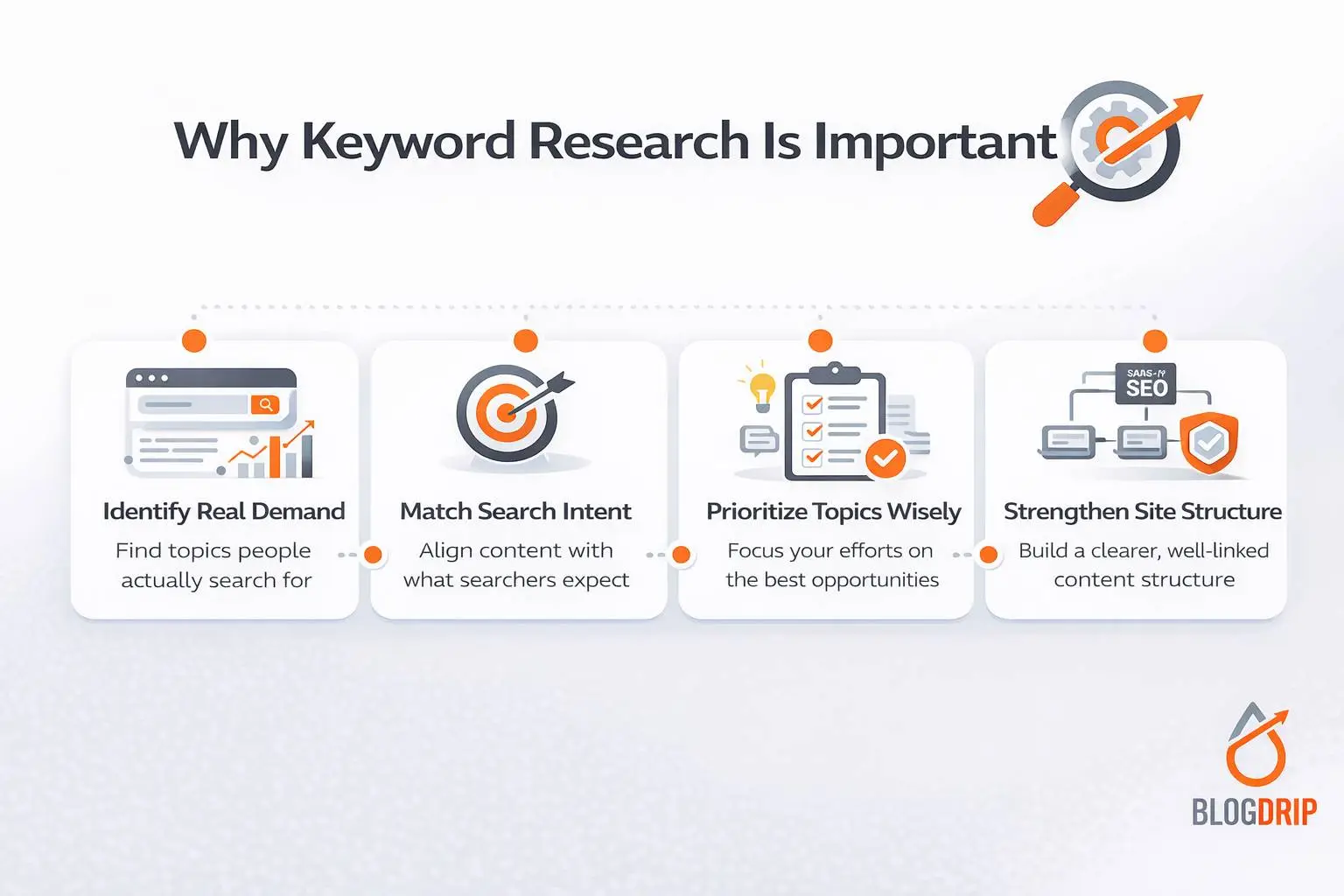
Keyword research matters because it improves the quality of nearly every major SEO decision. It affects content strategy, page targeting, site architecture, internal linking, and prioritization.
It connects your content to real search demand
The most obvious reason keyword research is important is that it shows whether there is actual demand for a topic.
Businesses often publish content around what they want to say rather than what users want to find. Those are not always the same thing. A page can be well written and still underperform if nobody is searching for the topic in that form.
Keyword research reduces that gap. It helps you identify subjects that already have an audience and shape content around the way that audience searches.
That does not mean every page must target a high-volume term. Lower-volume keywords can still be valuable when they are highly relevant, specific, or tied to clear intent. The point is not volume alone. The point is alignment.
It improves search intent matching
A keyword is not just a string of words. It reflects a goal.
Someone searching a broad educational query wants explanation. Someone searching a comparison term wants evaluation. Someone searching a service phrase may be much closer to taking action.
Keyword research helps you understand that difference before a page is created. That is one of the main reasons it matters so much. It prevents you from building the wrong type of content for the query.
When intent and format do not match, rankings usually suffer. A product page will struggle for a definition-based query. A blog article may struggle for a strongly commercial search. Good keyword research helps avoid that mismatch early.
It helps you choose the right topics to prioritize
Most websites have more ideas than resources. They cannot publish everything at once, so prioritization matters.
Keyword research helps decide which topics deserve immediate attention and which can wait. It gives structure to content planning by showing which themes are relevant, realistic, and strategically useful.
This is especially important when building content clusters. A website should not publish random articles simply because they sound related to SEO. It should build around clearly defined topic relationships, where a pillar page covers the broad subject and cluster pages answer narrower supporting questions.
It reduces wasted SEO effort
A surprising amount of SEO underperformance comes from content that never had a strong opportunity to begin with.
Sometimes the topic has little search demand. Sometimes the page targets the wrong intent. Sometimes several articles compete for the same keyword. Sometimes the site tries to rank for terms that are too competitive for its current authority.
Keyword research does not remove all risk, but it helps you avoid obvious mistakes. That makes your content process more efficient and your SEO strategy more disciplined.
It strengthens site architecture and internal linking
Keyword research is important not only for choosing keywords, but also for deciding where topics should live on the site.
When research is done properly, it supports:
- clearer page roles
- better keyword mapping
- stronger internal linking
- more logical content clusters
- less duplication across articles
That matters because search engines do not evaluate pages in isolation alone. They also interpret how pages relate to one another. A well-structured site with strong topical connections is easier to crawl, easier to understand, and often easier to grow over time.
Why Keyword Research Matters Beyond Rankings
It is easy to think about keyword research only in terms of rankings, but its value is broader than that.
It improves content quality
When you know what people are asking, you can produce content that is more focused and more useful.
Instead of writing vague, broad articles, you can answer specific needs with clearer structure and sharper relevance. That often improves not only rankings but also engagement, because the content feels more aligned with what the reader expected to find.
It supports better business relevance
Traffic alone is not the goal. Relevant traffic is.
Keyword research helps you choose topics that connect to your expertise, your services, your products, or your audience’s real problems. That makes your SEO work more commercially useful, even when the page itself has informational intent.
A strong informational cluster page may not convert directly, but it can attract qualified users, reinforce trust, and guide readers toward related content deeper in the funnel.
It helps build topical authority over time
A site gains authority on a subject by covering it with consistency and depth. Keyword research helps define the edges of that coverage.
For example, if your site is building around Keyword Research, you do not want only one broad page. You want supporting content that covers definitions, importance, process, intent, clustering, and mapping in a structured way. Your pillar page frames the full topic, while cluster pages like this one help expand depth without creating redundancy.
That layered coverage is one of the clearest reasons keyword research is important. It helps transform SEO content from isolated publishing into strategic topic development.
Common Mistakes That Show Why Keyword Research Matters
The easiest way to understand the importance of keyword research is to look at what happens when it is ignored.
Creating content based on assumptions
Many businesses assume they know how their audience searches. Often, they do not. Internal terminology and customer language are frequently different.
Keyword research helps bridge that gap.
Targeting broad terms without a plan
Broad head terms may look attractive, but they are not always the best place to start. Without research, teams often chase difficult keywords that are too competitive or too vague.
A better strategy often starts with clearer, more focused queries.
Publishing overlapping pages
Without keyword research and mapping, websites often create multiple pages aimed at the same intent. That leads to cannibalization, diluted signals, and unclear internal structure.
Ignoring intent altogether
A page can target the right words and still fail if it answers the wrong question. Keyword research matters because it brings the “why behind the search” into the planning process.
How to Use Keyword Research More Effectively
If you want keyword research to produce better SEO results, treat it as a strategic process rather than a tool report.
Start with the topic and the audience. Then review how people search, what the search results look like, and which page type makes sense. Group related keywords where appropriate instead of creating a separate page for every variation.
For cluster content, keep each page tightly focused. This page, for example, answers why keyword research is important. It should support broader pages on Keyword Research without repeating everything they cover. That separation strengthens the cluster and gives each page a distinct role.
A strong process usually includes:
- identifying core topics
- reviewing search intent
- evaluating competition realistically
- grouping related terms
- mapping topics to the correct pages
- connecting them through internal links
This is where keyword research becomes more than research. It becomes planning.
Timing and Expectations
Keyword research improves strategy immediately, but SEO outcomes still take time.
Its value often shows up first in better decisions: better topics, clearer content briefs, stronger page structure, and fewer wasted articles. Rankings and traffic gains come later through execution.
For established sites, better keyword targeting can improve performance relatively quickly when it leads to page consolidation, improved intent matching, or stronger internal linking. For newer sites, the benefits are still real, but they usually take longer to show because authority must be built gradually.
That is why keyword research should be viewed as a foundation rather than a shortcut. It improves the quality of SEO work, and better work tends to perform better over time.
Conclusion
Why keyword research?
Because it is the process that turns SEO from guesswork into strategy.
It helps you understand what people search for, what they mean when they search, and what your website should publish in response. It improves relevance, supports intent matching, guides content priorities, strengthens site architecture, and reduces wasted effort.
For a website using a pillar-and-cluster model, keyword research is not just helpful. It is structural. It helps every page serve a clearer purpose and makes the wider content strategy more coherent.
That is the real reason keyword research matters: it gives your SEO direction before you invest time in content, not after.