
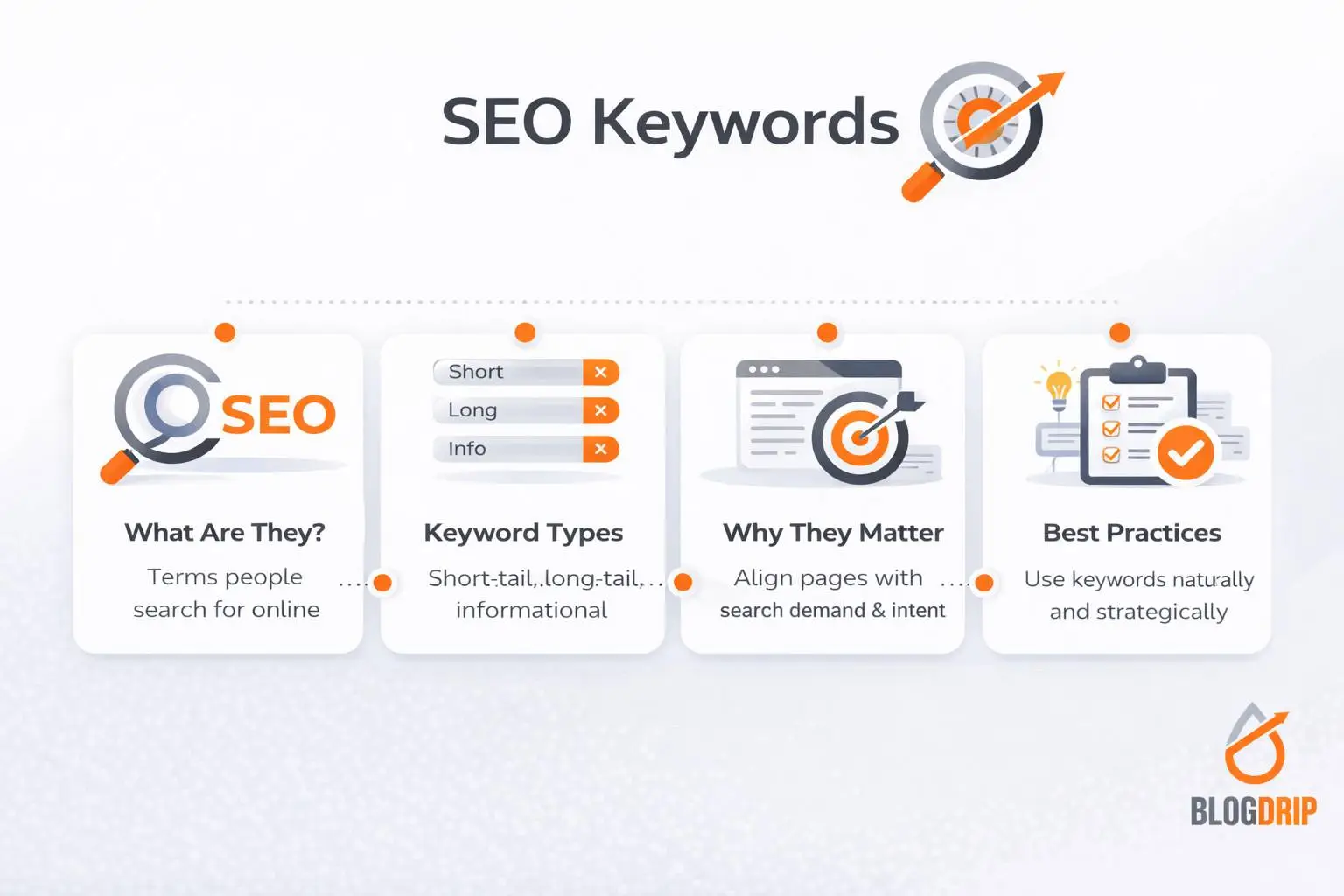
SEO Keywords: What They Are and How They Work
SEO keywords are the words, phrases, and search queries people use in search engines when looking for information, products, services, or solutions. In SEO, those keywords help define what a page is about and which searches it may be able to rank for.
That basic definition is useful, but it is not enough on its own. In practice, SEO keywords are not just terms to place on a page. They are signals of intent, topic relevance, and demand. They help shape content strategy, page structure, internal linking, and the broader site architecture.
For websites building topical authority, understanding SEO keywords is essential. A pillar page on Keyword Research explains the wider strategy behind discovering and evaluating opportunities. This page takes a narrower approach. It focuses specifically on what SEO keywords are, how they function within search optimization, and how to use them properly without falling into outdated habits. Your broader Keyword Research guide already frames how keywords fit into a larger SEO system. This page is designed to clarify the concept itself in a more focused way.
What Are SEO Keywords?
SEO keywords are the terms that connect a searcher’s query to the content on your website.
If someone searches for “SEO keywords,” “how to find keywords for SEO,” or “what are keywords in SEO,” search engines analyze those terms and look for pages that seem most relevant and useful. The keywords on a page, along with many other signals, help search engines understand whether that page is a good match.
In practical terms, SEO keywords help answer three questions:
- What topic is this page about?
- What type of search intent does it satisfy?
- How does it fit into the wider content structure of the site?
A keyword can be a single word, but more often it is a phrase. In modern SEO, keyword targeting is usually topic-driven rather than based on one exact phrase repeated over and over.
That distinction matters. Search engines have become much better at understanding context, related language, and meaning. So while keywords still matter, the goal is no longer to place the same phrase mechanically throughout a page. The goal is to create content that clearly addresses the topic and aligns with how people search for it.
Why SEO Keywords Matter
SEO keywords matter because they help align your website with real search behavior.
Without a clear understanding of keywords, content can become vague, misaligned, or disconnected from what users actually want. A page may be well written, but if it does not reflect the language and intent of the audience, it will often struggle to perform in search.
They connect your pages to user intent
Every keyword reflects some kind of need. The user may want information, comparison, navigation, or a direct transaction.
For example, a query like “what are SEO keywords” shows informational intent. The user wants a clear explanation. A query like “SEO keyword tool” may suggest commercial intent because the user is looking for software options. A query like “buy SEO services” points further down the decision path.
Understanding keywords helps you match the page to that intent. That is one of the main reasons keywords still matter so much in SEO.
They shape page targeting
A page without a clear keyword focus often lacks direction. It may cover too many ideas at once, miss the main search intent, or compete with another page on the same site.
SEO keywords help define what a page should target, what related terms it should include, and how narrowly or broadly it should be structured.
They support topical authority
In a pillar-and-cluster model, keywords are part of how topic relationships are built.
A broad pillar page may target a high-level concept like Keyword Research, while cluster pages target narrower queries such as what keyword research is, why it matters, or how to identify SEO keywords. That structure helps search engines understand the depth of the site’s coverage and makes internal linking more meaningful.
How SEO Keywords Work
SEO keywords work by helping search engines interpret relevance.
They are not the only factor in rankings, and they have not worked in a simplistic way for years. But they still play a foundational role in how a page communicates its subject matter.
Search engines use them to understand page topics
When search engines crawl a page, they assess titles, headings, body copy, internal links, metadata, and overall context. Keywords help indicate what the page is about, especially when they appear naturally in prominent and relevant places.
This does not mean repetition is the goal. It means clarity is the goal.
A page targeting “SEO keywords” should clearly discuss SEO keywords, related concepts, and the practical meaning of the term. If the content wanders or relies on vague wording, the topical signal becomes weaker.
They help match queries to pages
Search engines compare the wording and meaning of a user’s search with the wording and meaning on available pages. This includes not only exact matches, but related terms, semantic relevance, and the overall usefulness of the content.
That is why modern keyword optimization is broader than placing one phrase in the title and a few headings. Good pages also include supporting language, subtopics, and context that help reinforce relevance naturally.
They guide content planning
SEO keywords are not only for on-page optimization. They are also used earlier in the process to decide what content should exist at all.
When you know what people search for, you can make better decisions about which topics deserve a page, which terms belong together, and which searches should be handled by a pillar page versus a supporting article.
Important Types of SEO Keywords
Not all keywords serve the same purpose. Understanding the main keyword types helps with both planning and execution.
Short-tail keywords
Short-tail keywords are broad, high-level search terms, often one or two words long. An example would be “SEO keywords.”
These can have significant search demand, but they are often competitive and sometimes ambiguous. A broad keyword may be useful for a pillar page or a higher-level educational article, but it usually needs strong supporting content around it.
Long-tail keywords
Long-tail keywords are more specific phrases, such as “what are SEO keywords in digital marketing” or “how to use SEO keywords on a website.”
These terms often have lower search volume, but they usually show clearer intent and can be easier to target effectively. In a content cluster, long-tail keywords often make strong cluster-page opportunities.
Informational keywords
Informational keywords reflect a desire to learn or understand something. Queries starting with what, why, how, when, or best are often informational, though not always.
This page targets an informational keyword because the user is clearly looking for an explanation.
Commercial and transactional keywords
Commercial keywords suggest evaluation or comparison, while transactional keywords indicate stronger intent to act or buy.
These matter because they require different page types. Informational keywords belong on educational content. Commercial and transactional keywords often belong on service pages, product pages, or comparison content.
Common Mistakes With SEO Keywords
A lot of SEO confusion comes from outdated keyword practices. The term “SEO keywords” is still widely used, but many people apply old ideas to a modern search environment.
Keyword stuffing
Keyword stuffing is the repeated, unnatural use of a term in an attempt to influence rankings. It weakens readability, undermines trust, and often makes the content feel dated.
A page should use its primary keyword clearly, but naturally and only where it genuinely helps.
Treating every keyword variation as a separate page
Not every related query needs its own article. If several terms share the same intent and can be answered well on one page, separating them may create thin content and cannibalization.
This is where keyword clustering matters. Related terms often belong together.
Ignoring search intent
A keyword is not just a phrase. It reflects what the searcher wants. Pages that target keywords without considering intent often fail even when the wording seems relevant.
Optimizing for tools instead of users
Keyword tools are useful for discovery and prioritization, but they should not dictate unnatural writing. Content still needs to read clearly, solve the user’s problem, and reflect real expertise.
Practical Guidance for Using SEO Keywords Well
The best way to use SEO keywords is to treat them as strategic direction, not mechanical instructions.
Start by identifying the main topic of the page and the primary search intent. Then use the main keyword where it strengthens clarity, such as in the title, key headings, introduction, and relevant body copy. After that, support it with semantically related language and subtopics rather than forced repetition.
For example, a page targeting “SEO keywords” can also naturally include related language such as search queries, keyword targeting, search intent, keyword mapping, and content relevance. That helps build topic depth without over-optimizing.
It is also important to think about where the page sits in the wider site structure. A page about SEO keywords should support broader keyword research content, while also linking naturally to related cluster topics like search intent, long-tail keywords, and keyword clustering where relevant.
This is where keyword use becomes stronger. It is not just about one page ranking for one term. It is about building a connected topic structure that search engines and users can both follow.
Timing and Expectations
Using SEO keywords properly improves clarity and targeting immediately, but rankings still take time.
A page with better keyword alignment has a stronger foundation because it is more likely to match demand and intent. But performance still depends on content quality, internal linking, competition, technical SEO, and overall site authority.
That is why keyword use should be seen as part of a larger process. Strong keyword targeting improves your odds, but it does not replace the need for better content and better structure.
Conclusion
SEO keywords are the search terms and phrases that help connect user queries to the right pages. They matter because they shape relevance, support intent matching, and guide both content planning and on-page optimization.
But their real value is not in repetition. It is in clarity.
Used well, SEO keywords help you create pages that reflect what people actually search for, fit into a stronger topic structure, and serve a clear purpose within your wider SEO strategy. For a site building authority through a pillar-and-cluster model, that makes them more than a technical detail. They become part of the foundation of how the site grows.