
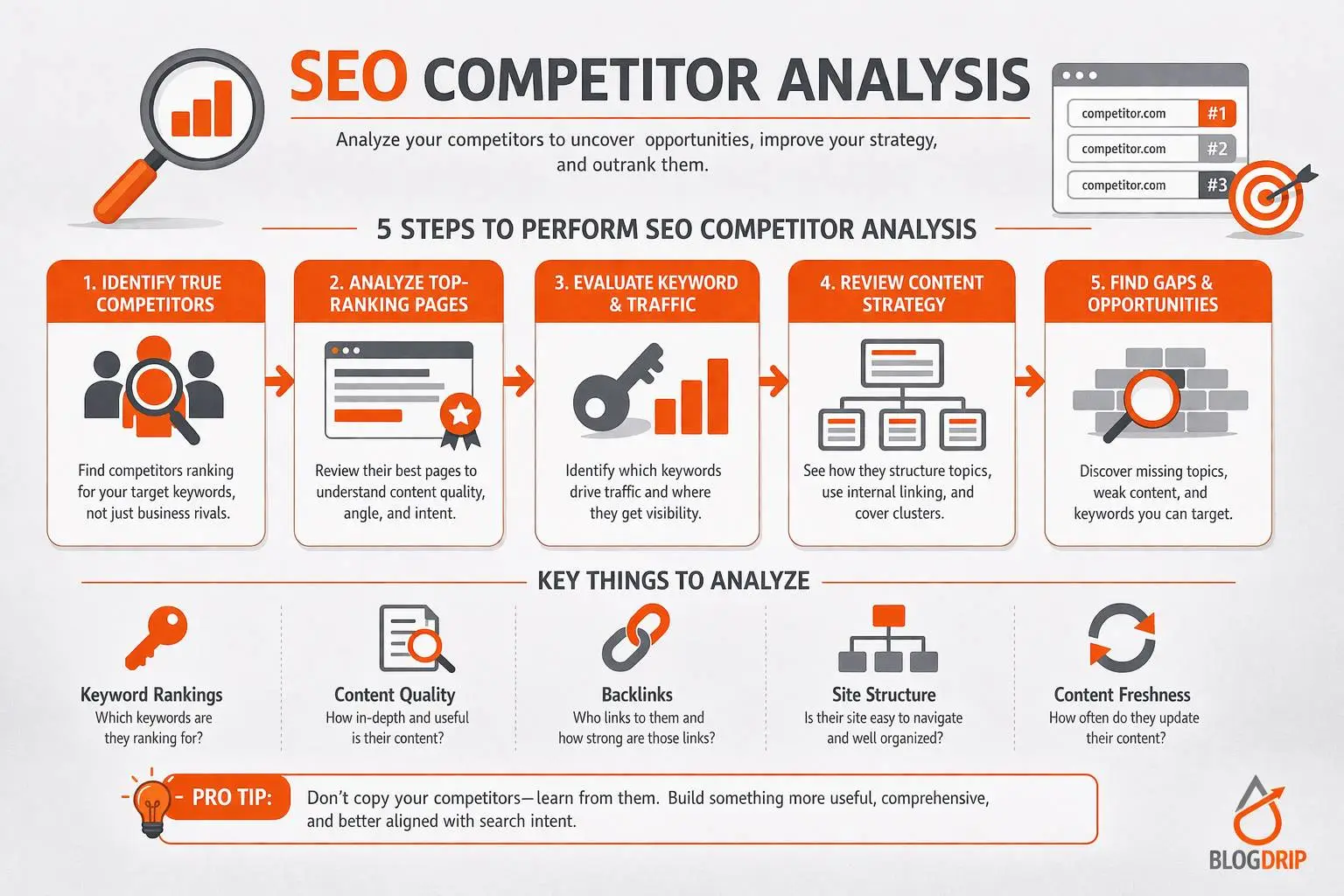
SEO Competitor Analysis: How to Learn From Competitors Without Copying Them
SEO competitor analysis is the process of reviewing competing websites and pages to understand how they earn visibility, which topics they rank for, where their content is strong or weak, and what opportunities exist for your own site. It is a practical part of keyword research and content planning because it helps you assess the search landscape before deciding what to create.
A lot of teams approach competitor analysis too casually. They glance at a few rankings, note which domains appear often, and assume they understand the market. That usually leads to shallow conclusions. Strong SEO competitor analysis is not about watching competitors out of curiosity. It is about identifying patterns, gaps, expectations, and realistic openings that can improve your own strategy.
For a website building topical authority through a pillar-and-cluster model, this matters even more. Competitor analysis helps you see how other sites structure topic coverage, where they have strong cluster depth, and where their content leaves room for something more useful or better organized. Your broader Keyword Research guide already explains that competitor analysis helps uncover gaps, patterns, and opportunities within the search landscape. This page focuses specifically on how SEO competitor analysis works and how to use it strategically.
What Is SEO Competitor Analysis?
SEO competitor analysis is the process of evaluating competing sites, pages, and search results to understand how they perform in organic search and what that means for your own content strategy.
In practical terms, it helps answer questions like these:
- Which websites consistently rank for the topics we care about?
- What keywords and subtopics do they cover?
- How strong are their pillar pages and supporting cluster pages?
- What kind of search intent are they satisfying?
- Where are they strong?
- Where are they weak, outdated, or incomplete?
- What opportunities exist for our site to create something better or more focused?
This is important because competitor analysis is not only about who ranks. It is also about why they rank.
A competitor in SEO is not always the same as a business competitor. Sometimes the sites competing with you in search are publishers, software companies, directories, media sites, or niche blogs rather than direct commercial rivals. That distinction matters because SEO competitor analysis is based on the search results, not just on market perception.
Why SEO Competitor Analysis Matters
SEO competitor analysis matters because it helps turn keyword research into more realistic decisions.
Without it, content planning often becomes disconnected from the actual result landscape. Teams target keywords without understanding the strength of existing pages, the type of content Google already rewards, or the level of topical depth expected in that space.
It reveals the competitive standard
One of the clearest benefits of competitor analysis is that it shows you what “good enough to rank” currently looks like.
That includes:
- content depth
- page structure
- intent match
- topical completeness
- supporting internal links
- content freshness
You do not need to imitate competitors directly, but you do need to understand the quality threshold you are trying to exceed.
It exposes content gaps
Competitor analysis helps reveal where coverage is incomplete.
A competing site may rank because it has authority, but the page itself may still be shallow, outdated, overly generic, or weakly structured. Those are often the most useful opportunities, because they create room for a more helpful asset.
It improves keyword prioritization
Not every keyword deserves the same level of effort. Competitor analysis helps you decide which opportunities are realistic now, which may require more authority, and which topics are better pursued through focused cluster pages rather than broad head terms.
It supports stronger topical strategy
When you analyze how competitors cover a subject across multiple pages, you get a clearer picture of how the topic is structured in search.
That is especially useful for pillar-and-cluster planning. You can see whether competitors rely on one broad guide, several smaller supporting articles, or a more complete topic network.
How SEO Competitor Analysis Works
A strong SEO competitor analysis process is structured. It is not just browsing competitor blogs.
Start with the search results, not assumptions
The first step is to identify your real SEO competitors by reviewing the search results for your target topics.
This matters because the domains competing with you in search may be different from the companies you think of as competitors commercially. If they rank where you want to rank, they are part of the SEO landscape you need to study.
Look for domains that appear repeatedly across your core topic areas and supporting keywords.
Identify competing pages, not just domains
It is not enough to analyze websites at a high level. Rankings happen at the page level.
For each target topic, review the actual pages that rank and assess:
- the topic angle
- the depth of coverage
- the content format
- the search intent match
- the clarity of the page structure
- the subtopics included
A strong domain may rank with a mediocre page. A smaller site may rank because its page is tightly aligned with the query. These differences matter.
Evaluate content quality and intent alignment
Once you identify ranking pages, ask what makes them competitive.
Look at whether the pages:
- answer the core query clearly
- cover relevant supporting subtopics
- match the dominant search intent
- reflect beginner or advanced expectations
- feel current and well maintained
- provide clear structure and usability
This is where competitor analysis becomes more useful than a simple rank check. You are assessing the reasons a page succeeds, not just the fact that it does.
Compare topical coverage across the cluster
A single strong article is not the whole picture. For cluster-driven SEO, you also need to look at how competitors cover the wider topic.
Ask:
- Do they have a pillar page on the main concept?
- What supporting pages sit beneath it?
- Which cluster topics are missing?
- Are there overlaps or weak internal distinctions?
- Does their content architecture feel deliberate or scattered?
This often reveals opportunities that are less obvious at the keyword level alone.
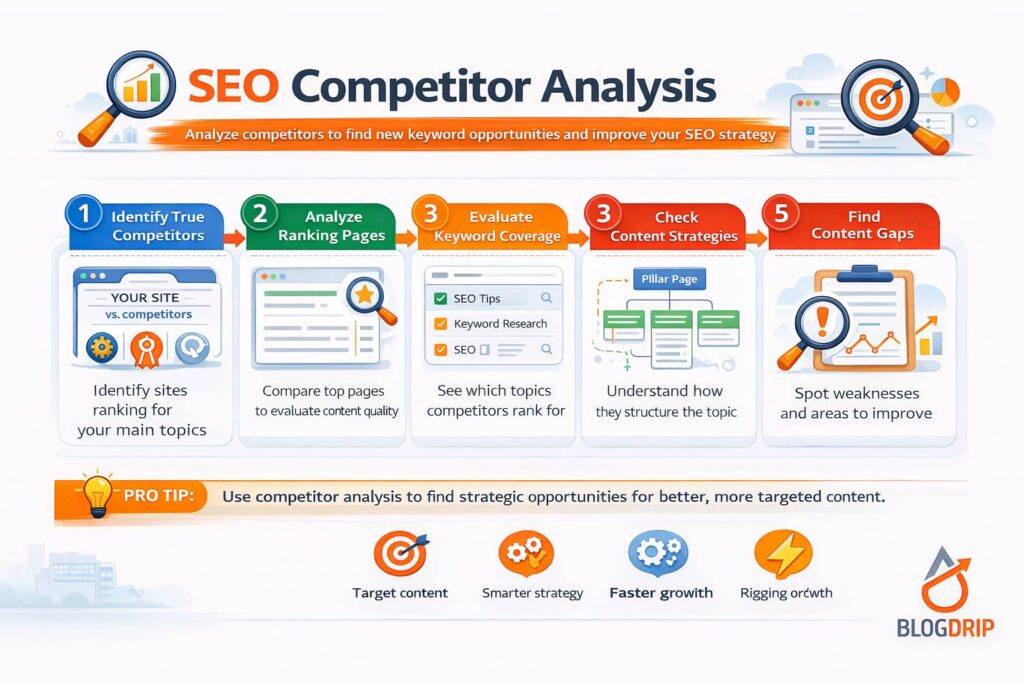
Important Areas to Review in SEO Competitor Analysis
A useful competitor analysis should cover more than rankings.
Keyword coverage
Review which topics and subtopics competitors appear to own. Look at both broad themes and supporting informational searches.
This can help identify missing pages on your site or confirm where a topic deserves more depth.
Search intent and page type
Check whether ranking competitors are using guides, definitions, comparison pages, tools, service pages, or product-led assets.
This helps clarify what kind of page Google expects for the query.
Content depth and structure
Review how complete the page feels.
Does it answer the topic thoroughly? Does it use clear headings? Does it cover important subtopics logically? Is it practical, generic, or overly surface-level?
Internal linking and topic relationships
A site’s internal linking often reveals how seriously it treats a topic.
If competitors connect relevant pages well, that can reinforce topical authority. If they do not, there may be an opportunity for your site to build a clearer cluster structure.
Freshness and maintenance
Some competitors rank with outdated pages simply because there is no stronger alternative yet. These can be strong opportunities if the topic still matters but the current results feel old or incomplete.
Common Mistakes in SEO Competitor Analysis
Competitor analysis often becomes ineffective when teams use it too narrowly.
Copying instead of learning
The goal is not to recreate a competitor’s content. The goal is to understand what the market is rewarding and where your site can be more useful, clearer, or better structured.
Focusing only on the top result
The first result matters, but so does the wider result page. Patterns across multiple rankings usually tell you more than one outlier.
Ignoring intent
A page may look impressive, but if you do not understand the intent it satisfies, the analysis stays shallow. Intent is one of the most important parts of why a page ranks.
Looking only at domains, not pages
Domain authority matters, but rankings happen page by page. Page-level analysis often reveals weaknesses that domain-level assumptions miss.
Treating competitor data as static
Competitor analysis is not one-and-done. Rankings shift, pages get updated, and new content appears. It should be revisited regularly, especially in competitive topic areas.
Practical Guidance for Better SEO Competitor Analysis
A practical SEO competitor analysis process should support action, not just observation.
Start with a core topic and review the search results for that topic and its key supporting queries. Identify which domains appear often, then study the ranking pages more closely. Look at what they cover, what they leave out, and how clearly they satisfy the search intent.
From there, decide:
- which topics you can compete on now
- which content gaps are worth targeting
- whether a broad or narrow page is the better fit
- which related subtopics deserve their own cluster pages
- where your internal linking and site structure can be stronger
This is especially useful in a pillar-and-cluster model because competitor analysis helps define not just what to write, but how to structure topic coverage. A competitor may rank for the pillar term while leaving cluster topics weak. In that case, your opportunity may be to build a better-supported topical network rather than trying to win only the head term immediately.
It is also worth comparing competitors against your own site honestly. Sometimes the gap is not just that they have more content. It is that their content is mapped more clearly, aligned more tightly with intent, or supported more effectively by internal links.
Timing and Expectations
SEO competitor analysis improves strategy quickly, but the results from acting on it still take time.
Its first value usually appears in better prioritization, sharper briefs, clearer page roles, and stronger content planning. Ranking gains come later through execution, internal linking, and overall site quality.
For established sites, competitor-driven improvements can lead to relatively fast gains when they reveal outdated competing pages, weak intent alignment in the SERP, or obvious content gaps. For newer sites, the benefits are still significant, but they often build more gradually as topic coverage and authority improve.
Competitor analysis does not replace content quality. It helps direct it more intelligently.
Conclusion
SEO competitor analysis is the process of studying the pages and domains competing for your target keywords so you can understand the search landscape more clearly.
It matters because it reveals what the current result page rewards, where competitors are strong, where they are vulnerable, and how your own site can compete more strategically. Done well, it improves keyword prioritization, content planning, topic clustering, and internal structure.
For a website building authority through a pillar-and-cluster model, SEO competitor analysis is not just a research exercise. It is part of how you decide where to compete, how to structure your content, and what kind of page has the best chance to earn visibility.