
Keyword Research Tools: What They Do and How to Use Them Strategically
Keyword research tools help you discover how people search, evaluate keyword opportunities, and organize SEO decisions more effectively. They are essential to modern search strategy, but they are often misunderstood. Many teams treat them as automatic answer engines, when in reality they are better understood as decision-support tools.
That difference matters. A keyword tool can show you search terms, volume estimates, related queries, and sometimes keyword difficulty or SERP insights. What it cannot do on its own is decide which keyword is worth targeting, whether the search intent fits your page, or how that opportunity should support your wider site architecture.
For websites building authority through a pillar-and-cluster model, keyword research tools are useful because they help surface topics, supporting questions, long-tail opportunities, and competitive gaps. But they only become truly valuable when their data is interpreted strategically. Your broader Keyword Research guide already explains how keyword discovery connects to search intent, clustering, and mapping. This page focuses more specifically on keyword research tools, what they are, why they matter, and how to use them well.
What Are Keyword Research Tools?
Keyword research tools are SEO platforms or software features that help you identify search terms, estimate demand, review related queries, and assess the search landscape around a topic.
In practical terms, they help answer questions like these:
- What keywords do people search for around this topic?
- How broad or specific is the demand?
- What related questions should be considered?
- Which terms are more competitive than others?
- What pages currently rank for these queries?
- How should these keywords be grouped into content clusters?
A good keyword research tool does not replace SEO judgment. It gives you more visibility into the market so you can make better decisions.
That is why the best use of keyword research tools is not simply exporting lists. It is using the data to support topic planning, intent analysis, keyword mapping, and content prioritization.
Why Keyword Research Tools Matter
Keyword research tools matter because they make search demand visible.
Without them, SEO teams are often working from instinct, internal language, or limited anecdotal knowledge. That can still produce useful ideas, but it usually misses how people actually search and which opportunities are already present in the market.
They reveal search demand
One of the clearest benefits of keyword research tools is that they help you see which topics, questions, and phrases people are actively searching for.
This is especially useful when planning new content. Instead of guessing which subtopics belong in a cluster, you can identify the broader theme and then expand it into real search variations.
They improve topic coverage
A strong topic cluster is rarely built from a single keyword. It is built from a main topic plus related questions, subtopics, modifiers, and supporting concepts.
Keyword research tools help uncover those layers. That can lead to stronger pillar pages, better cluster articles, and more comprehensive internal linking.
They support better prioritization
Not every keyword deserves the same level of investment. Some keywords are more relevant, more realistic, or more strategically useful than others.
Keyword research tools help provide signals around search volume, related demand, and competitive patterns. These signals are useful when deciding what to tackle first.
They help identify gaps and opportunities
Tools can also reveal where competitors have visibility and where your site may have content gaps.
This is not about copying competitors mechanically. It is about understanding the search landscape so you can choose opportunities where your content can be more useful, more focused, or better structured.
How Keyword Research Tools Work
Keyword research tools work by collecting and organizing search-related data into a format that helps marketers interpret demand and opportunity.
Different tools vary in methodology, interface, and depth, but most offer several core functions.
Keyword discovery
Most keyword research tools allow you to enter a broad topic or seed term and generate related keyword ideas.
These may include:
- close variations
- question-based queries
- longer-tail phrases
- semantically related searches
- terms competitors rank for
This helps expand a topic from one broad phrase into a set of possible targets and subtopics.
Search volume estimates
Many tools provide estimated search volume, often on a monthly basis.
This can help indicate relative demand, but it should be treated as directional rather than exact. Volume is useful for prioritization, but not enough to make a keyword decision on its own.
Difficulty or competition signals
Many tools provide a keyword difficulty estimate or some form of ranking competitiveness score.
These metrics can be helpful, but they should never replace actual SERP review. A difficulty number can guide you, but the current ranking pages often tell you more about the real challenge.
SERP analysis
Some tools provide snapshots of the pages currently ranking for a keyword. This can help you evaluate intent, content format, and competitive strength.
For practical SEO work, this is often one of the most useful parts of a keyword tool because it connects raw keyword data to real search results.
Clustering and organization
More advanced tools help group related keywords into clusters or organize them into content plans.
This is especially useful for sites following a pillar-and-cluster structure, where the goal is not simply to target individual keywords, but to build coherent topic coverage.
Important Types of Keyword Research Tools
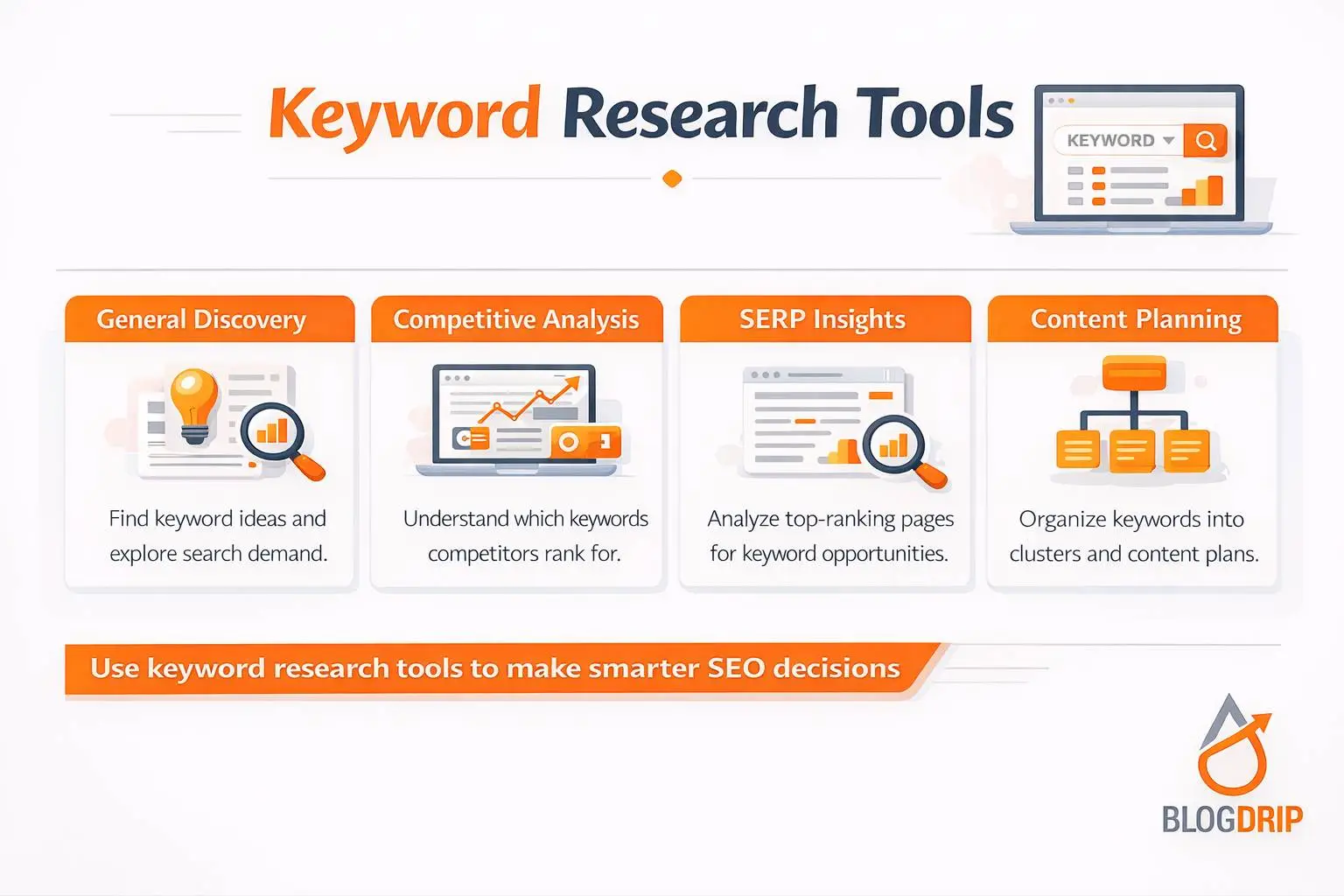
Not all keyword research tools serve the same purpose. Some are better for discovery, while others are stronger for competitive analysis or content planning.
General keyword discovery tools
These are typically used to generate keyword ideas, explore search demand, and review related phrases.
They are useful early in the process when you are defining topic scope and looking for supporting subtopics.
Competitive research tools
These tools help you understand which keywords competitors rank for, where they have coverage, and where topic gaps may exist.
They are especially useful when you want to understand how mature the search landscape is around a subject.
SERP-focused tools
Some tools emphasize ranking-page analysis and live search result interpretation.
These are valuable when deciding whether a keyword is realistically targetable and whether the intent fits the page you plan to create.
Content planning and clustering tools
Some platforms focus more on grouping terms, organizing clusters, and supporting content workflows.
These can be especially helpful for larger websites, content teams, or anyone building structured topical authority rather than isolated articles.
Common Mistakes When Using Keyword Research Tools
Keyword research tools are useful, but they often create bad decisions when used too mechanically.
Treating the tool as the strategy
A tool can provide data, but it cannot define your goals, your site architecture, or your editorial priorities. That part still requires judgment.
Overvaluing search volume
High volume often attracts attention, but it can be misleading when the keyword is vague, highly competitive, or poorly aligned with user intent.
A lower-volume keyword with clear intent and stronger relevance may be the better opportunity.
Relying too heavily on difficulty scores
Difficulty metrics can be helpful, but they are simplifications. They do not always reflect the true quality of the ranking pages or whether your site can compete with a better-focused asset.
Ignoring search intent
A keyword may look promising in a tool, but if the live results show a different intent from the page you plan to create, the opportunity may not be as strong as it appears.
Exporting too much data without structure
Many teams collect thousands of keywords and still make poor decisions because the data is not grouped, prioritized, or mapped to real pages.
This is where keyword clustering and mapping become essential. Research only becomes useful when it supports structure.
How to Use Keyword Research Tools Strategically
The best way to use keyword research tools is to treat them as inputs into a larger SEO process.
Start with your core topics, not random keywords. Use the tool to expand those topics into related phrases, supporting questions, and narrower long-tail opportunities. Then evaluate the results through a strategic lens.
That usually means asking:
- Is this keyword relevant to our audience?
- What intent does it reflect?
- Does it belong on a pillar page or a cluster page?
- Is the competition realistic for our site?
- Should this become a new page, strengthen an existing page, or be grouped into a larger cluster?
This is where keyword research tools become far more valuable. They move from being data sources to planning aids.
For a site using a pillar-and-cluster structure, this approach is especially important. A broad term may support a pillar page, while related informational questions, process terms, and long-tail phrases help define the supporting cluster. That creates a more durable SEO strategy than publishing disconnected pages around whatever the tool surfaces first.
Choosing the Right Keyword Research Tool
The right tool depends on the job you need it to do.
If your goal is early-stage discovery, you may prioritize broad idea generation and related phrase depth. If your goal is competitive analysis, you may need stronger visibility into competitor rankings and gaps. If your workflow depends on organizing clusters and content plans, then grouping and mapping features may matter more.
In practice, most serious SEO workflows do not rely on one metric or one screen. The value comes from combining tool data with live SERP review and strategic interpretation.
That is why choosing a keyword research tool should be based less on feature lists and more on how well it supports your actual SEO process.
Timing and Expectations
Keyword research tools can improve clarity immediately, but they do not produce rankings by themselves.
Their value usually appears first in better planning: better topics, sharper targeting, stronger content briefs, cleaner cluster structure, and fewer wasted pages. Ranking improvements come later through the quality of the pages created from those decisions.
For established sites, better tool use can lead to faster gains when it supports content consolidation, stronger internal linking, or improved topic coverage. For newer sites, keyword research tools are still highly useful, but they are most effective when paired with realistic keyword choices and focused content execution.
A tool can speed up understanding. It cannot replace strategy.
Conclusion
Keyword research tools help you discover how people search, evaluate opportunities, and organize SEO decisions more effectively.
They matter because they make demand, relevance, and search patterns more visible. But their real value does not come from the data alone. It comes from how that data is interpreted, grouped, and applied within a clear SEO strategy.
For a website building topical authority through a pillar-and-cluster model, keyword research tools are most useful when they support stronger topic selection, intent analysis, clustering, and keyword mapping. Used well, they do not just help you find keywords. They help you build a more coherent search strategy around them.