
Keyword Research: A Practical Guide to Building SEO Strategy on the Right Terms
Keyword Research sits at the center of effective SEO because it shapes what a website publishes, how pages are structured, and which opportunities are worth pursuing. It is not just a list-building exercise. Done properly, it helps you understand what your audience is actually searching for, what they expect to find, and how your website can earn visibility by meeting that need better than competing pages.
For businesses, marketers, and SEO professionals, the real value of Keyword Research is strategic clarity. It helps you avoid producing content based on assumptions, and instead build pages around demand, intent, and relevance. That matters whether you are planning a new website, expanding a content cluster, or improving an existing site that already has traffic but lacks direction.
This guide explains what Keyword Research is, why it matters, how it works in practice, and how to use it as the foundation for a strong pillar-and-cluster content strategy. It follows the brief and requirements you provided for an informational pillar page on the topic.
What Is Keyword Research?
Keyword Research is the process of identifying the search terms, topics, questions, and phrases people use in search engines, then evaluating which of those terms are relevant, realistic, and valuable for your website to target.
In practical terms, it is how you move from “we should write about SEO” to “we should create a pillar page about Keyword Research, supported by cluster pages on search intent, keyword difficulty, long-tail keywords, competitor analysis, and content mapping.”
A keyword is not just a phrase with search volume. It represents a searcher’s need. That need may be informational, commercial, navigational, or transactional. Good Keyword Research looks beyond the phrase itself and asks deeper questions:
- What is the user trying to accomplish?
- What kind of page is Google already rewarding?
- How competitive is this topic for our site?
- Can we create something that is more useful, more complete, or more specific?
That is why modern Keyword Research is closely tied to search intent, content strategy, internal linking, and topical authority.
Why Keyword Research Matters
Without Keyword Research, SEO becomes reactive and inconsistent. Teams publish content based on instinct, internal terminology, or assumptions about what users care about. That often leads to pages that are technically optimized but strategically weak.
It connects SEO to real demand
The clearest benefit of Keyword Research is that it shows where search demand exists. Instead of guessing which topics deserve investment, you can identify which themes people are already actively searching for and how frequently those searches happen.
That does not mean chasing only high-volume terms. In many cases, the best opportunities come from specific, lower-volume queries with clearer intent and lower competition. Strong SEO strategy balances reach with realism.
It improves content relevance
When you understand how people search, you can create pages that align with their expectations. A page targeting an informational query should educate and clarify. A page targeting a commercial query should compare options or explain services. Keyword Research helps you match the content format to the underlying intent.
It supports topical authority
Search engines increasingly reward websites that cover a topic in depth, not just isolated terms. Keyword Research helps you build topic clusters instead of random standalone pages. A pillar page on Keyword Research can naturally connect to supporting articles on related concepts such as:
- long-tail keywords
- search intent analysis
- keyword clustering
- content briefs
- competitor keyword analysis
- keyword mapping
That structure helps both users and search engines understand the breadth of your coverage.
It reduces wasted effort
One of the most common SEO problems is publishing content that never had a realistic chance to perform. Sometimes the topic has no meaningful demand. Sometimes the intent does not match the page. Sometimes the competition is far too strong for the site’s authority level. Keyword Research helps filter those poor bets before content is created.
How Keyword Research Works
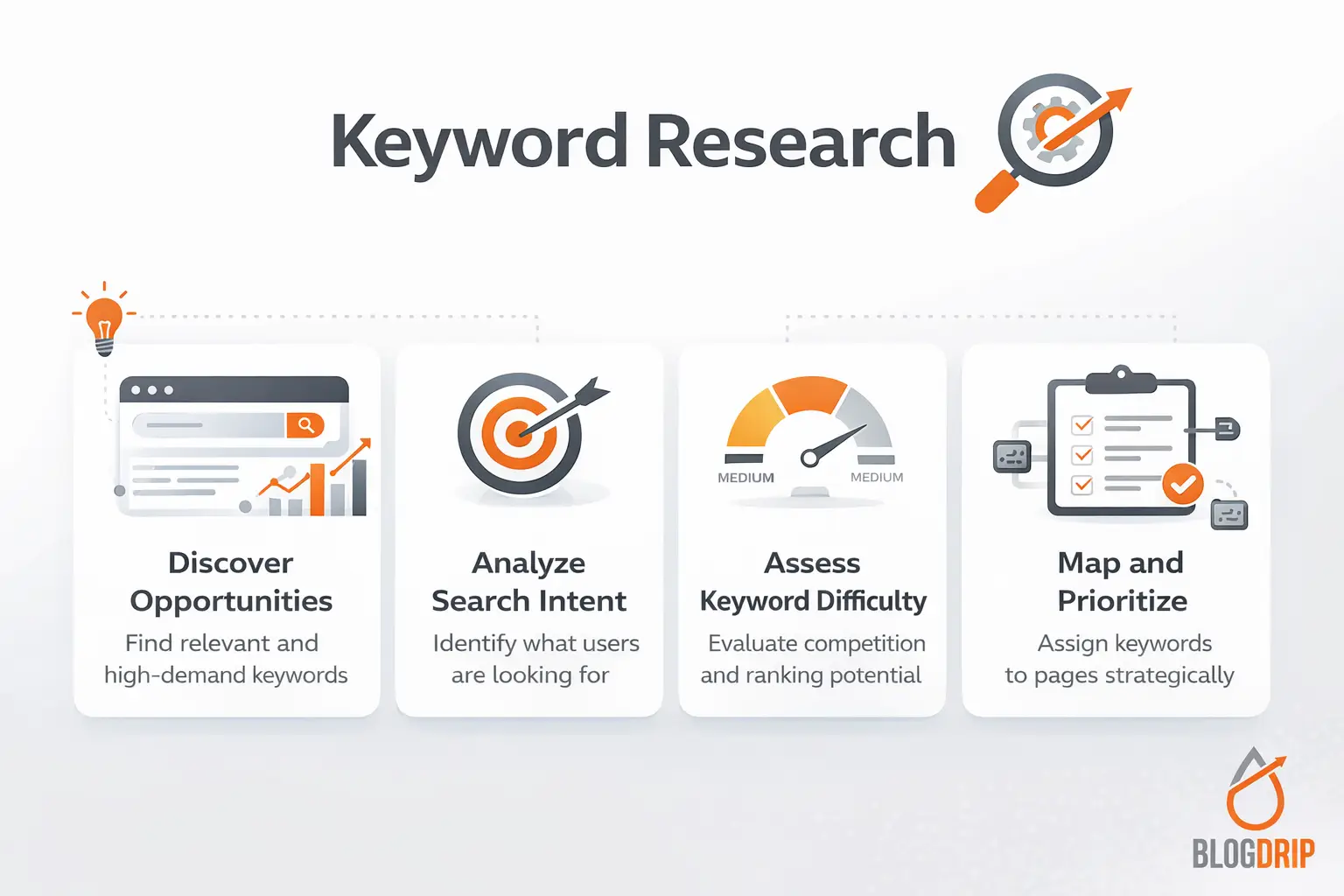
Keyword Research is not one action. It is a process that combines discovery, evaluation, prioritization, and mapping.
Start with topics, not isolated terms
A common mistake is to begin with a keyword tool and export thousands of phrases. That creates volume, but not direction.
A better starting point is to define the core topics that matter to your audience and your business. These usually sit at the intersection of three things:
- what your audience wants to know
- what your business can credibly address
- what supports your wider SEO goals
For example, if your website focuses on SEO strategy, broad topics might include Keyword Research, on-page SEO, technical SEO, link building, local SEO, and content strategy. From there, you can expand each topic into subtopics and search variations.
Expand into keyword variations and related terms
Once you have a core topic, you can build out a keyword set that includes:
- primary terms
- long-tail variations
- question-based queries
- semantically related phrases
- problem-focused searches
- comparison-style searches where relevant
For Keyword Research, that might include phrases around process, tools, strategy, search intent, clustering, and keyword prioritization. These related terms help shape comprehensive coverage and strengthen topical relevance.
Evaluate intent before difficulty
Many teams focus too early on volume and keyword difficulty. Those metrics matter, but search intent should come first.
Look at the current search results for the term you want to target. Ask:
- Are the top-ranking pages guides, tools, service pages, or product pages?
- Are they beginner-level or advanced?
- Do they answer one question or cover the topic broadly?
- Is the user clearly researching, comparing, or ready to buy?
If the results are dominated by educational guides, then an informational article is likely the correct format. If the results show product landing pages, then a blog post will struggle, no matter how optimized it is.
Assess opportunity realistically
After intent, evaluate whether the keyword is worth targeting. Useful considerations include:
Relevance
Does the term closely align with your expertise, offer, or content strategy? A keyword can have strong volume, but if it is only loosely related to your business, it may attract low-value traffic.
Competition
How strong are the pages currently ranking? Look beyond a single difficulty score. Review the quality, depth, and authority of the competing pages. In practice, this tells you more than a tool metric alone.
Business value
Will ranking for this topic support your broader goals? Informational content may not convert immediately, but it can attract qualified traffic, support internal links to commercial pages, and build trust over time.
Content gap
Do you already have a page on this topic? If so, should you improve it, consolidate it, or build supporting cluster content instead of creating another overlapping article?
Important Subtopics Within Keyword Research
A strong pillar page should not stop at definition and process. It should explain the key ideas that shape real-world application.
Search intent
Search intent is one of the most important parts of Keyword Research because it determines what kind of page should be created. You are not only targeting words. You are targeting the reason behind them.
A user searching “Keyword Research” usually wants a comprehensive explanation. A user searching “best keyword research tools” likely wants comparisons. A user searching “keyword research service” may be evaluating providers.
This is why intent mapping should be part of your content planning process. It prevents the common mistake of publishing the wrong type of page for the query.
Long-tail keywords
Long-tail keywords are more specific search queries, often with lower search volume but clearer intent. They are especially useful for newer sites, specialized businesses, and cluster content.
They also tend to produce stronger alignment between query and page. A broad term may be difficult to rank for and ambiguous in intent. A more specific phrase can create better opportunities to satisfy the searcher precisely.
In a topical cluster, long-tail keywords often belong on supporting pages rather than the pillar page itself.
Keyword clustering
Keyword clustering is the practice of grouping related terms that can be addressed on the same page. This is important because not every variation deserves a separate article.
For example, closely related phrases around how to do Keyword Research, Keyword Research process, and Keyword Research for SEO may often belong within one strong guide rather than several thin pages.
Clustering helps prevent cannibalization, improves page depth, and makes site architecture more coherent.
Keyword mapping
Keyword mapping connects keywords to specific pages on the site. This is where research becomes implementation.
A good keyword map ensures that:
- each important topic has a clear target page
- multiple pages are not competing for the same intent
- pillar and cluster relationships are deliberate
- internal links reinforce topic structure
For a site building topical authority, keyword mapping is essential. Research without mapping often results in duplication and weak internal architecture.
Competitor analysis
Competitor analysis in Keyword Research is not about copying another site’s editorial calendar. It is about identifying gaps, patterns, and opportunities.
Review which topics competitors cover well, where they have shallow or outdated content, and which queries they rank for that your site has not addressed. This can reveal both defensive needs and growth opportunities.
The goal is not to mimic. It is to understand the search landscape and choose where your content can be more useful or more focused.
Common Keyword Research Mistakes
Keyword Research often fails not because teams skip it entirely, but because they approach it too mechanically.
Chasing volume without considering intent
High search volume is attractive, but it is meaningless if the page does not satisfy the user’s actual need. Traffic without relevance rarely produces strong business outcomes.
Treating every keyword as a separate page
This creates thin content, internal competition, and bloated site architecture. Not every phrase deserves its own URL.
Ignoring the existing search results
Search engines already signal what they believe matches the query. If you ignore the current results, you are likely working against the market rather than with it.
Using tools without strategic judgment
Keyword tools are valuable, but they do not replace analysis. Metrics can guide decisions, but they cannot tell you whether a topic fits your brand, your audience, or your site’s current authority.
Failing to connect research to site structure
Research becomes far more useful when it informs pillar pages, cluster pages, navigation, and internal links. Without that connection, even good keyword data often ends up underused.
Practical Guidance for Doing Keyword Research Well
A strong Keyword Research process is disciplined, but it does not need to be complicated.
Start with core topics that reflect your expertise and audience needs. From there, expand into related terms, review live search results, group keywords by intent, and assign them to the right type of page.
For most websites, the best results come from thinking in topics first and keywords second. That means building a central pillar page around a broad concept, then supporting it with narrower cluster content. In this model, your internal linking becomes more purposeful because each page has a distinct role.
A practical workflow often looks like this:
- Define the core topic and business relevance.
- Gather primary and related keyword opportunities.
- Review search intent and the current search results.
- Group related terms into logical clusters.
- Decide which terms belong on a pillar page and which belong on supporting articles.
- Map each cluster to a specific page.
- Build internal links that reinforce topical relationships.
- Revisit research periodically as rankings, competition, and search behavior change.
This approach is more durable than publishing content one keyword at a time.
Timing and Expectations
Keyword Research can produce quick clarity, but SEO results rarely happen immediately. Research improves decision-making at the start of the process. Rankings, traffic growth, and authority gains take longer.
For an established site, refined Keyword Research can improve performance relatively quickly when it leads to better targeting, consolidation, or re-optimization of existing content. For newer sites, results usually depend on consistent execution across content quality, technical SEO, and internal linking.
It is also worth setting realistic expectations about competition. A site will not rank for every broad head term simply because it publishes an article. Keyword Research improves your odds by helping you choose viable opportunities and structure content strategically, but it does not eliminate the need for patience and quality.
Conclusion
Keyword Research is not just the first step in SEO. It is the framework that makes the rest of the strategy coherent. It helps you understand what people search for, why they search for it, and how your website should respond through content, structure, and intent alignment.
The strongest use of Keyword Research goes beyond finding phrases with traffic potential. It supports smarter topic selection, clearer page roles, stronger internal linking, and a site architecture built for topical authority. That is especially important in a pillar-and-cluster model, where each page needs a distinct purpose while still contributing to a broader thematic structure.
When approached strategically, Keyword Research helps you publish less randomly, compete more intelligently, and build a website that earns visibility through relevance and depth rather than guesswork.