
Use Keywords in Content: How to Improve Relevance Without Sounding Forced
To use keywords in content well, you need more than a target phrase and a few placement rules. Many pages underperform because the writer either overuses the keyword until the copy sounds unnatural or avoids it so much that the page never becomes topically clear. Both mistakes weaken SEO.
Keywords still matter because they help connect a page to real search behavior. They tell search engines what the page is about, and they help users confirm they have landed in the right place. But good optimization is not about repetition. It is about clarity, context, and intent.
That distinction matters even more on a site built around a pillar-and-cluster model. A cluster page should target one clear subtopic, support the broader pillar, and use language that makes its role in the content ecosystem obvious. If keyword use is sloppy, the page can become vague, overlap with nearby pages, or feel over-optimized.
This is Cluster page content, so the focus here is specific. This article explains what it means to use keywords in content, why it matters, how it works, what supporting SEO concepts shape it, what common mistakes to avoid, and how to approach keyword use in a way that improves rankings without damaging quality.
What Is Using Keywords in Content
To use keywords in content means incorporating the primary search phrase, close variations, and related topic language into a page so the subject is clear to both users and search engines.
In practice, this goes beyond inserting an exact-match phrase a set number of times. It includes:
- the primary keyword the page targets
- close variants of that keyword
- semantically related language
- supporting subtopics users expect to see
- natural phrasing that reflects the search intent behind the query
The goal is not to “place keywords” mechanically. The goal is to make the page unmistakably relevant to the topic while keeping the writing natural and useful.
That is why strong keyword use usually feels invisible. The content reads clearly, the topic is obvious, and the language feels like it belongs there.
Why It Matters
Keywords remain important because relevance still matters. Search engines use many signals to understand a page, but the actual language on the page is still one of the clearest.
It clarifies the topic
A page should have one clear subject. Good keyword use reinforces that focus. If the language is too vague or the target topic barely appears in meaningful places, the page becomes harder to interpret.
It supports search intent alignment
The wording people use in search often reflects what they want. A query can suggest informational intent, commercial investigation, or a more practical need. Using the right keyword language helps shape the content around that intent rather than treating all searches as the same.
It strengthens topical authority
On a site using topic clusters, each page needs a clear role. Keywords help define how a page fits within the wider structure. They make it easier to distinguish one cluster page from another and help reinforce the relationship between clusters and the pillar page.
It improves content when done properly
This is where the nuance matters. Good keyword use often improves the writing because it forces clearer focus, stronger headings, and more direct explanations. Bad keyword use makes the writing worse because it prioritizes repetition over usefulness.
How to Use Keywords in Content
To use keywords in content properly, start with the page strategy first and the keyword placement second.
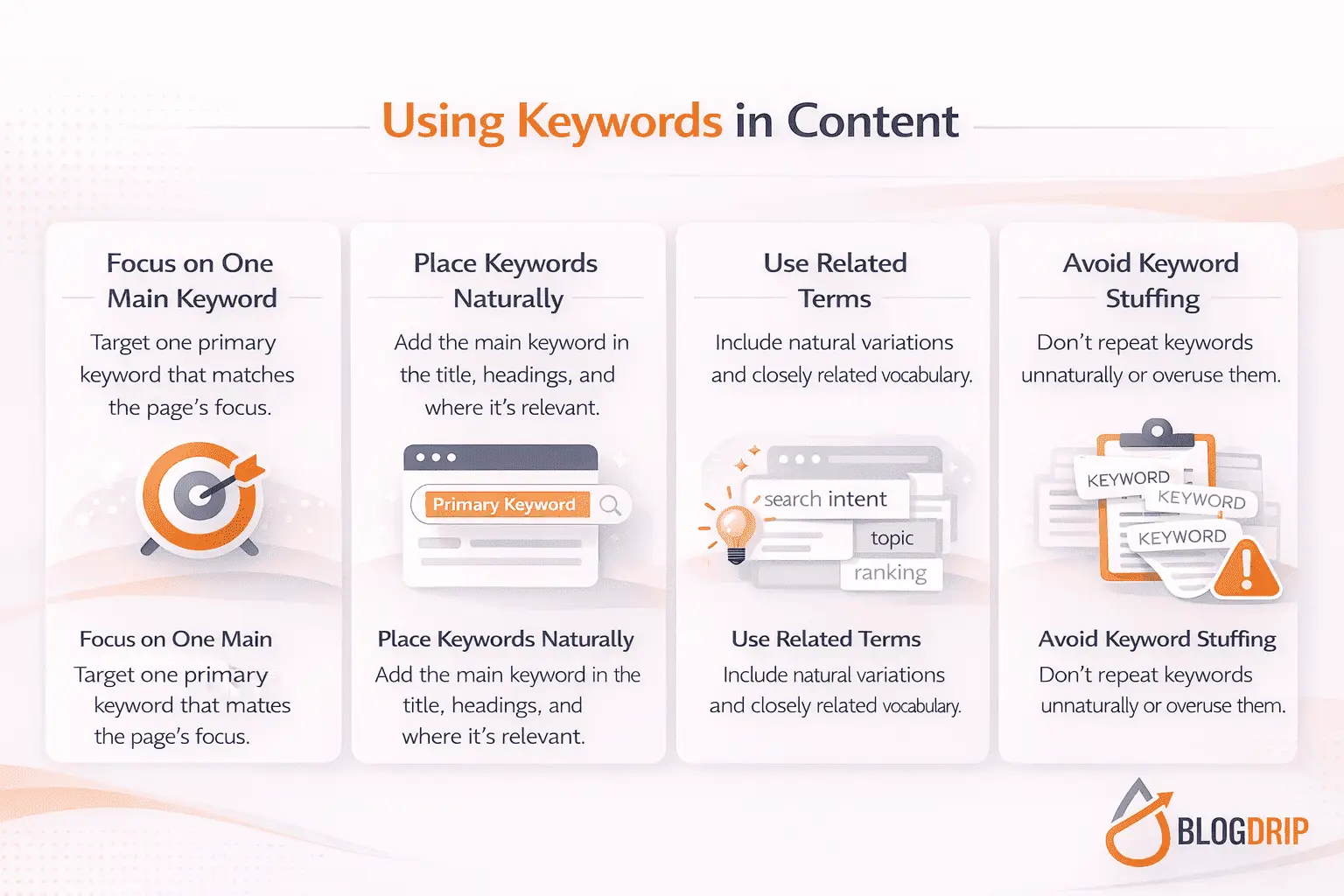
Start With One Main Keyword Focus
Most pages should have one primary keyword target or one tightly related keyword group.
If you try to target too many different terms on one page, the content often becomes unfocused. It starts answering multiple different questions, which weakens relevance and makes the page harder to position.
Match the keyword to the page role
A broad query may belong on a pillar page. A narrower or more specific phrase may belong on a cluster page. The target keyword should fit the purpose of the page within the wider site architecture.
Understand the search intent behind the keyword
A keyword is not just a phrase. It reflects a need. Before optimizing a page, review what users are likely trying to achieve. If the intent is informational, the page should teach clearly. If the intent is comparative, the page should help evaluate options. The keyword only makes sense when paired with the right intent.
Place Keywords in High-Value Areas
Some parts of a page carry more topical weight than others. The primary keyword or a close variant should usually appear in the most important structural elements.
Title tag and H1
These are two of the strongest signals of page focus. The keyword should appear naturally here whenever possible.
Introduction
The opening should confirm the page topic early. This helps both users and search engines understand the subject quickly.
Key headings
Not every heading needs the exact keyword, but important headings should reflect the topic and its major supporting angles.
Body content
The main copy should use the target phrase and related terms where they naturally belong. If the sentence sounds written for the algorithm rather than the reader, the wording probably needs revision.
Use Related Language, Not Just Exact Match
Modern SEO is not dependent on repeating the exact phrase in every section. Search engines understand context better than they once did, so strong pages usually rank because they cover the topic comprehensively, not because they hit a rigid density pattern.
That means a page targeting “use keywords in content” should also naturally mention related ideas such as keyword placement, search intent, on-page SEO, semantic relevance, topical clarity, and keyword stuffing. Those terms help create a fuller topical picture.
Important Supporting Concepts
Keyword use becomes much stronger when it is connected to broader SEO principles.
Search Intent
Search intent is the most important supporting concept because the same keyword can fail if the page answers the wrong need.
Why intent shapes keyword use
If users want a practical guide and the page reads like a glossary entry, the keyword may be present, but the page still misses the mark. Keyword optimization without intent alignment is shallow optimization.
Why intent affects content depth
Some topics need brief, direct answers. Others need layered explanation and supporting examples. The keyword alone does not tell you how long the page should be. Intent does.
On-Page SEO
Keywords are part of on-page SEO, but they work best when the rest of the page structure supports them.
Headings and hierarchy
Clear headings make the page easier to scan and help search engines interpret topic relationships more effectively.
Internal linking
Internal links can reinforce page relevance when the anchor text and surrounding context are natural and useful. A page gains meaning from the wider site, not just from its own copy.
Semantic Relevance
Semantic relevance means covering the topic with the language and concepts people genuinely expect.
This is why some pages rank without repeating the exact keyword constantly. They use the natural vocabulary of the topic, answer the supporting questions users have, and demonstrate real subject coverage.
Common Mistakes
Most keyword problems come from overcorrection in one direction or the other.
Keyword Stuffing
This is the most obvious mistake. Repeating the same phrase too often makes the copy awkward, lowers readability, and can reduce trust.
Targeting Too Many Keywords at Once
A page often becomes unfocused when it tries to rank for several loosely related phrases with different intents. This usually weakens the page rather than broadening its reach.
Forcing Keywords Into Headings
Headings should help the reader understand the structure of the page. If they are written only to insert exact-match phrases, they often become clumsy and unhelpful.
Ignoring Search Intent
A page can use the keyword correctly in all the traditional places and still fail because it answers the wrong question. Intent mismatch is often a bigger problem than keyword placement.
Writing for tools instead of readers
Some pages are optimized as if a score is the goal. The result is often robotic content that looks “SEO-ready” but feels weak in practice. Good pages use keyword guidance without letting it dominate the writing.
Practical Guidance
The best way to use keywords in content is to start with the topic, the user need, and the page role. Once those are clear, the keyword has a natural place in the page rather than feeling inserted.
Write the page around one clear topic. Use the target phrase in the title, H1, opening, and relevant sections where it improves clarity. Then support it with related language and useful subtopics that make the page feel complete.
It also helps to review the content after writing rather than optimizing every sentence in real time. In many cases, the natural use of keywords improves once the structure is solid and the message is clear.
For cluster pages, stay disciplined. A cluster page should not try to capture every related variation of the topic. It should serve one main intent, support the broader pillar, and remain clearly distinct from nearby pages.
Timing and Expectations
Using keywords in content correctly can strengthen a page’s relevance signals quickly, but it is not a standalone ranking solution.
A page still needs quality, good structure, intent alignment, internal support, and enough authority to compete. Keyword use improves the foundation. It helps search engines interpret the page more clearly and helps users confirm they are in the right place.
That is the right expectation. Good keyword use supports performance. It does not replace the rest of the SEO work.
Conclusion
To use keywords in content well is to make the topic of the page clear without damaging readability or usefulness.
That means keyword optimization is not about repetition. It is about relevance, intent, and context. Done properly, it helps search engines understand the page, helps users trust the page, and strengthens the role of that page within the wider topic cluster.
For websites building topical authority, this matters at the page level and the site level. Each cluster page should use language that defines its role clearly and supports the broader architecture without becoming forced or generic.
That is the real value of learning how to use keywords in content. It turns a page from a loosely written article into a focused, more competitive SEO asset.