
Rewrite Content: How to Improve Existing Pages Without Losing SEO Value
To rewrite content well, you need more than better wording. You need a clear reason for the update, a realistic view of search intent, and a strong understanding of the page’s role in the wider site. Without that, rewriting becomes cosmetic. The page changes, but it does not become more useful, more relevant, or more competitive.
That is why rewriting matters. Many websites already have pages with SEO value. They may have rankings, impressions, links, or topical relevance. Over time, though, those pages can become outdated, too thin, poorly structured, or less aligned with what users now expect. In those cases, to rewrite content strategically is often more effective than publishing something entirely new.
For sites using a pillar-and-cluster model, this is even more important. A weak cluster page does not just underperform on its own. It can also weaken the broader topic structure by creating overlap, confusion, or low-value support.
This is Cluster page content, so the focus here is specific. This article explains what it means to rewrite content, why it matters, how it works, what common mistakes to avoid, and how to do it in a way that strengthens long-term SEO performance.
What Is Rewrite Content
To rewrite content means substantially revising an existing page so it becomes clearer, more useful, better aligned with search intent, and more effective within the wider content strategy.
In practice, rewriting may involve:
- changing the structure of the page
- improving the introduction and section flow
- removing outdated or weak sections
- expanding missing explanations
- updating examples and references
- improving internal links
- sharpening the page’s keyword and topic focus
This is not the same as making a few edits or refreshing a sentence here and there. When you rewrite content properly, you are improving the page’s substance, positioning, and usability.
That distinction matters because some pages already carry useful SEO value. A careless rewrite can weaken that value by removing what still works or by changing the page so much that it no longer serves the same intent.
Why Rewrite Content Matters
To rewrite content strategically is often one of the most efficient ways to improve organic performance.
It helps older pages stay competitive
Search results change. Competing pages improve, user expectations shift, and the intent behind a topic often becomes clearer over time. A page that once ranked reasonably well can fall behind even when the topic is still relevant.
It improves the value of existing assets
A page with impressions, internal links, or topical relevance already has a foundation. Rewriting that page is often more efficient than creating a new one that has to earn relevance from zero.
It strengthens clarity and usefulness
Some pages fail because the topic is not explained clearly enough. The information may be vague, repetitive, too broad, or badly organized. A strong rewrite improves how the page communicates, not just how it sounds.
It supports the broader topic cluster
In a pillar-and-cluster model, every page should have a distinct role. Rewriting weak cluster pages helps make the whole topic system stronger and more coherent.
How Rewrite Content Works
A strong rewrite starts with diagnosis, not editing. Before changing the page, you need to understand why it is underperforming.
Start With the Page’s Role
Every page should have a clear purpose.
Define what the page is meant to do
Is it answering a specific informational question, supporting a pillar page, or targeting a long-tail variation? A rewrite should strengthen that role rather than blur it.
Keep one primary intent
A page usually performs best when it serves one main intent. If it tries to define, compare, teach, and sell all at once, the result often becomes diluted.
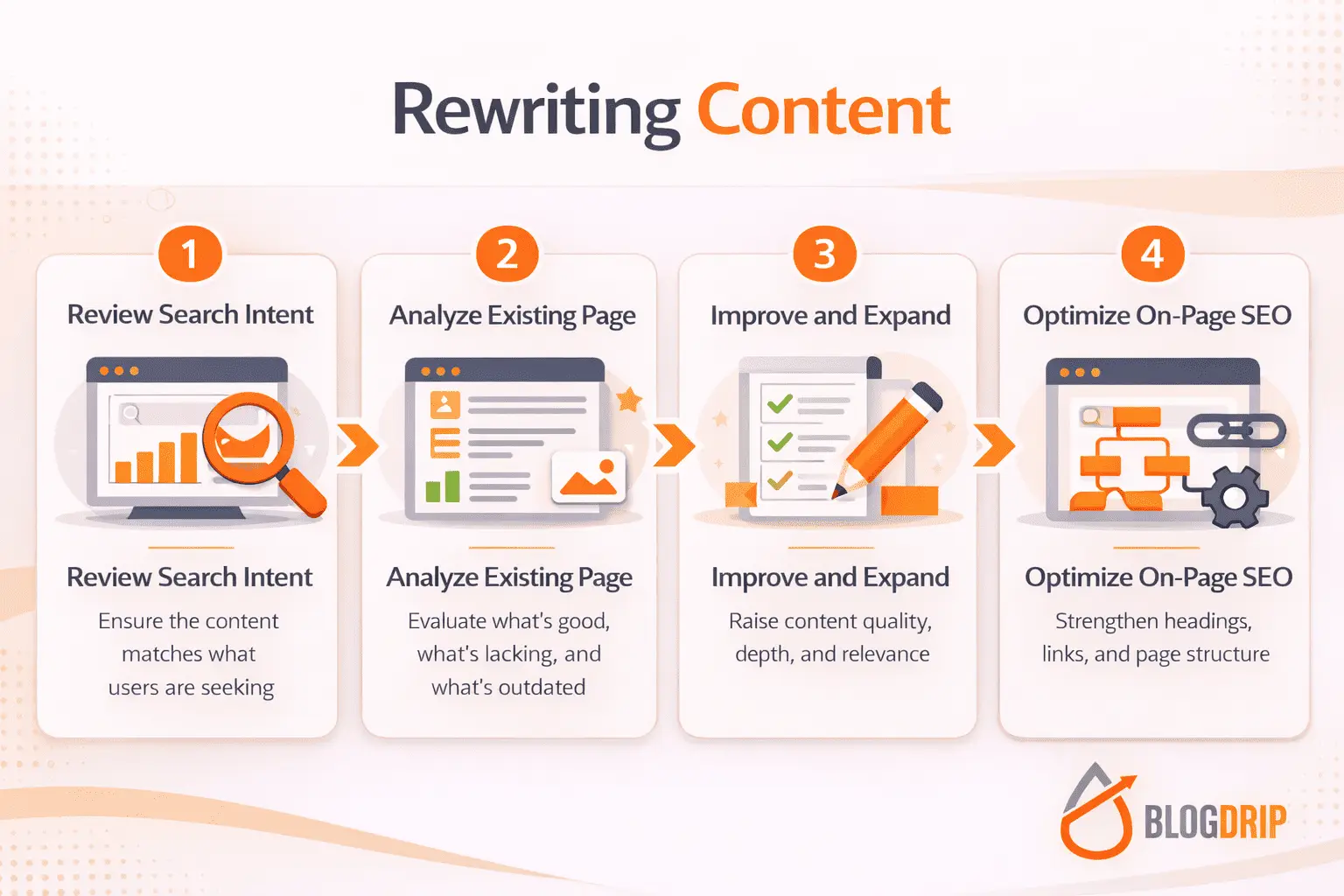
Review Search Intent First
Search intent should guide the rewrite more than wording does.
Check what users expect
Look at the type of pages that rank for the target query. Do users want a quick explanation, a practical guide, or a broader overview? If the page does not match that expectation, rewriting needs to address that first.
Improve intent alignment
A page can mention the right keyword and still fail because it answers the wrong need. A strong rewrite brings the page closer to what the searcher actually wants.
Identify What Should Stay
Not every part of the page is necessarily weak. A useful example, a strong section, or a clear explanation may still deserve to stay. When you rewrite content, the goal is not to erase the page. The goal is to improve it selectively and strategically.
Fix Structure Before Style
Many pages are structurally weak before they are badly written.
Clarify the introduction
The opening should tell the reader quickly what the page covers and why it is useful.
Reorganize sections logically
The page should progress in a natural order. Key answers should appear where users expect them, not buried under unnecessary context.
Remove repetition
A lot of rewriting value comes from cutting sections that repeat the same point in slightly different ways.
Strengthen the Substance
Once the structure is clear, the actual content needs to improve.
Fill meaningful gaps
If the page is missing important subtopics, examples, or practical detail, add them.
Update outdated material
Old assumptions, stale examples, and dated references can weaken credibility even when the main topic is still relevant.
Improve usefulness, not just length
A strong rewrite makes the page better, not simply longer. More words only help when they add real value.
Important Supporting Concepts
To rewrite content well, you need to think beyond sentence-level improvement.
Search Intent Alignment
Search intent is one of the strongest influences on a rewrite. If the page does not satisfy the reason behind the search, surface-level improvements will not solve the deeper problem.
Sometimes the right rewrite is not bigger. Sometimes it is narrower, clearer, or more directly focused on the actual question users are asking.
On-Page SEO
Rewriting content often improves on-page SEO at the same time.
Headings and hierarchy
A stronger H1, better H2s, and cleaner page hierarchy make the page easier to scan and easier for search engines to interpret.
Keyword and topic clarity
A rewrite can improve how clearly the page signals its subject without forcing keywords unnaturally.
Internal Linking
A rewritten page should fit the wider site structure more effectively than before. It should link naturally to relevant supporting content and reinforce its role within the topic cluster.
Content Freshness
Some pages need rewriting because they no longer feel current. Even when the topic is still valid, stale examples and outdated context can reduce trust and usefulness.
Common Mistakes
When people rewrite content, they often make the same avoidable errors.
Rewriting Without a Diagnosis
This is the biggest mistake. Teams know a page feels weak, so they rewrite it without identifying whether the real problem is intent mismatch, thin coverage, poor structure, outdated content, or overlap with another page.
Changing Language Without Improving Value
A page can sound smoother after a rewrite and still remain strategically weak. If the structure, intent, and depth are still poor, the rewrite has not solved much.
Rewriting Too Aggressively
Some pages already have useful relevance and equity. Rebuilding them too drastically can remove what was still working. A rewrite should improve the page, not strip it of its strengths unnecessarily.
Adding Length Instead of Quality
Longer content is not automatically stronger content. Weak rewrites often add filler sections, repetitive explanations, or generic FAQs that make the page heavier without making it more useful.
Creating Overlap With Other Pages
A rewrite should clarify the page’s distinct role. If it starts covering the same ground as another cluster page, it can create cannibalization instead of improvement.
Practical Guidance
If you want to rewrite content effectively, start by prioritizing the right pages. Focus first on pages that already have some visibility, support important topics, or play a meaningful role in the content cluster.
Then review the page honestly. Assess intent alignment, structure, topical depth, freshness, internal links, and how well it fits the wider architecture. Only after that should you decide what kind of rewrite is needed.
It also helps to rewrite in layers. Start with page purpose and structure. Then improve the core sections. Then review internal links and supporting relationships. This keeps the rewrite strategic rather than reactive.
Finally, measure the right outcomes. Rankings matter, but so do impressions, engagement, usefulness, and how well the page supports nearby content in the cluster.
Timing and Expectations
When you rewrite content, results depend on the starting point of the page and the scale of the improvement.
If the page already has some relevance and the rewrite significantly improves intent match, structure, and usefulness, progress can appear relatively quickly after reindexing. In more competitive spaces, the effects may take longer and depend on broader factors such as site authority and internal support.
The most realistic expectation is steady improvement, not instant transformation. A good rewrite strengthens the page’s foundation, and ranking gains often follow when the rest of the SEO conditions are also in place.
Conclusion
To rewrite content well is to improve an existing page so it becomes clearer, more useful, more relevant, and more competitive without losing the SEO value it already has.
That makes rewriting a strategic SEO task, not a cosmetic one. It requires understanding the page’s purpose, matching search intent more accurately, improving structure, strengthening substance, and fitting the page more effectively into the wider topic cluster.
For websites building topical authority, this matters at every level. Strong clusters are not built only by publishing new pages. They are also built by revisiting older assets, improving weak pages, and making sure each page continues to earn its place in the content system.
That is the long-term value of choosing to rewrite content strategically. It turns existing pages into stronger SEO assets instead of leaving them to decline quietly over time.