
How to Improve Pages With Clear Priorities and Better SEO Decisions
A content optimization strategy is what turns random page updates into meaningful SEO progress. Many teams refresh titles, expand sections, add keywords, and rewrite paragraphs without a clear framework for why they are doing it. The result is activity, but not always improvement.
That is the core problem. Content does not usually underperform for one simple reason. A page may be too broad, too thin, poorly structured, misaligned with search intent, outdated, underlinked, or competing with another page on the same site. If you do not know which issue is holding the page back, optimization becomes guesswork.
For websites building topical authority through a pillar-and-cluster model, this matters even more. Each page has a role. Some pages introduce the topic broadly. Some go deeper into subtopics. Some support commercial goals. A strong content optimization strategy helps each page do its job more effectively and helps the whole cluster perform better as a system.
This is Cluster page content, so the focus here is specific. Rather than treating optimization as a general SEO checklist, this article explains what a content optimization strategy is, why it matters, how it works, what supporting concepts shape it, what common mistakes to avoid, and how to apply it in a practical way.
What Is a Content Optimization Strategy
A content optimization strategy is a structured approach to improving existing content so it becomes more relevant, more useful, better aligned with search intent, and more effective within the wider site architecture.
In practical terms, a content optimization strategy helps you decide:
- which pages deserve attention first
- what each page is meant to achieve
- what is holding the page back
- what type of improvement is actually needed
- how that page supports the wider content cluster
That last point is important. Optimization is not just about improving one page in isolation. It is also about improving how that page fits into the site as a whole.
A weak strategy usually treats every page the same way. It assumes more words, more keywords, or fresher dates will solve the problem. A strong strategy does the opposite. It starts with diagnosis and chooses the right action for the specific page.
Why It Matters
A content optimization strategy matters because SEO gains often come from improving what already exists, not just from publishing more.
It improves the return on existing content
Many websites already have pages with untapped value. Some rank on page two. Some generate impressions but weak clicks. Some attract traffic but do not satisfy users well enough. Strategic optimization can often unlock more value from those assets than creating new content from scratch.
It reduces wasted effort
Without a strategy, teams often optimize low-priority pages, expand content that should be consolidated, or rewrite pages that actually suffer from search intent mismatch. A good strategy helps direct effort toward pages and actions that matter.
It strengthens topical authority
In a pillar-and-cluster model, content should support itself. A strong pillar with weak cluster pages is still a weak topic system. Optimizing strategically across the cluster makes the whole subject area clearer and stronger.
It improves more than rankings
Better content can support rankings, but it can also improve user experience, internal navigation, perceived expertise, and conversion pathways. A strong strategy keeps those broader outcomes in view.
How a Content Optimization Strategy Works
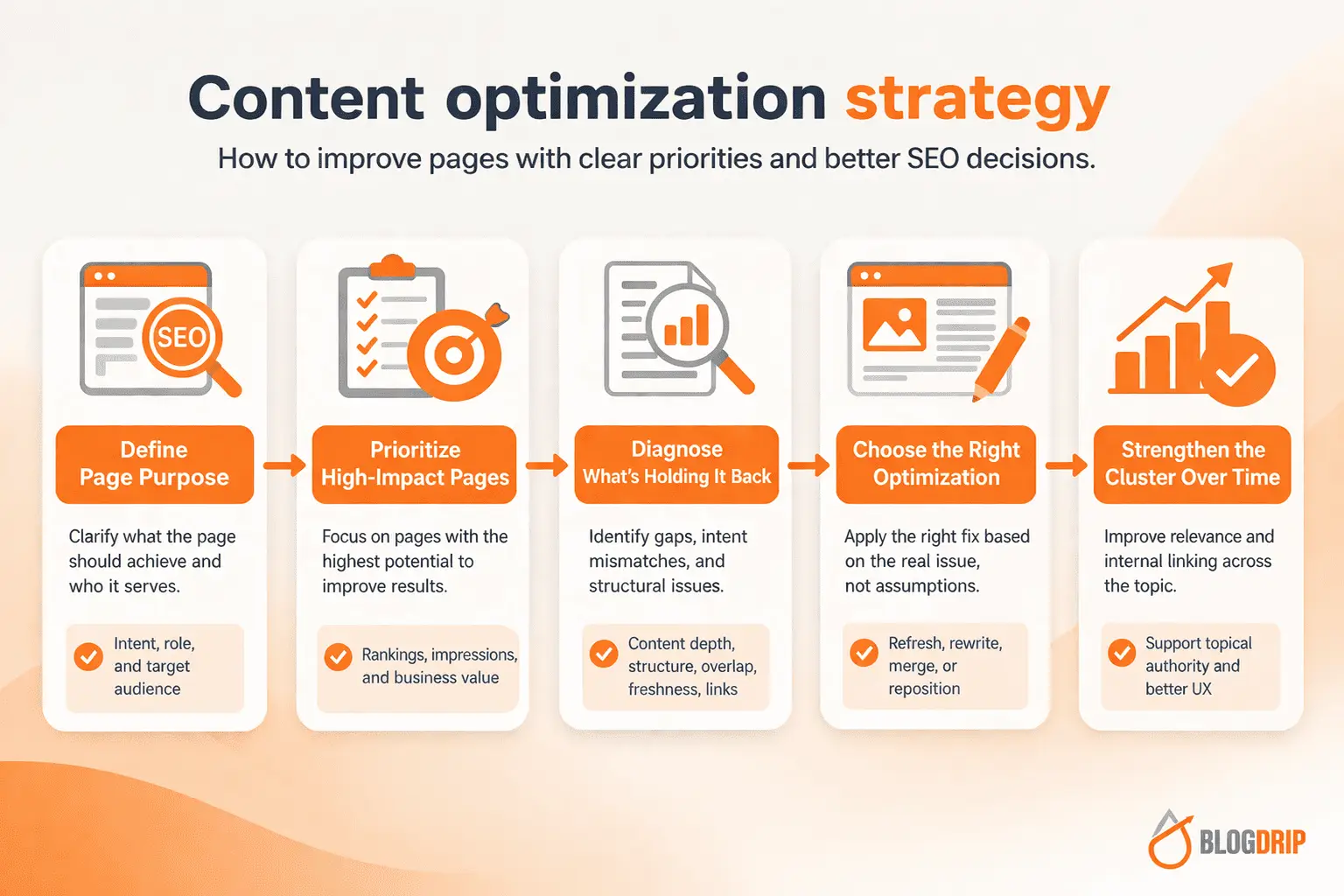
A useful strategy starts with diagnosis, prioritization, and page role clarity. It does not begin with editing.
Start With Page Purpose
Before changing a page, define what it is supposed to do.
Is it meant to answer an informational query, support a pillar page, capture a long-tail topic, or guide users deeper into the site? A page cannot be optimized properly if its purpose is unclear.
This is often where poor strategies break down. Teams try to make one page rank for several related ideas at once. That usually creates diluted intent and weaker performance.
Prioritize the Right Pages
Not every page deserves equal effort. A content optimization strategy should focus first on pages that are most likely to produce meaningful gains.
High-potential pages
These are pages already getting impressions, lower-page rankings, or early signs of relevance. They often need stronger structure, clearer focus, or better topical depth.
Strategically important pages
These include key cluster pages, commercially relevant pages, and pages central to important topic areas. Even if they are not performing strongly yet, they may matter too much to ignore.
Weak pages inside strong clusters
Sometimes the best opportunity is not the most visible page. It is the weak supporting page that reduces the strength of the whole topic cluster.
Diagnose the Real Problem
Once you know which page to review, identify what is actually holding it back.
Ask questions such as:
- Does the page match the intent behind the query?
- Is the structure clear enough?
- Is the content too thin or too broad?
- Does it overlap with another page?
- Is it outdated?
- Is the internal linking weak?
- Does it still fit the current site strategy?
This step matters more than most teams realize. If the diagnosis is wrong, the optimization work is usually wrong too.
Choose the Right Type of Optimization
Not every page needs a full rewrite. Some need better structure. Some need tighter keyword focus. Some need stronger internal links. Some need consolidation. Some need to be repositioned entirely.
A strong content optimization strategy does not assume that every problem needs the same solution.
Important Supporting Concepts
A content optimization strategy becomes much stronger when it is connected to the right supporting SEO concepts.
Search Intent
Search intent shapes what the page should look like and what kind of optimization is appropriate.
Why it matters
A page that targets the wrong intent will struggle even if it is well written. A broad overview cannot always compete for a query that needs practical depth. A transactional page will struggle for a query dominated by informational results.
How it changes optimization
Sometimes the page does not need more content. Sometimes it needs a clearer fit between what the user wants and what the page delivers.
Content Structure
Optimization rarely works well if the page structure is weak.
Headings and hierarchy
A clear heading structure helps users scan the page and helps search engines interpret the relationship between the main topic and supporting sections.
Flow and readability
Better sequencing, shorter paragraphs, and clearer sectioning often improve performance because they make the page easier to use.
Internal Linking
A page should not sit alone. Internal links help search engines understand page relationships and help users move through the topic cluster more naturally.
A content optimization strategy should review whether the page is linked from the right places and whether it links out to the right supporting pages in context.
Content Audits
A broader content audit strengthens optimization decisions. It helps reveal overlap, outdated pages, weak cluster support, and hidden opportunities for consolidation or repositioning.
Without that wider view, teams often keep optimizing pages that no longer deserve their own place in the content system.
Common Mistakes
Most failed optimization strategies are not really strategies. They are just lists of edits.
Optimizing Without Prioritization
Teams often spend time improving low-impact pages while stronger opportunities sit untouched. That creates work, but not much leverage.
Treating All Pages the Same
Not every page needs more depth, more keywords, or more headings. Different pages have different weaknesses, and strategy should reflect that.
Ignoring Cannibalization
A page may underperform because another page on the same site is targeting nearly the same query. Optimizing one page without addressing the overlap often solves very little.
Chasing Competitor Patterns Too Literally
Competitor review is useful, but copying structure, headings, or subtopics too closely often produces generic content. A strong strategy should improve differentiation, not reduce it.
Confusing Expansion With Improvement
Making a page longer is not the same as making it better. Strong optimization improves usefulness, clarity, and fit. Weak optimization just adds more material.
Practical Guidance
A practical content optimization strategy starts with a repeatable process.
First, identify the most important topic clusters on the site. Then identify which pages within those clusters matter most. That may include pages with ranking potential, key commercial pages, or weak supporting pages that reduce cluster strength.
Second, review each page by role, not just by traffic. A page can be strategically important even if it does not yet perform well.
Third, diagnose the page before editing. Review search intent, structure, topical depth, internal linking, freshness, and overlap. Decide what kind of change is actually needed.
Fourth, classify actions clearly. Some pages should be refreshed. Some should be rewritten. Some should be merged. Some should be repositioned. Some should be removed.
Fifth, optimize in cycles rather than as a one-time project. Search results change, competitors improve, and user expectations evolve. A strong strategy reflects that reality.
Timing and Expectations
A content optimization strategy improves outcomes over time, but it is rarely immediate.
Some gains appear fairly quickly, especially when pages already have some relevance and only need stronger intent alignment or better structure. Other gains take longer, particularly in competitive spaces or when broader content issues need to be fixed first.
The right expectation is not instant ranking movement. It is more consistent improvement, better use of effort, and a stronger topic architecture over time.
That is often more valuable than short-term ranking spikes because it creates a better long-term foundation.
Conclusion
A content optimization strategy is the framework that turns isolated edits into real SEO progress.
Done properly, it helps you prioritize the right pages, identify the actual problems, choose the right kind of optimization, and improve how content performs across the wider site. That makes it far more valuable than ad hoc updating or tool-driven tweaking.
For websites building topical authority, this matters at every level. Strong clusters are not created by publishing more pages alone. They are built by refining important content, strengthening internal relationships, and optimizing with a clear understanding of page purpose, search intent, and business value.
That is the long-term value of a content optimization strategy. It helps turn a growing content library into a stronger, clearer, and more competitive SEO asset.