
How to Create Content That Supports SEO and Drives Action
Conversion content sits at the point where visibility meets business value. A page may attract traffic, rank well, and generate impressions, but if it does not help users move toward a meaningful next step, the commercial impact can remain limited. That is why conversion-focused content matters. It connects organic discovery with action.
This topic is often misunderstood. Some treat conversion content as aggressive sales writing. Others focus so heavily on helpful, informational content that they avoid any conversion intent at all. Neither extreme works well. Strong conversion content does not pressure the user. It reduces friction, builds confidence, and makes the next step feel relevant and well timed.
For websites building topical authority through a pillar-and-cluster model, this is especially important. Not every page should convert directly, but some pages should play a clear role in moving the reader from information to decision. A good cluster strategy needs both educational depth and conversion pathways.
This is Cluster page content, so the goal here is focused. This article explains what conversion content is, why it matters, how it works, what key supporting concepts shape it, what mistakes to avoid, and how to approach it in a way that supports both SEO performance and business outcomes.
What Is Conversion Content
Conversion content is content designed to help a user take a meaningful next step after consuming information.
In practical terms, that next step could include:
- submitting an inquiry
- booking a call
- requesting a quote
- starting a trial
- downloading a resource
- viewing a service page
- moving from a blog article to a commercial page
That does not mean every page should push for a sale. Conversion content is broader than direct-response copy. It includes any content that supports movement through the decision process.
A strong conversion page usually does three things well. It addresses the user’s need clearly, reduces uncertainty, and presents a logical next action. That next action should feel like a continuation of the user journey, not an interruption.
This is what makes conversion content different from thin sales copy. It is still useful content. It still needs to match search intent. It still needs to earn trust. The difference is that it also has a defined role in helping the user progress.
Why Conversion Content Matters
Conversion content matters because traffic on its own is not the end goal for most businesses. Organic visibility is valuable, but if content never helps users move closer to a business outcome, the growth it creates can remain shallow.
It connects SEO to business value
SEO often succeeds in generating visits before it succeeds in generating action. Conversion content helps bridge that gap. It turns visibility into a more meaningful part of the customer journey.
It supports user decision-making
Many users do not need more information forever. At some point, they need reassurance, clarity, proof, and a next step. Conversion content helps meet that need without forcing a hard sell too early.
It improves the value of topic clusters
A pillar-and-cluster model should not only build authority. It should also support progression. Informational content can attract and educate, while conversion content can help qualified users move toward services, products, or consultations when the intent is right.
It reduces wasted traffic
A site may attract the right audience and still underperform commercially because the content ecosystem does not guide people well. Conversion content helps reduce that drop-off between interest and action.
How Conversion Content Works
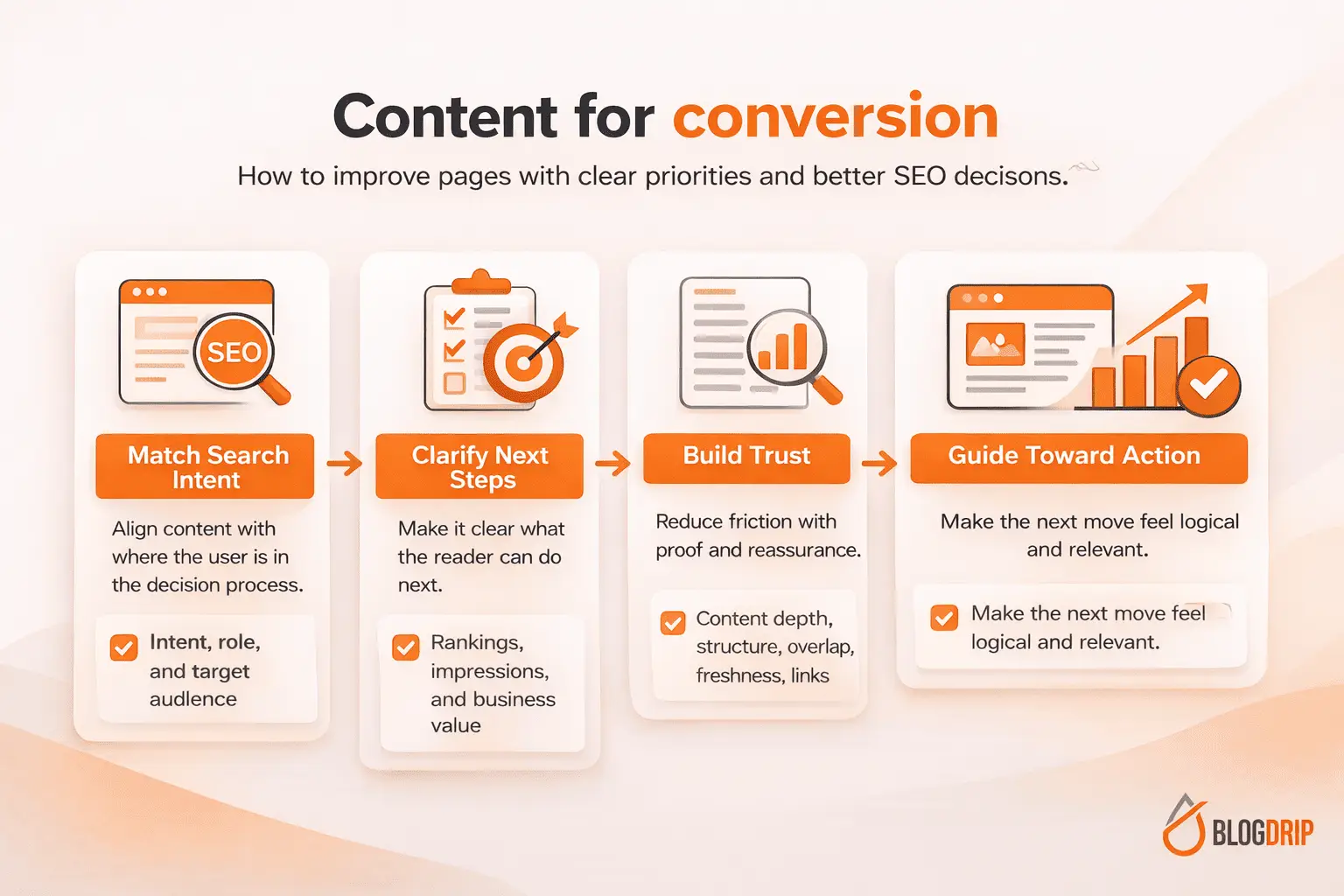
Conversion content works by aligning user intent, content structure, trust signals, and next-step design.
Start With Search Intent
Search intent is the first filter. A page cannot convert well if it ignores why the user arrived in the first place.
Informational intent needs a softer conversion path
If the user is still learning, the page should educate first. The conversion step should feel contextual and low friction, such as reading a related service page or downloading a helpful resource.
Commercial intent can support stronger calls to action
If the query already suggests evaluation or decision-making, the content can move more directly toward service differentiation, proof, and inquiry support.
The key is matching the strength of the CTA to the readiness of the user.
Clarify the Next Step
A page should make it obvious what the reader can do next.
That does not always mean using a large button or repeated form. Sometimes it means placing the right internal link at the right moment. Sometimes it means including a short CTA after a useful explanation. Sometimes it means offering a comparison, case study, or consultation page as the next step.
The important point is that the action should be relevant to the page and the user’s current stage.
Reduce Uncertainty
People convert when the next step feels clear and low risk.
That means strong conversion content often includes:
- practical explanations
- clear benefits
- trust-building detail
- useful internal links
- proof or credibility cues
- language that answers hidden objections
A user does not always need more persuasion. Often they need less uncertainty.
Important Supporting Concepts
Conversion content is shaped by several connected SEO and content principles.
Search Intent and Journey Stage
Conversion content works best when it matches where the user is in the journey.
Early-stage content
This type of content should educate and build trust. It can still support conversion, but more indirectly.
Mid- to late-stage content
This is where stronger conversion intent often fits naturally. Comparison pages, service explainers, solution pages, and evaluation-focused content often support more direct action.
A major mistake is expecting early-stage content to perform like a sales page.
Content Structure and UX
A page that is difficult to navigate will usually convert poorly, even if the message is strong.
Clear hierarchy
The user should be able to understand the page quickly through headings, layout, and sequencing.
Friction reduction
Short paragraphs, strong section order, and visible next steps improve usability and make conversion more likely.
Internal Linking
Conversion content often depends on strong internal pathways.
A blog article may not convert directly, but it can link naturally to a service page, case study, pricing explainer, or related solution article. Internal linking is what often turns a content system into a usable decision journey.
Trust Signals
Trust is central to conversion content. That includes clarity, expertise, consistency, proof, and realistic positioning. Users are more likely to act when the content feels credible and grounded rather than promotional or vague.
Common Mistakes
Conversion content often fails because businesses misunderstand what conversion actually requires.
Treating every page like a sales page
Not every page should push hard for action. Informational content still needs to serve informational intent first. Over-selling too early weakens trust.
Writing helpful content with no next step
This is the opposite problem. Some pages educate well but give the user nowhere meaningful to go. That wastes attention and weakens the commercial value of the content ecosystem.
Using vague calls to action
A CTA such as “learn more” or “get started” may be too generic unless the surrounding context makes the value of that next step very clear.
Ignoring internal page relationships
A page may be useful on its own but fail to support conversion because it does not connect to the right commercial or supporting pages at the right moment.
Prioritizing persuasion over clarity
If the page tries too hard to sell, it often becomes less trustworthy. Strong conversion content is practical first and persuasive through clarity, not hype.
Practical Guidance
A practical way to create better conversion content is to begin by mapping page roles across the cluster.
Identify which pages are primarily informational, which are mid-journey, and which are closest to commercial intent. Then make sure each page has an appropriate next step based on that role.
For informational cluster pages, focus on relevance and progression. Help the user understand the topic well, then guide them naturally toward the next most useful page. That might be a related service page, solution guide, or deeper commercial explainer.
For pages with stronger buying intent, reduce friction. Make the value proposition clear, answer likely objections, and keep the path to action simple.
It also helps to review conversion content through a user lens rather than only a marketing lens. Ask whether the next step feels logical, whether the CTA appears at the right time, and whether the page gives enough clarity for someone to act with confidence.
Timing and Expectations
Conversion content does not always improve performance immediately. Some gains show up quickly in better click-through behavior, stronger inquiry quality, or clearer user pathways. Other gains take longer, especially when the content is part of a broader topic cluster that is still building authority.
The most realistic expectation is progressive improvement. Strong conversion content tends to work best when it is part of a broader system that already attracts the right audience and supports trust through related content.
In other words, conversion content is rarely a shortcut. It is a multiplier for an already coherent content strategy.
Conclusion
Conversion content is content designed to help users take a meaningful next step without sacrificing usefulness, trust, or search intent alignment.
Done well, it does not feel overly promotional. It feels clear, helpful, and commercially aware. It supports SEO by serving the query properly, and it supports business goals by creating relevant pathways toward action.
For websites building topical authority, this matters because organic growth should not stop at visibility. A strong content ecosystem should also help the right users move forward when they are ready.
That is the real value of conversion content. It turns attention into progress and helps a content strategy support both rankings and results.