
Content Audit: How to Evaluate, Improve, and Strengthen Your Existing Content
A content audit is one of the most valuable exercises in SEO, yet it is often delayed until a website becomes difficult to manage. Pages accumulate over time, topics start to overlap, outdated posts remain live, and once-useful articles stop contributing to traffic or conversions. At that point, the problem is no longer content production. It is content control.
That is why a content audit matters. It helps you understand what you already have, what is performing well, what is underperforming, and what is weakening your site’s overall quality. For businesses building topical authority through a pillar-and-cluster structure, that clarity is essential. You cannot build a strong content system on top of weak, redundant, or misaligned pages.
This is Cluster page content, so the purpose here is specific. Rather than turning this into a general SEO guide, this article focuses on the role of a content audit: what it is, why it matters, how it works, and how to approach it strategically.
What Is a Content Audit
A content audit is the process of reviewing and evaluating the pages on a website to understand their quality, relevance, performance, and strategic role.
In practical terms, it means taking inventory of your content and asking better questions about it. Not just whether a page exists, but whether it still deserves to exist in its current form. A content audit helps you identify which pages should be improved, merged, redirected, expanded, repositioned, or removed.
A proper content audit usually looks at multiple dimensions, including:
- topical relevance
- search intent alignment
- organic performance
- internal linking support
- content quality
- freshness
- duplication or overlap
- conversion value
- fit within the wider site architecture
This is what separates a real content audit from a simple spreadsheet of URLs. The goal is not merely to catalog content. The goal is to make strategic decisions about it.
Why Content Audit Matters
A content audit matters because websites rarely decline for one dramatic reason. More often, they weaken gradually. Content becomes outdated, cluster structures become messy, and too many pages start competing for similar queries.
It improves overall site quality
Search performance is shaped by the overall quality of a site, not just its best pages. If a website is filled with thin, redundant, or neglected content, that creates noise. A content audit helps reduce that noise and improve the average quality level across the site.
It supports stronger rankings
Some pages fail because they are weak. Others fail because they are cannibalized by overlapping content nearby. A content audit helps identify both problems. That makes it easier to strengthen rankings by improving page quality and clarifying page purpose.
It protects topical authority
If you are building authority in a subject area, every page in the cluster matters. A strong pillar supported by weak or repetitive cluster pages sends mixed signals. A content audit helps tighten those relationships and reinforces the structure of the topic.
It creates better ROI from existing content
Many businesses focus on new content creation while ignoring the value already sitting on the site. A content audit often reveals faster gains in improving, consolidating, or reworking existing pages than in publishing more content without a plan.
How a Content Audit Works
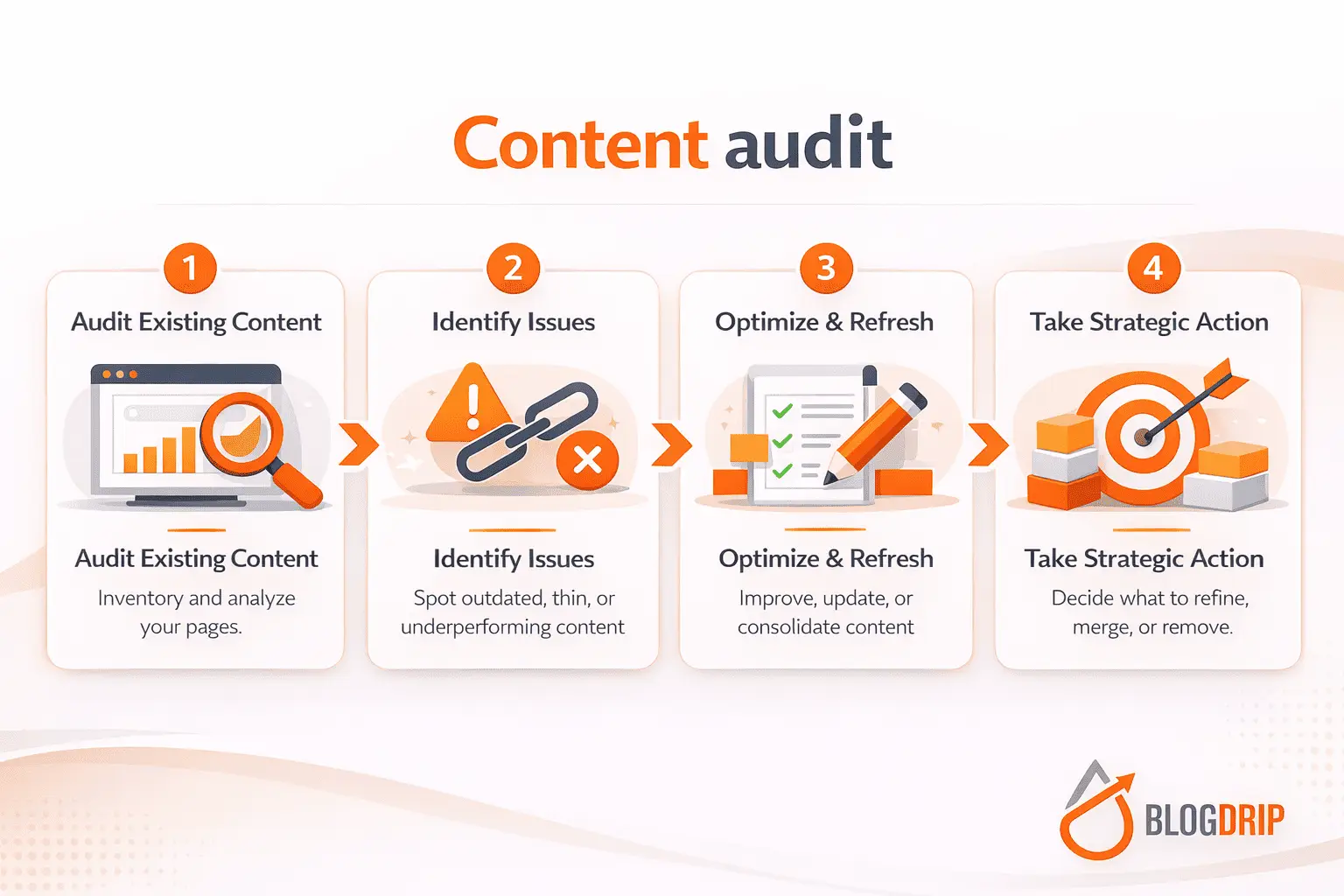
A content audit works best when it is structured around decision-making. It is not just a review process. It is a framework for deciding what to do with your content.
Start With a Full Content Inventory
The first step is to identify the pages you are evaluating. That usually includes blog posts, resource pages, guides, landing pages, and any indexable content that plays a role in organic search.
The goal is to create a clear view of what exists before judging what should change. On a small site, this may be straightforward. On a larger site, it often reveals more content than expected, especially when older campaigns, tags, or legacy sections are involved.
Review Page Purpose and Search Intent
Before looking at traffic, define what each page is meant to do.
A page should have a clear role. It may target a specific informational query, support a broader pillar topic, or serve a commercial function within the search journey. If the role is unclear, the page often becomes difficult to evaluate properly.
A content audit should examine whether each page still matches the search intent it appears to target. Some pages lose relevance because the query landscape changes. Others were never well aligned in the first place.
Evaluate Quality and Topical Fit
Performance data matters, but it is not enough on its own. A page may receive some traffic and still be strategically weak. Another page may have low traffic but still be important because it supports a pillar or serves a critical user need.
This is where qualitative review matters. During a content audit, ask:
- Is the page genuinely useful?
- Does it cover the topic clearly and accurately?
- Is it too thin for the query?
- Does it overlap with another page?
- Is it outdated?
- Does it fit the current content strategy?
Those questions often reveal more than traffic alone.
Assess Internal Linking and Content Relationships
A page may underperform because it is isolated. If it is buried in the site, weakly linked, or disconnected from the topic cluster it belongs to, its value can be limited.
A strong content audit reviews how pages relate to one another. That includes checking whether cluster pages support the pillar correctly, whether important pages receive enough internal authority, and whether overlapping pages are creating confusion.
Assign an Action
Once the page has been reviewed, the next step is deciding what to do with it.
The most common actions in a content audit are:
- keep as is
- update and improve
- merge with another page
- redirect to a stronger page
- rewrite for a different intent
- remove if it no longer adds value
This step is critical. Without it, a content audit becomes analysis without outcomes.
Important Subtopics Within a Content Audit
A strong content audit brings together several important SEO disciplines. Understanding those subtopics improves the quality of the review and the decisions that follow.
Search Intent and Page Role
Intent is central to any content audit because a page cannot perform well if it targets the wrong need.
Some pages look fine on the surface but underperform because the format is wrong for the query. A broad educational article may be targeting a term that needs a commercial page. A landing page may be trying to rank for a query where users expect a guide.
A content audit helps identify those mismatches and decide whether the page should be improved, repositioned, or replaced.
Content Quality and Topical Depth
A key part of a content audit is evaluating whether a page is strong enough to compete.
Thin or shallow content
Some pages simply do not go far enough. They answer the topic at a surface level but do not offer the depth needed for the query.
Redundant or overlapping content
Many sites accumulate multiple pages targeting very similar terms. This often weakens performance because search engines receive mixed signals about which page should rank.
Outdated content
Older pages may still be relevant in principle but outdated in practice. Examples become stale, recommendations lose relevance, and supporting information no longer reflects current search behavior.
Internal Linking and Cluster Structure
For sites using topic clusters, a content audit should assess whether the structure still makes sense.
A pillar page should not be surrounded by weak or repetitive cluster articles. Supporting pages should have clear roles, and internal links should reflect the topic relationships accurately. If those relationships are weak, the audit should surface that problem.
Performance and Business Value
Not every page should be judged by traffic alone.
Some pages have modest traffic but strong conversion influence. Others bring visitors but do not support meaningful goals. A content audit should consider both SEO value and business value, especially for pages that sit closer to commercial journeys.
Common Mistakes in a Content Audit
Many content audits fail not because the idea is wrong, but because the process is too shallow.
Treating it as a spreadsheet exercise
Cataloging URLs is useful, but it is only the start. A real content audit requires judgment. If the process stops at collecting page titles and traffic numbers, it will miss strategic issues.
Looking only at traffic
Traffic is an important signal, but it is not the only one. Some low-traffic pages are strategically important. Some high-traffic pages are low quality or poorly aligned with business goals.
Ignoring page overlap
This is one of the biggest mistakes. A site may have several articles targeting nearly identical queries, but the audit fails to identify the cannibalization. As a result, teams improve pages individually without fixing the structural problem.
Auditing without understanding the site architecture
A page should not be evaluated in isolation. Its value depends partly on where it sits in the broader content system. A content audit should reflect that.
Failing to turn findings into action
A content audit is only valuable when it leads to decisions. If pages are classified but never improved, merged, or removed, the audit remains theoretical.
Practical Guidance for Running a Strong Content Audit
A good content audit starts with prioritization. You do not always need to review the entire site at once. In many cases, it is more strategic to begin with one topic cluster, one content type, or one business-critical section.
Start by identifying the content area that matters most. That may be a core pillar topic, a declining blog category, or a section filled with aging posts.
Then review each page using a consistent framework. Look at its purpose, intent alignment, quality, freshness, internal linking, performance, and fit within the current strategy.
Keep the classifications simple enough to be useful. Overly complex scoring models often create administrative work without better decisions. In practice, what matters most is whether the page should be kept, improved, consolidated, repositioned, or removed.
It is also important to combine quantitative and qualitative review. Performance data shows what is happening. Strategic review helps explain why.
A content audit should ultimately help answer three bigger questions:
- Which content should we strengthen?
- Which content is creating noise or overlap?
- Which content best supports the authority we want to build?
Those answers are often more valuable than the audit document itself.
Timing and Expectations
A content audit is not a one-time event for most serious websites. It should be repeated periodically, though the frequency depends on publishing volume, site size, and how quickly the topic area changes.
A fast-moving site may need regular quarterly reviews of key clusters. A smaller site with slower publishing may need a more focused review once or twice a year.
In terms of results, a content audit does not improve rankings by itself. The value comes from what happens afterward. When weak pages are improved, overlapping pages are consolidated, and outdated content is refreshed, SEO gains often follow. But the audit is the diagnosis, not the cure.
That distinction matters. A content audit should be judged by the quality of the decisions it enables, not just by the completion of the exercise.
Conclusion
A content audit is the process of reviewing your existing content to understand what is working, what is weakening the site, and what needs to change.
Done properly, it helps improve content quality, strengthen site structure, reduce overlap, and support better SEO performance over time. It also gives a business something many content programs lack: control.
For websites building topical authority, that control is essential. Strong content systems are not built only by publishing more. They are built by maintaining clarity, improving important pages, and removing what no longer supports the strategy.
That is why a content audit remains one of the most valuable disciplines in SEO. It helps turn a growing content library into a more focused, more useful, and more competitive asset.