
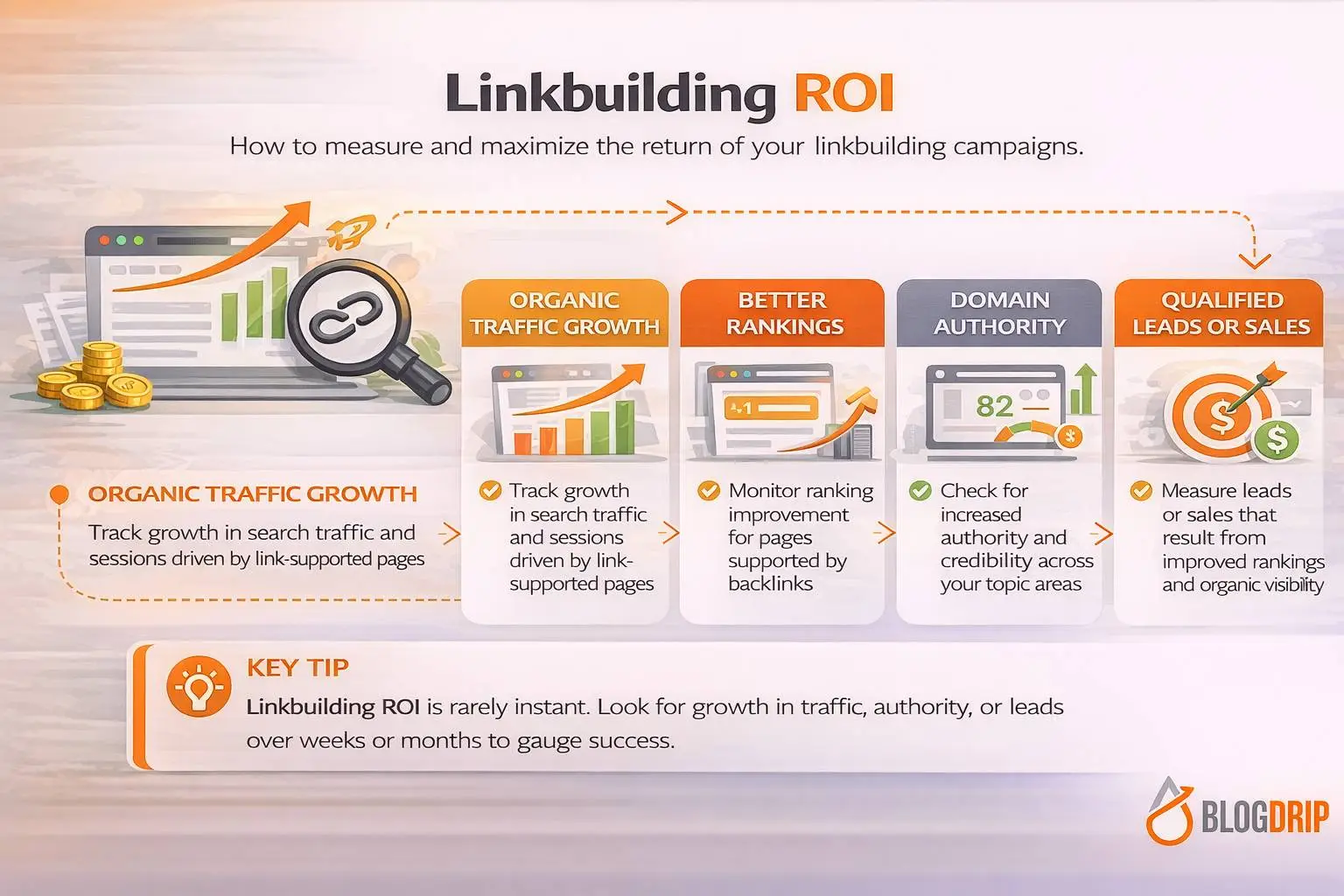
Linkbuilding ROI
Linkbuilding ROI is one of the most important and most misunderstood parts of SEO measurement. Many businesses invest in backlinks, outreach, content assets, or digital PR, but struggle to answer a simple question: is the investment actually producing value?
The difficulty comes from the fact that linkbuilding rarely behaves like a direct-response channel. A backlink does not usually create instant revenue in the way a paid ad might. Instead, it tends to influence rankings, visibility, authority, and traffic over time. That makes return on investment harder to measure, but not impossible. The writing guidance for this project emphasizes practical, publication-ready SEO content that is clear, strategic, and aligned with topical authority, which is exactly the right lens for this subject.
For a site using a pillar-and-cluster model, linkbuilding ROI should not be judged only at the page level. A single earned link can strengthen a key cluster page, which then supports related pages through internal linking and broader topic authority. That means return is often distributed across the wider site architecture, not confined to one URL. This broader structural view is consistent with the project guidance around internal linking, page roles, and long-term SEO value.
What Is Linkbuilding ROI?
Linkbuilding ROI is the return a business gets from the time, money, and effort invested in acquiring backlinks.
In practical terms, it measures whether linkbuilding is generating results that justify its cost. Those results may include:
- stronger rankings
- growth in organic traffic
- more referring domains
- better visibility for target pages
- increased authority for topic clusters
- more leads or revenue from organic search over time
This matters because linkbuilding is not free, even when links are not directly purchased. Internal staff time, agency retainers, freelancer support, content production, outreach tools, research, design, and reporting all contribute to the total investment. A serious assessment of ROI has to account for both the cost and the broader SEO outcomes.
Why Linkbuilding ROI Matters
Linkbuilding matters because backlinks remain one of the strongest off-page signals in SEO, but the cost of earning them can be significant. If teams do not measure return carefully, they often end up optimizing for the wrong thing.
It helps distinguish activity from value
A campaign may produce many backlinks without creating meaningful ranking gains. Another campaign may produce fewer links but strengthen the exact pages that drive future traffic and conversions. ROI helps separate surface activity from actual strategic impact.
It improves budget decisions
When businesses understand which linkbuilding methods create results, they can allocate budget more intelligently. They can invest more in tactics that support sustainable authority and reduce spend on low-value placements or volume-driven reporting.
It aligns linkbuilding with business goals
Good SEO strategy does not treat backlinks as vanity metrics. It connects them to traffic, visibility, and long-term business outcomes. Measuring ROI helps make that connection clearer.
It supports long-term thinking
A project brief focused on E-E-A-T, content quality, and topical architecture naturally points toward durable authority-building rather than quick wins. Linkbuilding ROI fits that model because it rewards strategies that compound over time instead of producing short-lived spikes.
How Linkbuilding ROI Works
Calculating linkbuilding ROI is not as simple as dividing one backlink by one sale. The process usually involves connecting cost to a chain of SEO effects.
Start with total investment
The first step is understanding the real cost of linkbuilding. That may include:
- agency or consultant fees
- internal team salaries and time
- outreach software
- content creation
- design work
- data or research costs
- reporting and quality control
Without a full cost view, ROI calculations tend to be misleading.
Define the outcomes you are measuring
Not every campaign should be judged by the same metric. Depending on the site’s stage and goals, useful outcomes may include:
- ranking improvements for promoted pages
- increased organic sessions
- higher visibility across a topic cluster
- lead growth from organic traffic
- stronger conversion performance on key landing pages
- growth in high-quality referring domains
For an early-stage site, ROI may be more about authority and visibility. For a mature site, it may connect more directly to revenue or pipeline.
Track changes over a realistic timeframe
Linkbuilding often works gradually. A strong link can improve a page’s ability to rank, but that influence usually appears over weeks or months rather than immediately. Judging return too early often leads to poor conclusions.
Attribute value carefully
A page may rank better after linkbuilding, but backlinks are rarely the only factor. Content quality, technical SEO, search intent alignment, and internal linking all shape the result. This means ROI in linkbuilding is often directional rather than perfectly isolated.
That is not a weakness. It is simply the reality of SEO as a system rather than a single-variable channel.
Important Metrics for Measuring Linkbuilding ROI
Organic traffic growth
One of the clearest ways to evaluate return is to look at organic traffic growth on the pages that were directly supported by linkbuilding. If those pages gain visibility and attract more qualified traffic over time, that is a strong sign of value.
Ranking improvement
Ranking gains are another important signal, especially for pages tied to commercially meaningful queries or strategically important topics. A page moving into stronger search positions can create compounding value beyond the initial backlink effort.
Referring domain quality
The number of links alone is not enough. The quality and relevance of the referring domains matter much more. A few strong editorial links can generate better ROI than dozens of weak placements.
Assisted cluster performance
For sites using a topic cluster structure, one linked page can help related pages through internal linking. This means ROI may show up across a broader set of URLs, not just the page that earned the backlink.
Leads and revenue from organic search
Where possible, linkbuilding ROI should connect to business outcomes. If improved rankings drive qualified traffic that later converts, that is one of the strongest forms of return. But it is important to evaluate this over the right time horizon rather than expecting immediate sales attribution.
Common Mistakes When Measuring Linkbuilding ROI
Focusing only on link count
This is the most common mistake. Link quantity can be easy to report, but it does not reveal whether the campaign improved visibility, authority, or business results.
Expecting instant revenue attribution
Linkbuilding often works upstream of the final conversion. It supports discovery, rankings, and trust. Demanding direct short-term revenue from every earned link usually underestimates how SEO actually performs.
Ignoring page quality
A linkbuilding campaign aimed at weak pages will often produce weak returns. If the destination page does not deserve to rank, backlinks alone cannot create strong ROI.
Underestimating internal linking
A linked page becomes more valuable when it passes relevance and authority to related pages. Ignoring this wider structural effect causes teams to undervalue the true return of good backlinks.
Using the wrong time window
A campaign measured after two weeks may look unprofitable, while the same campaign measured after four months may look highly efficient. SEO timing matters.
Practical Guidance for Improving Linkbuilding ROI
A strong linkbuilding strategy improves ROI by making each earned backlink more valuable.
Build pages that deserve authority
The better the destination page, the better the return potential. Strong educational guides, useful resources, original research, and well-structured cluster content are more likely to benefit from earned links.
Prioritize relevance over volume
A relevant backlink from a credible site generally creates more strategic value than a higher volume of weak placements. Quality improves both ranking impact and long-term profile strength.
Connect campaigns to topic clusters
Backlinks are more useful when they support pages that strengthen a wider topic area. A linked cluster page that connects naturally to related content can improve the return across multiple URLs.
Pair content and outreach deliberately
Linkbuilding works best when content creation and promotion are planned together. A page built with citation value is easier to promote and more likely to generate meaningful return.
Measure outcomes in layers
Useful ROI evaluation often includes:
- link quality
- ranking gains
- traffic growth
- visibility improvement across related pages
- lead or revenue contribution over time
This layered view is more realistic than relying on a single number.
Timing and Expectations
Linkbuilding ROI is usually delayed rather than immediate. A backlink may help a page gradually gain trust, move in rankings, and attract more traffic over time. In competitive spaces, this process can take longer.
That does not mean ROI is weak. It means it compounds. A strong link acquired today may still contribute to rankings, traffic, and authority months later, especially if it supports a well-built topic cluster. That long-term compounding effect is one reason linkbuilding remains strategically valuable even when direct attribution is imperfect.
For newer sites, the payoff may initially appear as stronger visibility and authority rather than direct revenue. For established sites, ROI may show up more clearly through improved rankings on important commercial pages and stronger organic conversion performance.
Conclusion
Linkbuilding ROI is not just about counting backlinks or forcing immediate sales attribution. It is about understanding whether the investment in earning links is creating stronger rankings, better visibility, healthier authority signals, and more valuable organic growth over time.
The best return usually comes from linkbuilding that supports strong content, relevant pages, and a clear internal architecture. That is especially true in a pillar-and-cluster model, where one strong backlink can strengthen a much wider topic area.
When measured properly, linkbuilding ROI becomes less about vanity metrics and more about strategic contribution. It shows whether linkbuilding is helping the site build real authority that compounds over time, which is ultimately what makes the investment worthwhile.