
How Many Backlinks Needed? A Realistic SEO Answer for Businesses
One of the most common questions in SEO is simple: how many backlinks needed to rank well?
It is an understandable question, but it has no fixed number as an honest answer. Some pages rank with very few backlinks. Others need a strong, relevant backlink profile just to compete for page one. The difference depends on the keyword, the intent behind it, the strength of competing pages, and the quality of the links involved.
That is why this topic is often misunderstood. Businesses ask for a target number when they should usually be asking a better question: how much authority do we need to compete in this search landscape?
This article explains how to think about backlink volume realistically, why raw totals can be misleading, what actually influences the number you need, and how to set better expectations in a cluster-based SEO strategy.
What Is How Many Backlinks Needed?
The phrase how many backlinks needed usually refers to how many external links a page or website needs to rank for a target keyword.
In practical SEO terms, that question is really about competitiveness. Backlinks are one of several signals that help search engines assess authority and trust. But they are not evaluated in isolation. A page does not rank just because it reaches a certain backlink count.
A more accurate framing is this: you need enough relevant authority to compete with the pages already ranking for your target search terms.
That may mean very few backlinks for low-competition informational content. It may mean a strong set of relevant, high-quality links for commercial keywords in crowded industries.
There is no universal backlink target
There is no reliable rule such as “10 backlinks for page one” or “50 links for a service page.” SEO does not work like that.
A page with three excellent, contextually relevant backlinks can outperform a page with 30 weak ones. Likewise, a very strong site architecture and excellent intent match can reduce how many backlinks a page needs in the first place.
So the useful answer to how many backlinks needed is not a number. It is a comparison against the actual search landscape.
Why This Question Matters
Even though the question has no fixed number, it still matters because backlink expectations affect planning, budget, and content strategy.
It helps set realistic SEO goals
Businesses often underestimate or overestimate link requirements. Some assume one or two links will solve a highly competitive SEO challenge. Others believe they need an enormous link count to rank for anything at all.
Both assumptions can lead to poor decisions. Good planning starts with realistic competitive analysis.
It shifts focus from volume to competitiveness
The question becomes useful when it stops being about totals and starts being about what level of authority your competitors already have.
That is how you move from guessing to strategy.
It helps prioritize the right pages
Not every page needs direct backlinks. In a pillar-and-cluster model, some informational pages are better link targets than commercial ones. Those stronger pages can then support related pages through internal linking.
That means the number of backlinks needed is also influenced by your site structure, not just the target page alone.
How to Think About How Many Backlinks Needed
A realistic answer comes from evaluating several factors together.
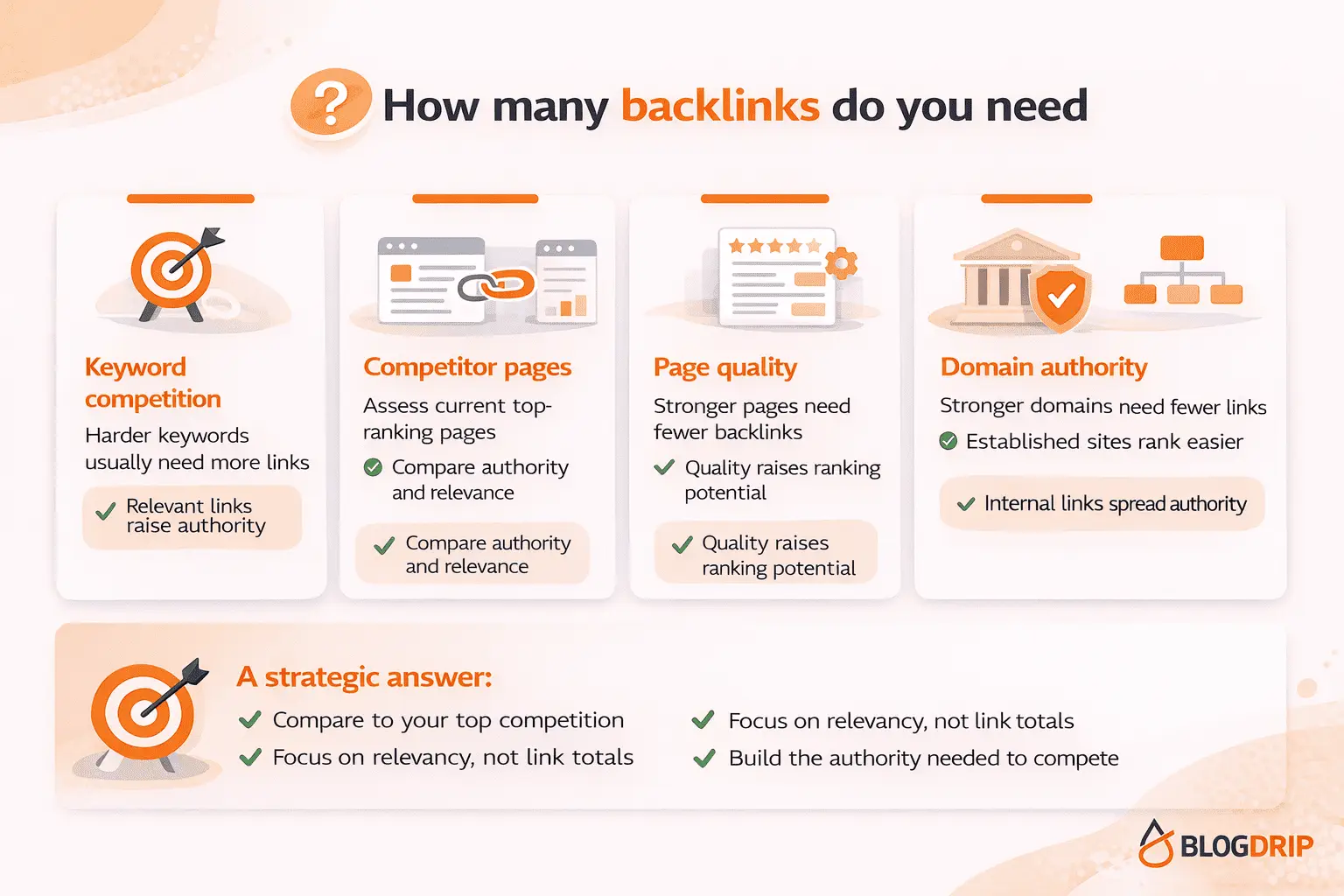
Keyword difficulty matters
The more competitive the keyword, the more likely backlinks will matter.
If you are targeting a low-competition query with strong intent alignment and useful content, you may need very few backlinks. If you are targeting a broad, high-value term dominated by established sites, the authority gap may be much larger.
This is one of the first filters to apply when thinking about how many backlinks needed.
Competitor profiles matter more than averages
Do not ask what the internet says you need. Ask what the pages already ranking in your niche appear to have.
Look at the current top-ranking pages and evaluate:
- how many referring domains they have
- how relevant those links are
- whether links point to the ranking page or mainly to the domain overall
- how strong the content is
- how strong the brand behind the page is
This comparison gives you a much more useful benchmark than any generic SEO rule.
Page quality changes the answer
A weak page needs more help and still may not rank. A strong page may need fewer backlinks because it satisfies search intent better, is better structured, and creates stronger user value.
Backlinks amplify quality. They do not replace it.
That means better content can reduce how many backlinks are needed, while poor content can make backlink targets effectively meaningless.
Domain strength changes the answer too
A new website often needs more external authority-building than an established site with a strong existing backlink profile.
If your domain already has trust, topical depth, and strong internal linking, a new page may rank with relatively few direct backlinks. If your site is new or weak, the same page may need much more support.
Important Subtopics That Influence Link Requirements
Referring domains vs total backlinks
When estimating how many backlinks needed, referring domains are usually more useful than raw backlink count.
One hundred backlinks from one website is not the same as 20 backlinks from 20 relevant websites. Diversity of credible referring domains often tells you more than total link volume.
Relevance matters more than totals
A smaller number of high-quality, topically relevant backlinks can outperform a much larger number of generic or weak links.
This is why businesses often misjudge competition. They compare totals without comparing quality.
Internal linking reduces pressure on direct linkbuilding
Strong internal linking can help distribute authority from well-linked pages to related pages in the same cluster.
This means not every page needs to earn its own large backlink profile. In many cases, a pillar page or a strong informational asset can attract links and support the wider topic area internally.
Search intent can outweigh link count
Some pages rank because they answer the query better, even when their backlink profile is modest. If a competitor has more links but weaker intent match, a better page can still compete.
That is why link requirements should never be assessed separately from search intent.
Common Mistakes When Asking How Many Backlinks Needed
Looking for a magic number
This is the biggest mistake. SEO does not provide one universal threshold for backlinks.
Any answer that promises a fixed number without reference to competition, content, or domain context is oversimplifying the problem.
Focusing on quantity over quality
More backlinks do not automatically mean better rankings. A page with fewer relevant links may outperform one with many low-quality placements.
The question is not only how many. It is what kind.
Ignoring the page itself
If the page is poorly written, thin, or not aligned with the keyword’s intent, even a strong backlink push may create disappointing results.
Building links to every page equally
Not every page deserves direct linkbuilding effort. Some pages are naturally better at attracting backlinks and can support the rest of the site through internal links.
A mature SEO strategy recognizes that difference.
Practical Guidance
A better way to approach this question is to replace “how many backlinks needed” with “how much authority do we need to close the gap?”
A practical process looks like this:
- identify the exact keyword or page type you want to rank
- review the current top-ranking pages
- compare referring domains, not just total links
- assess content quality and intent match
- estimate whether your page can compete on-page first
- decide whether direct backlinks, internal support, or both are needed
Focus on relative strength, not absolute numbers
If the current top pages all have strong relevant backlinks and established domain authority, you are probably entering a high-competition space.
If they have modest profiles and mixed content quality, the opportunity may be more accessible than it first appears.
Prioritize linkable assets
In many cases, your best route is not to force backlinks to a service page. It is to build stronger informational pages, earn links there, and use internal linking to support commercial sections.
This is often the smartest answer in a cluster strategy.
Build toward authority, not just rankings
A page that earns a few strong, relevant links can support more than itself if it sits inside a good site structure. That makes each link more valuable over time.
Timing and Expectations
Even when you secure enough backlinks to be competitive, results are rarely immediate.
Search engines still need time to crawl those links, process their context, and reflect their impact in rankings. Outcomes also depend on how those links interact with content quality, internal linking, and the overall trust of the domain.
For newer sites, progress is usually gradual. For established sites, smaller backlink gains may be enough to move already-competitive pages upward.
The realistic expectation is steady progress, not instant movement as soon as a number is reached.
Conclusion
So, how many backlinks needed?
The honest answer is: enough relevant authority to compete with the pages already ranking for your target query. Sometimes that is very few. Sometimes it is a meaningful link gap that takes time to close.
What matters most is not hitting a universal number. It is understanding your competition, improving page quality, earning relevant backlinks, and using internal linking to turn those gains into broader topical strength.
For websites building authority through a pillar-and-cluster model, that is the more strategic way to think about backlinks. The goal is not to chase numbers. The goal is to build enough credible authority for your best pages to win where it matters.