
How to Use Anchor Text Strategically Without Over-Optimizing
Anchor text looks simple on the surface. It is just the clickable text in a link. But in SEO, it plays a much bigger role than many site owners realize. It helps users understand what they are about to click, gives search engines context about the destination page, and influences how relevance is distributed across a site.
That is why anchor text SEO matters. Used well, anchor text supports internal linking, improves clarity, and reinforces topical relationships between pages. Used badly, it can make content feel forced, create weak user experience, and contribute to an over-optimized link profile.
This article explains what anchor text is, why it matters for SEO, how to use it properly, what mistakes to avoid, and how to think about it in a modern pillar-and-cluster strategy.
What Is Anchor Text SEO?
Anchor text SEO refers to the strategic use of clickable link text to improve clarity, topical relevance, and link context for users and search engines.
Anchor text is the visible text people click on in a hyperlink. For example, if a page links to another article using the words “internal linking strategy,” those words are the anchor text.
In practical SEO terms, anchor text helps answer a basic question: what is on the page being linked to?
That is useful for both readers and search engines. Readers get better navigation cues. Search engines get contextual hints about the destination page and the relationship between pages.
A simple definition
Anchor text is the clickable wording inside a link.
From an SEO perspective, good anchor text is:
- clear
- relevant
- natural in the sentence
- helpful to the reader
- aligned with the destination page
That last point matters. Strong anchor text should match the destination well, not just force a keyword into the link.
Why Anchor Text SEO Matters
Anchor text matters because links are not only pathways. They are also signals.
A link tells search engines that one page connects to another. Anchor text adds context to that connection. It helps explain why the destination page is relevant.
It improves contextual relevance
Anchor text gives search engines a clue about the subject of the linked page. If multiple relevant pages link to a destination using natural topical phrases, that can help reinforce how the page fits into a topic cluster.
This is especially useful for internal linking, where you control the anchor text directly.
It improves user experience
Good anchor text makes navigation easier. It tells users what they will find after the click. That creates a smoother reading experience and helps people move through your site more confidently.
Weak anchor text such as “click here” or “read more” is not always wrong, but it often adds less clarity than descriptive wording.
It supports topic clustering
In a pillar-and-cluster structure, anchor text helps define relationships between pages. A pillar page can link to supporting articles with clear, topic-relevant anchors. Cluster pages can link back to the pillar or across related subtopics with equally natural phrasing.
That makes your content structure easier to understand for both users and search engines.
How Anchor Text SEO Works
Anchor text works by adding semantic context to links.
When one page links to another, search engines can look at the words in and around the link to better understand the topic of the destination page. That context is not the only ranking signal, but it is still useful.
Internal anchor text
Internal anchor text is the most controllable form of anchor text SEO.
You choose where the link goes, what wording is used, and how the linked page fits into the site structure. This makes internal linking one of the best places to apply anchor text strategy carefully and consistently.
For example, a guide about backlinks might internally link to related pages using anchors such as:
- anchor text strategy
- types of backlinks
- backlink quality
- internal linking best practices
These anchors help reinforce topic relationships without sounding repetitive.
External anchor text
External anchor text refers to the wording used when other websites link to you, or when you link out to other websites.
You can control outbound anchor text from your own site, but you usually have limited control over how other sites link back to you. That is why backlink anchor text profiles should be judged by patterns, not by single examples.
A healthy backlink profile usually includes a mix of branded anchors, topical phrases, plain URLs, and general wording. Overly aggressive exact-match anchors can look manipulative.
Important Types of Anchor Text
Understanding anchor text SEO also means understanding the main categories of anchor text.
Exact-match anchor text
This uses the exact target keyword as the clickable text.
For example, linking to a page about anchor text SEO with the exact words “anchor text SEO.”
This can be useful occasionally, especially in internal linking, but it should be used carefully. Repeating exact-match anchors too often can make content feel forced.
Partial-match anchor text
This includes a variation of the keyword rather than the exact phrase.
Examples might include:
- guide to anchor text
- using anchor text for SEO
- anchor text best practices
This is often a safer and more natural option than exact-match repetition.
Branded anchor text
This uses a brand name as the link text.
Branded anchors are common in backlink profiles and help create a more natural mix of link signals.
Generic anchor text
This includes phrases such as “learn more,” “this article,” or “read here.”
Generic anchors are not automatically bad, but they usually provide less context than more descriptive anchors.
Naked URL anchor text
This is when the full URL itself is used as the link text.
It is common in citations, references, and some backlink contexts, though it is usually less elegant in body copy.
Common Mistakes in Anchor Text SEO
Most anchor text problems come from over-optimization or weak editorial judgment.
Overusing exact-match anchors
This is one of the most common mistakes. Using the same exact keyword again and again can make your content feel unnatural and create an artificial pattern.
A better approach is anchor text variation. Use different but relevant phrases that still match the destination page clearly.
Writing for search engines instead of readers
Anchor text should fit naturally into the sentence. If the wording sounds awkward or forced, the problem is usually not SEO. It is poor writing.
Good anchor text supports readability first.
Using vague anchors too often
Phrases like “click here” are not always wrong, but they often waste an opportunity to give clearer context. Descriptive anchor text usually improves both usability and SEO value.
Mismatching anchor text and destination page
A link should lead to what the anchor text suggests. If the wording implies one topic but the destination page covers something else, that weakens trust and clarity.
Practical Guidance for Better Anchor Text
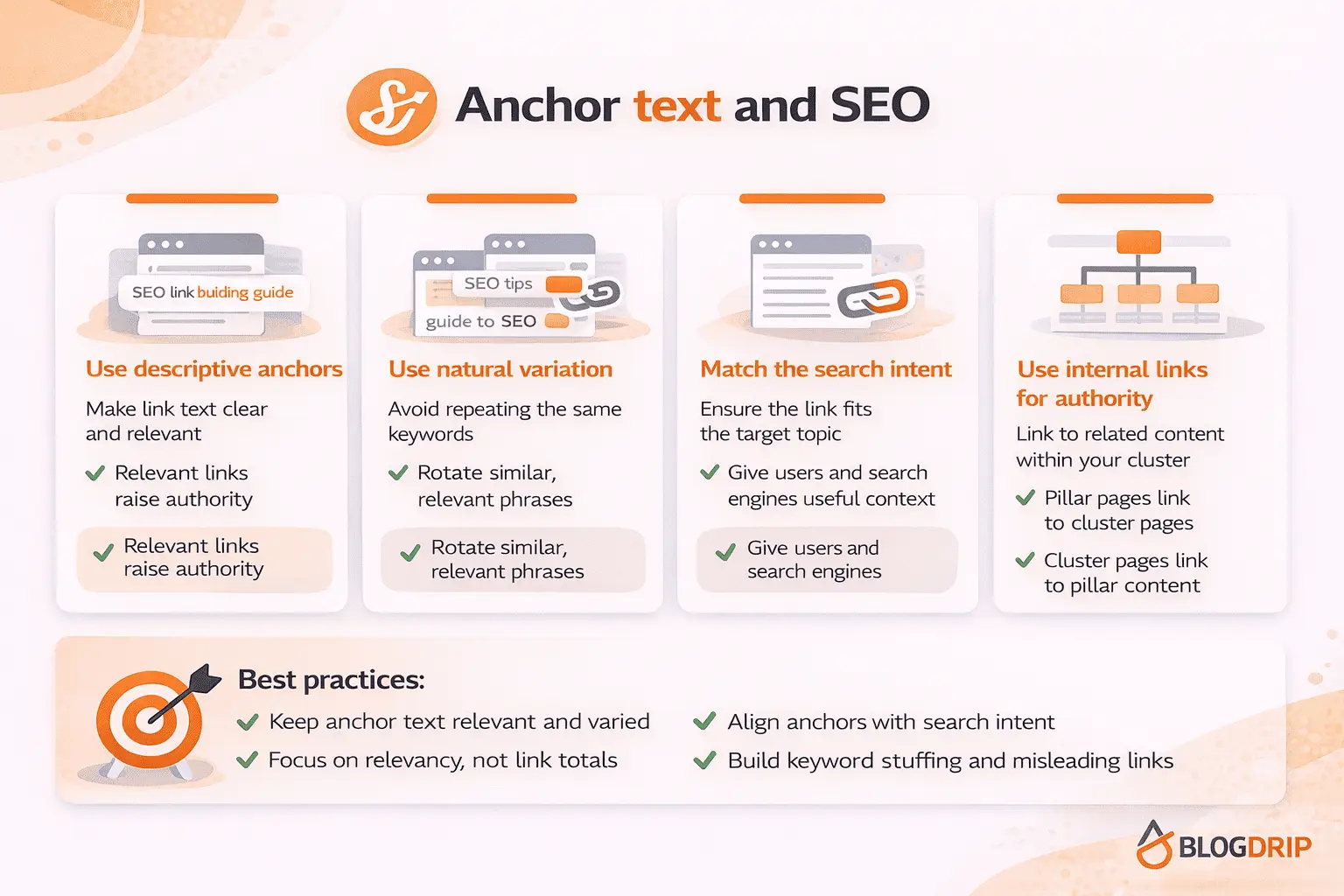
The best anchor text SEO strategy is usually simple: be descriptive, be natural, and vary your phrasing.
A good working standard is this: the anchor should help a reader understand what the destination page is about before they click.
Prioritize clarity
If a reader can predict the destination accurately from the anchor text, that is usually a good sign.
For example, “backlink quality assessment” is clearer than “this guide” if the linked page specifically covers backlink quality.
Use variation naturally
Not every link to the same page should use identical wording. Variation makes the content feel more natural and creates a healthier pattern.
Instead of repeating one exact phrase, you might rotate between:
- backlink quality guide
- assessing link quality
- what makes a backlink valuable
- backlink relevance and trust
This is especially useful across internal links.
Match the page’s intent
Anchor text should reflect what the destination page actually delivers. An informational article should usually be linked with an informational anchor. A commercial page should be linked in a way that fits that purpose.
This keeps expectations aligned.
Use anchor text strategically in clusters
In a topic cluster, anchor text can help define relationships between pages. Pillar pages can use broader anchors for cluster pages. Cluster pages can use more specific anchors back to supporting content or up to the pillar page.
That creates a stronger topical map across the site.
Timing and Expectations
Anchor text changes are not usually dramatic on their own. Good anchor text supports SEO incrementally by improving internal linking, contextual signals, and user clarity.
In most cases, you should not expect anchor text updates alone to transform rankings overnight. Their value comes from being part of a broader structure that includes strong content, thoughtful internal linking, and relevant backlinks.
That said, improving weak or repetitive anchor text can make a noticeable difference over time, especially on larger content sites with many related pages.
Conclusion
Anchor text SEO is not about forcing keywords into every link. It is about using link text in a way that improves clarity, supports relevance, and strengthens the structure of your site.
Good anchor text helps readers understand where they are going. It helps search engines understand how pages connect. And in a pillar-and-cluster model, it plays an important role in showing topical depth and logical content relationships.
The best approach is usually the simplest one: write anchor text that is natural, descriptive, and closely aligned with the destination page. That creates better user experience, stronger internal linking, and a healthier SEO foundation over time.