
Natural Link Profile: What It Means and Why It Matters in SEO
A natural link profile is one of the clearest signs that a website is earning attention in a credible way. It does not mean every backlink is perfect. It means the overall pattern of links pointing to a site looks earned, relevant, and proportionate rather than engineered purely to influence rankings.
That distinction matters. Many link building campaigns fail not because links do not work, but because the profile they create looks artificial. Too many exact-match anchors, too many links from weak sites, or too many backlinks aimed at the wrong pages can make a website look manipulated instead of trusted.
For websites built around a pillar-and-cluster model, this topic is especially important. A strong content structure helps define topical authority on-site, but the backlink profile around that structure helps validate it externally. This page explains what a natural link profile is, why it matters, and how to build one without relying on outdated link building habits.
What Is a Natural Link Profile?
A natural link profile is the overall mix of backlinks a website earns in a way that resembles normal editorial and brand-driven growth.
In practical terms, that means the backlink profile shows variety. Links come from different types of websites, point to different pages, use different anchor texts, and appear over time in a way that looks consistent with real visibility rather than manufactured activity.
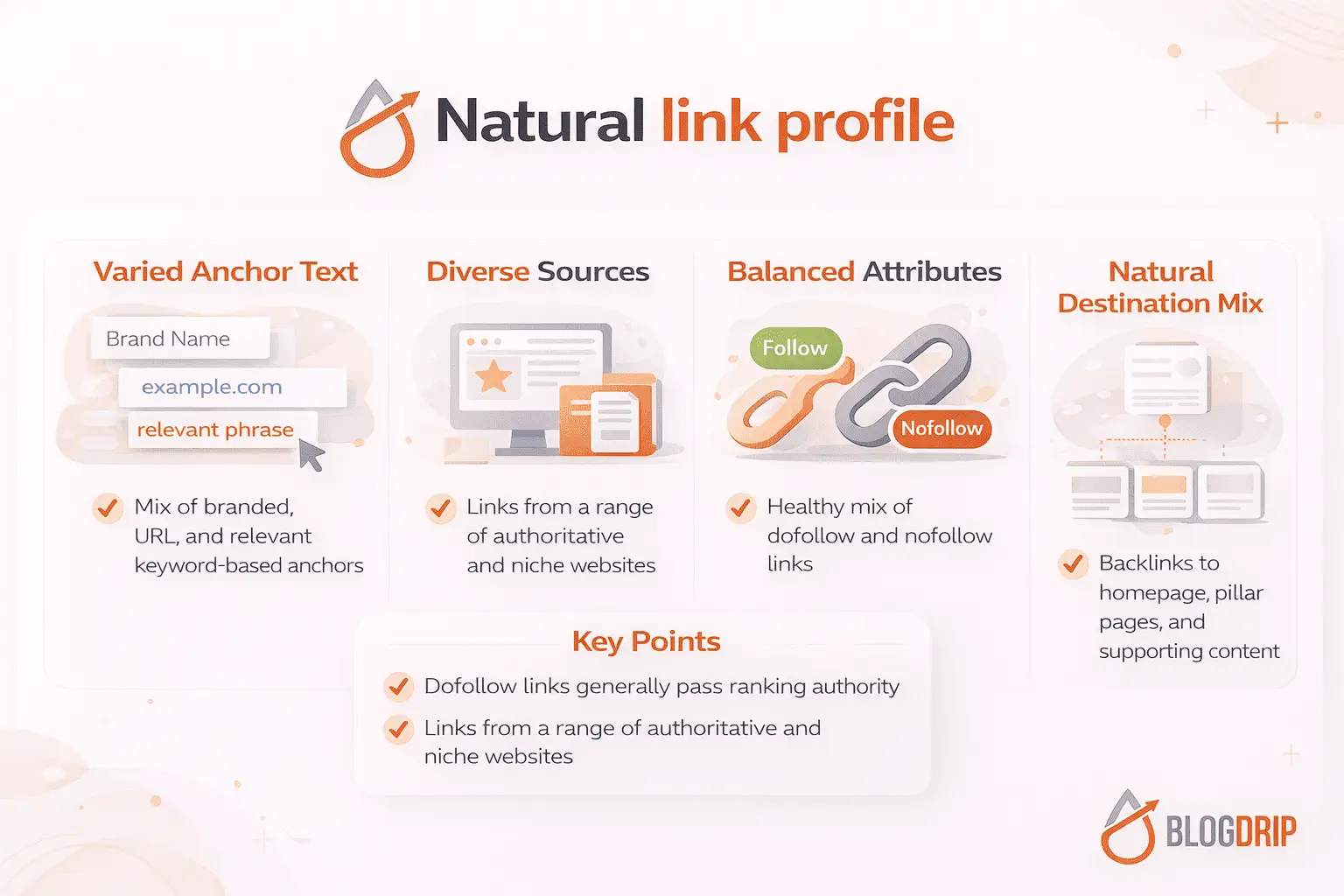
A natural link profile usually includes a mix of:
- branded anchors
- partial-match and descriptive anchors
- follow and nofollow links
- homepage links and deep links
- links from highly authoritative sites and smaller relevant publications
The key idea is balance. Search engines do not expect every backlink to look identical, and neither should you. Real websites earn links in uneven but believable ways.
Why It Matters
A natural link profile matters because search engines do not evaluate backlinks one by one in isolation. They also look at the broader pattern.
If a site has hundreds of backlinks with identical anchor text, all pointing to one commercial page, from low-quality sites that exist mainly to publish links, that profile looks manipulated. Even if some individual links are indexed, the overall signal is weak.
A more natural backlink profile tends to support SEO in three ways.
First, it strengthens trust. A varied profile is more consistent with real editorial behavior.
Second, it supports topical relevance. When links come from related pages and point to content that fits the subject matter, the signals are stronger.
Third, it reduces dependency on any single tactic. A site that earns mentions through content, digital PR, resources, citations, and partnerships is usually more resilient than one built on one narrow method.
For cluster-based SEO, this matters because backlinks should reinforce the site architecture, not distort it. A natural profile helps support both broad pillar pages and focused supporting content.
How a Natural Link Profile Works
A natural link profile is not something you create by randomly mixing link types. It emerges when content quality, site structure, and outreach approach are aligned.
If your site publishes useful content and earns references from relevant sources, the pattern usually develops in a balanced way. Some publishers use branded anchors. Some link to your homepage. Others cite a specific guide or supporting article. Some links are followed, others are nofollowed. That variation is normal.
Anchor text distribution
Anchor text is one of the clearest signals in any backlink profile. In a natural profile, anchors vary.
You will usually see:
- brand name anchors
- naked URLs
- partial-match anchors
- descriptive phrases
- occasional generic anchors such as “this guide” or “read more”
What you should not see is a profile dominated by aggressive exact-match commercial anchors. That pattern often reflects SEO-first link placement rather than real editorial choice.
Link destination diversity
Natural profiles do not send every backlink to the homepage or to one money page.
Some links should point to brand-level pages, but others should support deeper content. In a pillar-and-cluster structure, that often means backlinks should be distributed across pillar pages, cluster pages, and standout supporting resources where relevant.
This helps search engines understand that your site has depth, not just one page being artificially promoted.
Source diversity
Not every good link has to come from a major publication. A natural link profile often includes different source types: industry blogs, niche publications, business directories, associations, expert roundups, tools pages, local citations, and editorial mentions.
The important question is not whether every site is high authority by a third-party metric. It is whether the site is credible, relevant, and capable of sending a legitimate signal.
Important Subtopics
Relevance matters more than appearances
A profile can look diverse on the surface and still be weak if the links are topically irrelevant. Relevance should sit at the center of link evaluation.
For example, a B2B SaaS website is usually better served by links from industry publications, marketing blogs, technology resources, and business websites than by a random collection of unrelated domains.
A natural link profile is not just varied. It is varied within a believable topical ecosystem.
Follow and nofollow should both exist
A normal backlink profile includes both follow and nofollow links. Real brands get mentioned in places that use different link policies.
This is one reason the discussion around [dofollow vs nofollow] should be handled carefully. Followed links often matter more for direct SEO impact, but nofollow links can still contribute to visibility, referral traffic, and profile credibility.
Deep links support topical authority
If all backlinks point only to the homepage, the site may struggle to build strength across its wider content structure. Deep links to relevant cluster pages help reinforce specific topics.
That is why pages covering subjects such as [contextual backlinks] or anchor text strategy can become valuable link targets within a broader authority-building plan.
Common Mistakes
Forcing exact-match anchors
This is one of the fastest ways to make a backlink profile look engineered. Exact-match anchors can occur naturally, but when they dominate, the pattern becomes obvious.
Building links only to commercial pages
A natural profile usually includes links to informational content, branded pages, research assets, and tools, not just conversion-focused landing pages.
Prioritizing quantity over credibility
Large volumes of weak links can make a profile noisier without making it stronger. In many cases, a smaller set of relevant editorial links is more useful than a large number of low-quality placements.
Using the same acquisition tactic repeatedly
If most of your backlinks come from one pattern, such as low-end guest posts or generic directories, the footprint becomes predictable. A stronger profile usually reflects multiple legitimate acquisition paths.
Practical Guidance
The best way to build a natural link profile is to stop trying to manufacture one directly and instead build the conditions that produce it.
Start with content worth referencing. That includes strong pillar pages, focused cluster pages, original viewpoints, useful frameworks, and pages that genuinely solve a problem.
Then make link acquisition more selective. Look for sites that are topically aligned and editorially credible. Ask whether the link would still make sense if rankings were not the goal.
A practical approach usually includes:
- earning branded mentions as well as keyword-relevant links
- building links to both pillar content and supporting pages
- accepting a mix of followed and nofollowed mentions
- varying anchor text naturally
- focusing on relevance before metrics
You should also review backlink patterns regularly. Not every audit needs to become a cleanup project, but you should understand whether your link profile reflects the site you are trying to build.
Timing and Expectations
A natural link profile is not built quickly. In most cases, it develops over time as content earns attention, relationships grow, and the site publishes more pages worth citing.
That is why aggressive short-term link building often creates unnatural patterns. It moves faster than real visibility normally develops.
The better expectation is gradual compounding. As your content cluster matures and earns more references, the backlink profile should broaden in a way that supports long-term authority rather than short-term spikes.
Conclusion
A natural link profile is not about randomness. It is about credibility.
The strongest backlink profiles show variation in anchor text, source types, destination pages, and link attributes, while still staying relevant to the site’s topic and purpose. That is what makes the pattern believable to search engines and useful for long-term SEO.
For a website built around topical authority, this should be the goal. Do not chase a profile that looks manipulated but technically optimized. Build one that reflects real editorial trust, supports the right pages, and grows in line with the quality of your content.