
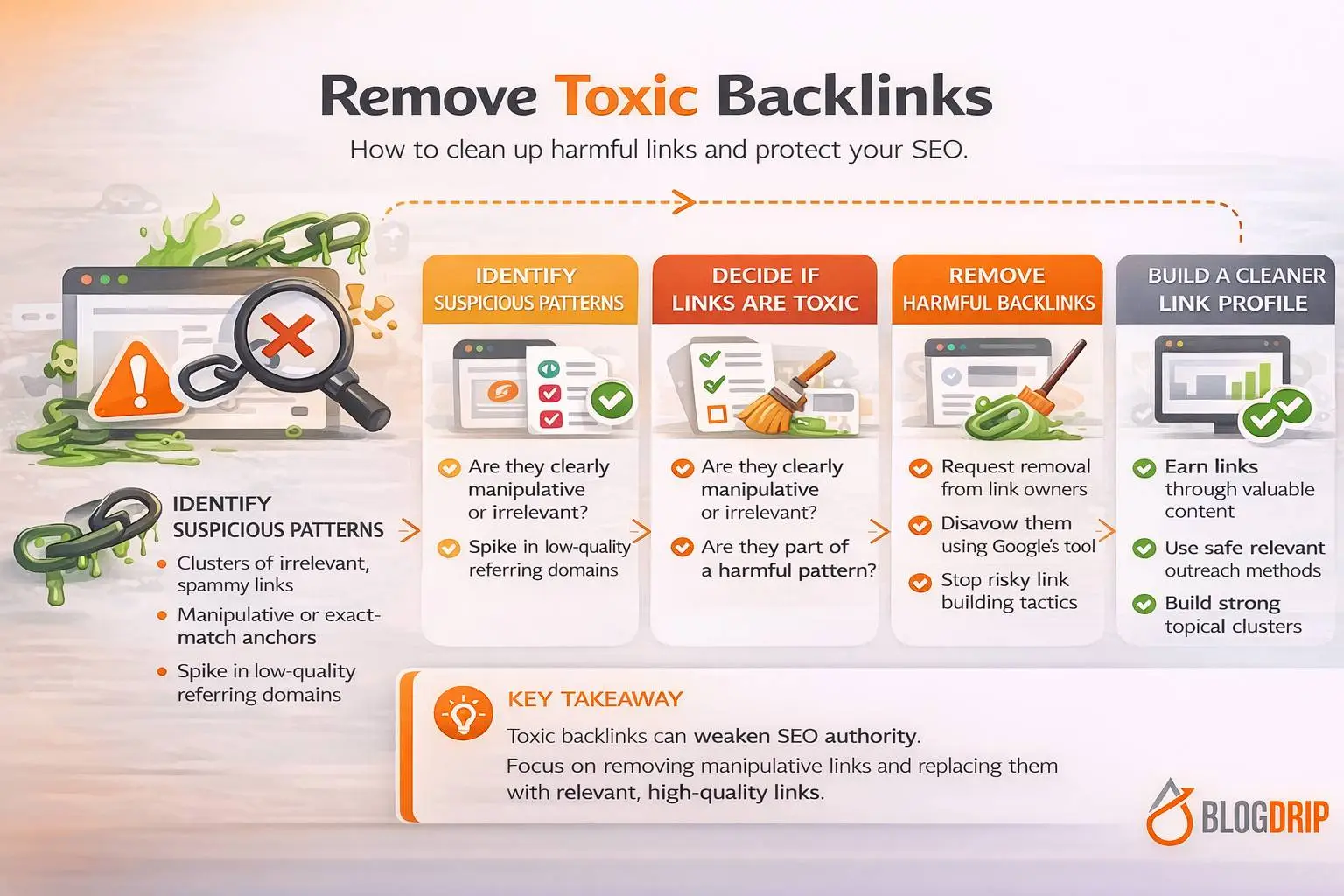
Remove Toxic Backlinks
The idea of “toxic backlinks” has become common in SEO, but it is often used too loosely. Many site owners assume that any low-quality or suspicious-looking link is automatically dangerous and should be removed immediately. In practice, the situation is more nuanced.
When people search for how to remove toxic backlinks, they are usually trying to protect rankings, recover from a backlink problem, or reduce the risk of Google penalties. That is a reasonable concern. Backlinks can absolutely become a problem when they are part of manipulative patterns, spam-heavy campaigns, or low-trust linkbuilding tactics. But not every weak link requires aggressive cleanup, and not every ranking issue is caused by so-called toxic backlinks.
That is why this topic needs a careful approach. The goal is not to panic over every questionable referring domain. The goal is to identify genuinely harmful patterns, understand whether action is necessary, and strengthen the overall backlink profile in a way that supports long-term SEO performance. For a site building topical authority through a pillar-and-cluster model, that means focusing on trust, relevance, and sustainable authority rather than reacting to every imperfect link.
What Does “Remove Toxic Backlinks” Mean?
Remove toxic backlinks means identifying backlinks that may harm a website’s SEO performance and taking steps to eliminate or neutralize their impact.
In practical terms, this usually involves:
- reviewing the backlink profile for suspicious patterns
- identifying low-quality, manipulative, or irrelevant links
- deciding whether those links actually represent a risk
- requesting removal where appropriate
- reducing dependence on harmful linkbuilding tactics going forward
The phrase “toxic backlinks” is popular because it sounds precise, but it can also be misleading. A backlink is rarely harmful in isolation just because a tool labels it suspicious. The bigger issue is usually whether the site has a broader pattern of manipulative or low-trust links.
That distinction matters because SEO decisions should not be based only on automated toxicity scores. They should be based on relevance, editorial quality, intent, and the overall shape of the backlink profile.
Why Toxic Backlinks Matter
Toxic backlinks matter because backlinks are still one of the strongest external signals in SEO. When a site accumulates links through manipulative, spam-heavy, or low-quality sources, those links can weaken trust instead of building authority.
They can contribute to penalty risk
One of the clearest concerns is that a poor backlink profile may contribute to manual actions or broader distrust around the site’s authority signals. This usually happens when the link profile suggests deliberate manipulation rather than natural growth.
They can distort linkbuilding strategy
Sites that accumulate toxic links often do so because the broader strategy is flawed. They rely on shortcuts such as paid placements, spam-heavy automation, link networks, or weak outreach rather than building assets that deserve links.
They can make diagnosis harder
A site with ranking problems may waste time chasing technical explanations when the real issue is an unhealthy backlink profile. At the same time, some site owners overreact and blame backlinks for everything. This is why careful review matters.
They can weaken long-term trust
Even if questionable links do not trigger an obvious penalty, a backlink profile built on weak signals is rarely a strong foundation for durable rankings. Authority compounds best when it is earned through relevance and quality, not manufactured through low-trust placements.
What Makes a Backlink “Toxic”?
A backlink is usually considered toxic when it appears manipulative, irrelevant, spam-heavy, or part of a broader pattern designed to influence rankings artificially.
Common characteristics of toxic backlinks
These links often come from:
- irrelevant websites with no topical fit
- pages built mainly to sell or place links
- low-quality directories or profile spam
- private blog networks
- auto-generated content pages
- thin sites with heavy outbound link footprints
- hacked or compromised pages
- repetitive exact-match anchor schemes
The real issue is not simply that the website looks weak. It is that the link appears to exist for ranking manipulation rather than for any editorial reason.
Context matters more than labels
Many SEO tools assign “toxic” or “spam” scores, but those labels are only a starting point. A backlink can look suspicious in a tool and still be largely irrelevant to actual risk. On the other hand, some links that look clean by simple metrics may still be part of manipulative patterns.
This is why manual review matters. A useful question is:
Would this link still make sense if SEO were removed from the equation?
If the answer is no, the placement deserves closer scrutiny.
How to Evaluate Whether Toxic Backlinks Need Removal
Removing links without good judgment can waste time and create unnecessary confusion. The first step is to decide whether the backlinks are genuinely harmful or simply low value.
Look at the overall pattern
One weak link is rarely the core problem. A stronger sign of risk is a pattern such as:
- large clusters of irrelevant domains
- many links from obvious link-selling sites
- anchor text that is overly optimized
- repeated placement types across suspicious pages
- backlink spikes tied to aggressive campaigns
Patterns reveal strategy. That is what matters most.
Review relevance and editorial quality
Check whether the referring sites and pages are relevant to your topic. Ask whether the content is real, useful, and selective about linking out. If the page exists mainly to host links, the placement is weak no matter what the domain metrics suggest.
Compare backlinks to the site’s own strategy
If the site has been using aggressive paid backlinks, spammy niche edits, manipulative guest posting, or link networks, then toxic backlinks are more likely to be part of a meaningful problem. If not, some suspicious links may simply be noise rather than something that needs urgent removal.
Separate weak links from real risk
A low-quality link is not always a dangerous link. Some backlinks are just low value. Others suggest active manipulation. The second category deserves more attention than the first.
Important Subtopics Within Removing Toxic Backlinks
Manual actions and unnatural links
One of the clearest reasons to clean up backlinks is the presence of a manual action related to unnatural links. In that scenario, removal work becomes more urgent because the issue has already been identified as serious.
Toxic backlink tools
SEO tools can be useful for finding patterns and prioritizing review, but they should not make the final decision on their own. A toxicity score is not a substitute for SEO judgment.
A healthy process is to use tools for discovery, then manually confirm:
- whether the site is relevant
- whether the page has real quality
- whether the link placement looks editorial
- whether the anchor text pattern looks forced
Paid and manipulative links
Backlinks acquired through undisclosed paid placements, link insertions, private networks, or overt ranking manipulation are more likely to require action than random weak backlinks. These are often the links that create broader profile problems.
Anchor text over-optimization
Sometimes the issue is not just the linking domain but the anchor pattern. If a site has too many exact-match commercial anchors from questionable sources, that can make the backlink profile look manufactured.
Common Mistakes When Trying to Remove Toxic Backlinks
Removing links purely because a tool flagged them
This is one of the most common mistakes. Automated tools can overstate the danger of harmless or irrelevant links. Acting without manual review often leads to wasted effort.
Treating every bad link as a crisis
Some weak backlinks add no value but also cause little meaningful harm. A site owner can spend too much time trying to clean up noise while ignoring bigger strategic issues such as weak content or poor internal linking.
Ignoring the source of the problem
If toxic backlinks came from an agency, previous SEO vendor, paid campaign, or manipulative internal strategy, then simply removing links is not enough. The underlying behavior has to stop.
Focusing only on cleanup
Removing toxic backlinks can help reduce risk, but it does not build authority by itself. A site still needs better content, stronger page roles, and healthier link acquisition going forward.
Sending every request blindly
Not every weak link deserves outreach. Removal requests should be focused on the links that actually matter, especially those tied to manipulative patterns or serious relevance problems.
Practical Guidance for Removing Toxic Backlinks
A smart cleanup process should be selective, evidence-based, and tied to the site’s wider SEO strategy.
Audit the backlink profile carefully
Start by identifying suspicious patterns, not just isolated domains. Look at:
- relevance of referring domains
- quality of linking pages
- anchor text distribution
- placement style
- backlink growth trends
This helps distinguish random noise from genuine profile risk.
Prioritize clearly manipulative links
The highest-priority candidates for removal are often:
- paid links intended to pass ranking value
- private network placements
- spam-heavy directory or profile links
- irrelevant niche edits
- exact-match anchor schemes on weak sites
These are more likely to undermine trust than a handful of low-value links with no real pattern.
Request removal where it makes sense
If the links are clearly manipulative and on real sites with reachable owners, removal requests can be a practical step. Keep requests short, factual, and specific.
Strengthen the site’s own authority
Cleanup should happen alongside improvement. Publish stronger resources, improve key cluster pages, reinforce internal linking, and build assets worth citing. This makes the site less dependent on questionable backlinks and more capable of earning better ones.
Shift to safer linkbuilding methods
If the site has relied on risky tactics, replace them with better approaches such as:
- content-led linkbuilding
- useful linkable assets
- relevant outreach
- digital PR
- high-quality guest contributions
- broken link building with real editorial fit
This is what turns backlink cleanup into actual recovery rather than temporary maintenance.
Timing and Expectations
Removing toxic backlinks is rarely an instant fix. Even when harmful links are identified and addressed, improvements may take time.
Several factors affect the timeline:
- how serious the backlink issue is
- whether there is a manual action
- how much of the profile is manipulative
- whether the site also has content or technical weaknesses
- how quickly better signals replace weak ones
This is why expectations should stay realistic. Link cleanup can reduce risk and support recovery, but it does not guarantee quick ranking gains on its own. In many cases, the bigger win is restoring a healthier foundation for future SEO growth.
Conclusion
To remove toxic backlinks effectively, the goal is not to erase every imperfect link. The goal is to identify the links and patterns that genuinely undermine trust, reduce dependence on manipulative tactics, and rebuild a backlink profile that supports authority rather than imitates it.
That means the best approach is selective and strategic. Review the profile carefully, focus on links that clearly reflect manipulation or low trust, and pair cleanup work with stronger content and safer linkbuilding methods.
For a site building topical authority, this is the right long-term path. A clean backlink profile matters, but it becomes most valuable when it supports pages that genuinely deserve visibility and connect naturally to a wider topic cluster.