
Types of Backlinks: Which Ones Matter for SEO?
When people talk about backlinks, they often treat them as if they all carry the same value. They do not. Some links can strengthen authority and help strong pages compete. Others are weak, irrelevant, or mostly neutral. A few can become a problem if they come from manipulative sources or exist only to influence rankings artificially.
That is why understanding the main types of backlinks matters. If you are building topical authority through a pillar-and-cluster model, the goal is not to collect as many links as possible. The goal is to earn the right kinds of links to the right pages.
This article explains the main types of backlinks, why they matter, how to evaluate them, and what businesses often get wrong.
What Are Types of Backlinks?
The phrase types of backlinks refers to the different ways backlinks can be grouped based on source, placement, purpose, or technical attribute.
A backlink is any link from another website to your website. But backlinks are not all created equally. They can come from editorial articles, guest posts, news sites, directories, resource pages, communities, business partners, or social platforms. They can also be standard links, nofollow links, sponsored links, or user-generated links.
That difference matters because search engines evaluate links in context. A relevant editorial link from a respected site is very different from a low-value link placed on an unrelated page.
So when you think about the types of backlinks, the most useful question is not simply what category a link belongs to. It is whether the link is credible, relevant, and strategically useful.
Why Types of Backlinks Matter
Backlinks remain an important part of SEO because they help search engines understand whether other websites consider your content worth referencing.
But backlinks influence SEO differently depending on the kind of link.
Some links strengthen authority more than others
A contextual link from a trusted industry site usually carries more value than a random listing or a weak site-wide placement. That is why quality matters more than totals.
Some links are more useful for trust than rankings
Not every good backlink needs to be judged only by ranking impact. Some links drive relevant traffic, reinforce brand visibility, or support credibility in your market.
Some link types carry more risk
Low-quality paid placements, irrelevant directories, or manipulated anchor text patterns can weaken a backlink profile rather than strengthen it. A poor link strategy often looks impressive in spreadsheets but performs badly in practice.
How Backlinks Work in Practice
A backlink creates a connection between another website and your page. Search engines crawl that link and use it as one of many signals when evaluating your content.
The link becomes more valuable when:
- the linking site is relevant
- the page itself has editorial quality
- the link appears naturally in context
- the destination page deserves to be referenced
This is why the same backlink type can vary in quality. A guest post on a credible niche publication may be useful. A guest post on a thin site built only to place links usually is not.
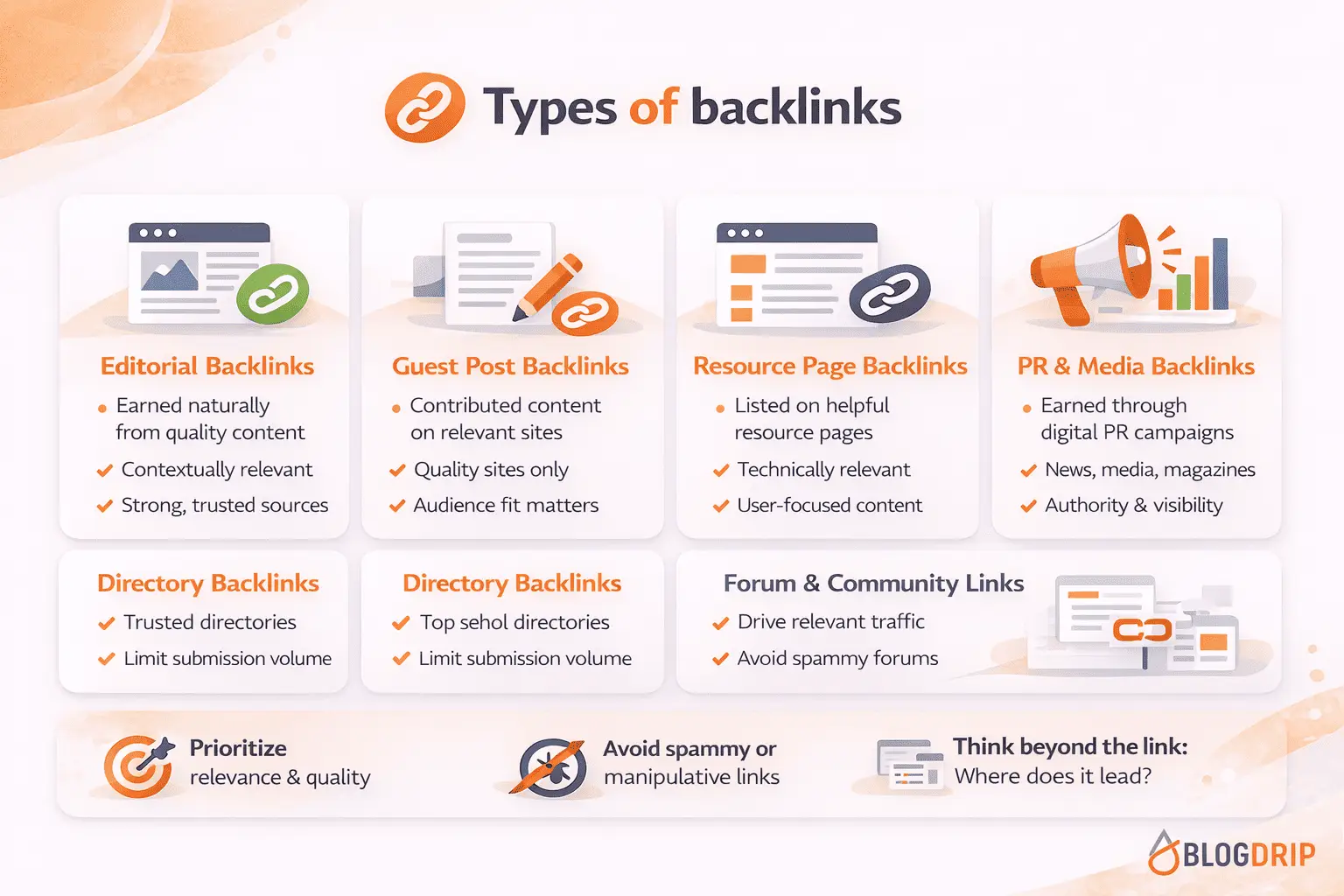
The Main Types of Backlinks
The best way to understand the types of backlinks is to look at the ones you are most likely to encounter in real SEO work.
Editorial backlinks
Editorial backlinks are usually the most valuable backlink type.
These are links added because a publisher, editor, or writer genuinely wants to reference your content. They often appear in articles, guides, news coverage, opinion pieces, or expert commentary.
Editorial backlinks are strong because they are usually:
- relevant
- natural
- contextually placed
- based on merit
If you want to build long-term authority, these are often the best links to earn.
Guest post backlinks
Guest post backlinks come from content you write for another website.
They can still be useful, but only when the site is relevant, the article is strong, and the placement makes sense editorially. Guest posting becomes weak when it turns into a volume tactic focused on easy placements rather than audience fit and quality.
A good guest post can support authority. A low-quality one usually adds little.
Resource page backlinks
These backlinks come from pages that collect useful tools, guides, sources, or educational materials on a topic.
They can be valuable because the purpose of the page is to direct users toward helpful content. If your page genuinely belongs there, the link often makes strong editorial sense.
This link type works especially well for guides, research pieces, and practical resources.
Digital PR and media backlinks
These are links from publishers, journalists, magazines, or news websites that cite your expertise, commentary, or data.
This is one of the strongest types of backlinks because it often combines authority, visibility, and trust. These links are harder to earn, but they can have strong long-term value when they are relevant.
Directory backlinks
Directory backlinks come from business listings, local citations, or industry directories.
Some are legitimate and useful, especially for local SEO or niche trust signals. Others are outdated and exist mainly for link submission.
A trusted business listing can be useful. Mass submission to low-quality directories usually is not.
Partner and relationship backlinks
These links come from clients, suppliers, associations, memberships, sponsorships, or business relationships.
They are often legitimate and brand-relevant, even if they are not always the strongest ranking signals on their own. When the connection is real and the link makes sense for users, they can support trust and visibility.
Forum, comment, and community backlinks
These backlinks come from blog comments, forums, Q&A platforms, or online communities.
In most cases, these are not the strongest authority signals. Many are nofollow and many appear in low-editorial environments. Still, they can have value if they drive relevant traffic or help surface useful content to the right audience.
Their usefulness is usually contextual, not purely algorithmic.
Important Supporting Subtopics
To understand the types of backlinks properly, a few related concepts also matter.
Follow vs nofollow links
Some backlinks are standard links that can pass stronger SEO signals. Others use attributes such as nofollow, sponsored, or user-generated content tags.
Nofollow links are not useless. They can still bring referral traffic, visibility, and brand exposure. They just are not interpreted in exactly the same way as standard editorial links.
Anchor text
Anchor text is the clickable text used in a link. A healthy backlink profile usually includes branded anchors, natural phrases, plain URLs, and some topical references.
Over-optimized exact-match anchor text often suggests manipulation rather than natural linking.
Relevance
Relevance matters more than many businesses assume. A backlink from a site in your market or topic area is usually more useful than a stronger-looking link from an unrelated source.
Common Mistakes
Many SEO problems come from misunderstanding backlink types.
Treating one link type as always good or always bad
A guest post is not automatically good. A directory link is not automatically bad. A nofollow link is not automatically worthless.
The better question is whether the link is relevant, credible, and useful in context.
Chasing volume over quality
A site with fewer strong backlinks can outperform a site with many weak ones. Raw totals are one of the least useful ways to judge link quality.
Ignoring the destination page
Even strong backlinks underperform when they point to weak content. Links work best when the page being linked to is already useful, well-structured, and worth citing.
Looking at links in isolation
A backlink is more valuable when it supports a page that sits inside a good internal linking structure. If authority comes into one page but never flows through the site, part of the value is lost.
Practical Guidance
If you want to approach backlink types strategically, start by focusing on what kind of links your best pages can realistically earn.
A sensible approach usually looks like this:
- prioritize editorially earned links
- use guest posts selectively
- treat directories as quality filters, not a scale tactic
- value digital PR and media links where relevant
- judge links by context, not just category
Build pages that deserve stronger links
The best backlink types usually go to pages that genuinely add value. These are often:
- in-depth guides
- original research
- useful resources
- strong pillar pages
- practical educational content
Weak pages usually attract weak links.
Think in terms of authority fit
Ask whether a link strengthens your credibility in the topic area you want to own. That is a more useful standard than simply asking whether it counts as a backlink.
Timing and Expectations
Different types of backlinks create value at different speeds.
A directory or partner link may be easier to secure quickly, but often has more limited upside. Editorial and media backlinks usually take more time to earn, but can create stronger long-term value.
Backlinks also work cumulatively. A strong backlink profile is rarely built through one tactic. It grows through relevance, consistency, and better content over time.
Conclusion
Understanding the main types of backlinks helps you make better SEO decisions.
Not all backlinks matter equally. Editorial links, relevant resource links, strong media mentions, and carefully chosen guest posts usually create more value than weak directories, random placements, or manipulative tactics.
That is why good linkbuilding is not about collecting links. It is about earning the kinds of links that reinforce trust, topical relevance, and long-term authority.
For a cluster-based SEO strategy, the best backlink types are the ones that strengthen high-value pages and help the wider content structure perform better over time.