
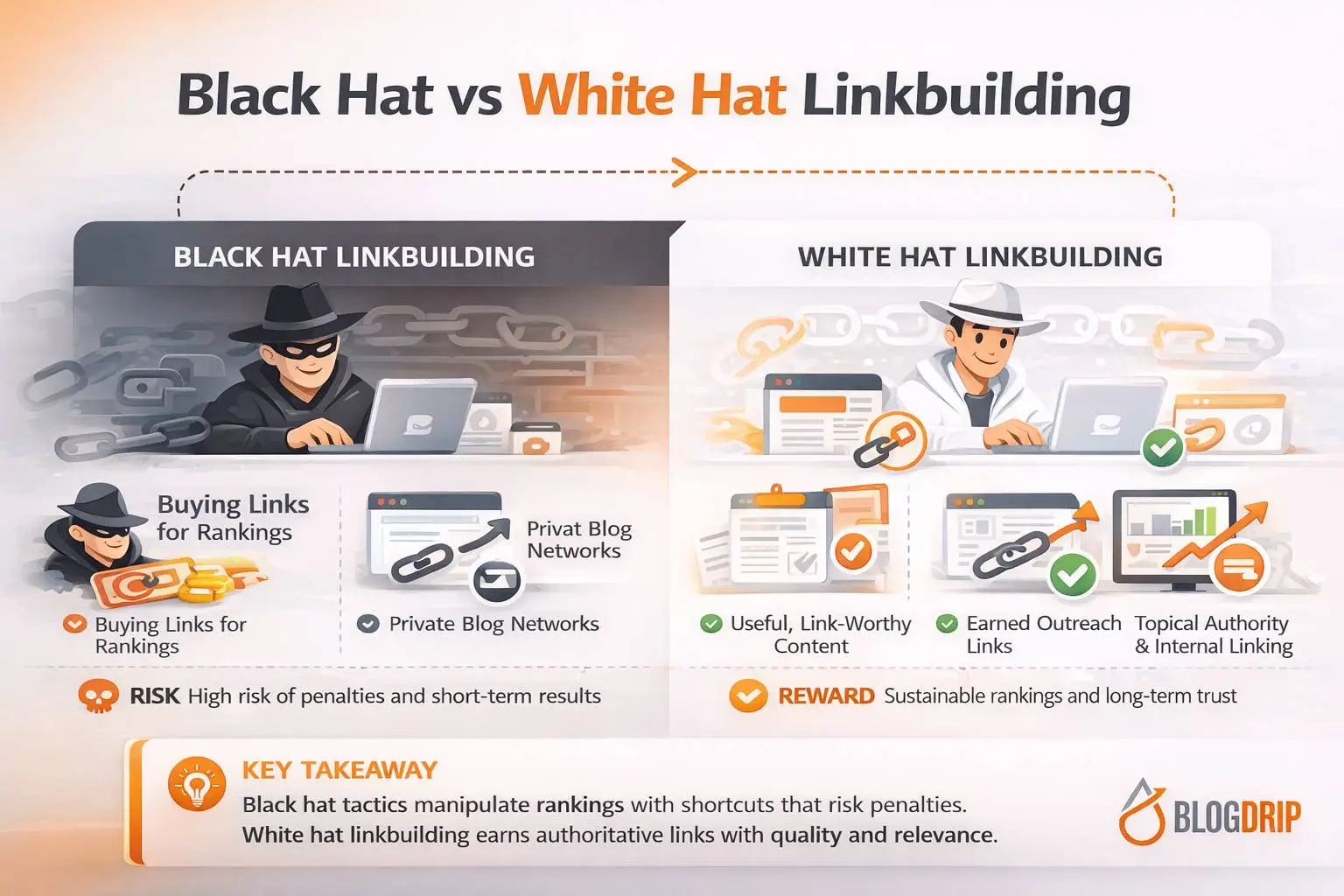
Black Hat vs White Hat Linkbuilding
Black hat vs white hat linkbuilding is one of the clearest ways to understand how different SEO strategies create very different long-term outcomes. Both approaches aim to influence rankings by affecting a site’s backlink profile, but they rely on very different logic.
White hat linkbuilding focuses on earning links through relevance, usefulness, editorial credibility, and sustainable promotion. Black hat linkbuilding focuses on manipulating link signals through tactics designed primarily to influence rankings, often with little regard for quality, transparency, or long-term trust.
That distinction matters because linkbuilding is not only about getting links. It is about what those links say about your website. A backlink profile built through credible methods can support authority over time. A profile built through manipulative shortcuts may produce temporary gains, but it often introduces strategic weakness and long-term risk.
For a site building topical authority through a pillar-and-cluster model, this is especially important. Strong SEO performance depends on having content that deserves visibility, internal linking that supports related pages, and external links that reinforce credibility rather than distort it. That is why understanding black hat vs white hat linkbuilding is not just theoretical. It shapes how durable your growth will be.
What Is Black Hat vs White Hat Linkbuilding?
Black hat vs white hat linkbuilding refers to two fundamentally different approaches to acquiring backlinks.
White hat linkbuilding involves earning links in ways that make editorial and strategic sense. These links typically come from useful content, relevant outreach, digital PR, guest contributions with real value, resource inclusion, or other methods where the link exists because the destination page genuinely improves the experience for readers.
Black hat linkbuilding involves tactics designed mainly to manipulate search signals. These methods often attempt to manufacture the appearance of authority rather than earn it. The backlink may still exist on a real website, but the placement is driven by ranking manipulation rather than authentic editorial judgment.
In practical terms, the difference often comes down to this question:
Would this link still make sense if SEO were removed from the equation?
If the answer is yes, the tactic is more likely to be white hat. If the link exists mainly because someone is trying to simulate authority rather than create value, the tactic is moving toward black hat.
Why the Difference Matters
The distinction matters because linkbuilding does not operate in isolation. It affects how a site builds authority, how sustainable its rankings are, and how much trust its backlink profile actually deserves.
White hat linkbuilding supports durable SEO
White hat methods align with a broader content-led SEO strategy. They usually strengthen pages that already have value, help reinforce topic clusters, and work well with internal linking and site structure. That makes the authority earned through these links more durable.
Black hat linkbuilding prioritizes shortcuts
Black hat tactics often look attractive because they can seem faster or more controllable. Instead of creating something genuinely worth citing, they try to replicate the appearance of editorial endorsement.
That may produce movement in some cases, but it also creates fragility. If the backlink profile relies on manipulative patterns, the site’s growth is built on weaker foundations.
The site strategy changes depending on the approach
A team using white hat methods is more likely to invest in:
- better content
- clearer page roles
- useful linkable assets
- relevant outreach
- stronger internal linking
A team relying on black hat methods is more likely to invest in:
- link volume over relevance
- placement buying
- network-based links
- over-optimized anchors
- short-term gains over content quality
This is why black hat vs white hat linkbuilding is really a broader strategy question, not just a tactical one.
What White Hat Linkbuilding Looks Like
White hat linkbuilding is not one tactic. It is a category of approaches built around earning backlinks in a way that is useful, credible, and strategically sound.
Earning links through useful content
One of the clearest white hat methods is creating content that other websites naturally want to cite. This may include:
- detailed guides
- original research
- statistics pages
- useful templates
- tools and calculators
- strong educational resources
These pages attract links because they help someone write, explain, compare, or support a point more effectively. This aligns closely with content marketing and linkable asset strategy.
Relevant outreach
Outreach can be white hat when it is grounded in relevance and value. For example, contacting a publisher to suggest a genuinely useful resource, point out a broken link replacement, or share a new data asset can be legitimate if the link would improve the content.
The outreach itself is not what makes the tactic white hat or black hat. The deciding factor is whether the content deserves the placement and whether the request makes editorial sense.
Guest contributions with real value
Guest posting can also be white hat when the host site is relevant, the article is genuinely useful, and the link is natural rather than forced. The goal should be to contribute expertise, not just insert a backlink.
Digital PR and brand-led visibility
Digital PR, expert commentary, data stories, and brand-driven mentions often fall into white hat linkbuilding because they earn attention through something worth covering. The link is a byproduct of visibility and usefulness, not just a purchased signal.
What Black Hat Linkbuilding Looks Like
Black hat linkbuilding usually centers on manipulative shortcuts that try to create ranking signals without earning them.
Buying links for ranking manipulation
Paid link placements intended mainly to pass ranking value are one of the most common black hat practices. This includes undisclosed paid insertions, purchased niche edits, or networks of sites selling contextual links that exist primarily for SEO manipulation.
Link networks and manufactured ecosystems
Private blog networks and similar systems are classic black hat territory because they are designed to simulate authority through controlled, artificial link relationships rather than real editorial signals.
Spam-heavy automation
Large-scale automated comments, forum links, profile links, and low-quality directory links are also common black hat approaches. The issue is not only their quality but the fact that they are usually created without meaningful editorial judgment.
Over-optimized anchor manipulation
Black hat strategies often over-control anchor text by forcing exact-match phrases repeatedly across acquired links. This can make the backlink profile look engineered rather than naturally developed.
Low-quality placements with no real fit
A link inserted into irrelevant, thin, or obviously sponsored content purely to pass value is another common sign of black hat behavior. Even if the site has metrics, the placement still lacks real strategic credibility.
Important Subtopics Within Black Hat vs White Hat Linkbuilding
Relevance
Relevance is one of the clearest dividing lines between white hat and black hat methods. White hat links usually come from pages and sites that make topical sense. Black hat links often ignore this when volume or access becomes the main goal.
A relevant link from a modest but credible site can be more useful than a manipulative placement on a higher-metric domain.
Editorial intent
White hat links are usually driven by editorial reasoning. Black hat links are usually driven by ranking manipulation. This is a useful lens because it helps evaluate not just the tactic, but the motive behind it.
Linkable assets
White hat linkbuilding tends to depend on assets that are genuinely worth citing. That includes in-depth guides, resources, research, or tools. Black hat methods often skip this step and try to create authority signals without building anything especially valuable first.
Internal linking and site structure
White hat strategies make more sense inside a pillar-and-cluster model because earned backlinks can strengthen connected topic areas through internal links. Black hat approaches often ignore this and treat backlinks as isolated ranking injections rather than part of a larger authority system.
How to Tell the Difference in Practice
Sometimes the labels are obvious. Sometimes they are not. A useful way to evaluate a tactic is to ask a series of practical questions.
Does the link make sense for the reader?
If the answer is no, the tactic is already questionable.
Is the destination page genuinely useful?
If the page would be hard to justify without SEO, that is a warning sign.
Is the linking site relevant and credible?
Topical fit matters. So does whether the publication looks like a real editorial environment or a link-selling platform.
Is the tactic primarily trying to earn trust or imitate it?
This is often the clearest difference between white hat and black hat SEO.
Would you be comfortable explaining the link strategy publicly?
White hat tactics are usually easy to explain. Black hat tactics often rely on obscurity, ambiguity, or euphemisms.
Common Mistakes When Comparing Black Hat and White Hat Linkbuilding
Treating it as only a moral debate
This is not just about “good SEO” and “bad SEO.” It is about how strong or fragile the resulting authority actually is.
Assuming anything faster is black hat
Some efficient tactics can still be white hat if they are relevant and editorially sound. Speed alone is not the test.
Assuming anything manual is white hat
A manually placed paid backlink can still be manipulative. Human effort does not automatically make a tactic legitimate.
Ignoring the role of content quality
White hat linkbuilding is much harder without content worth citing. Teams sometimes compare tactics without acknowledging that the quality of the destination page changes everything.
Focusing only on link counts
White hat methods often look slower on a spreadsheet because they may produce fewer links in the short term. But stronger, more relevant links usually support better long-term authority than a larger number of weak placements.
Practical Guidance for Choosing the Right Approach
A strong SEO strategy should lean toward white hat methods because they support durable authority and fit naturally into broader site growth.
Build pages that deserve links
Start by identifying which pages on your site are worth promoting. These are often pillar resources, strong cluster pages, original research, or useful tools.
Use outreach to amplify value, not replace it
Outreach works better when it supports a strong asset rather than trying to sell a weak page into a placement.
Prioritize relevance and credibility
The best links are not always the easiest to get. Focus on the ones that make real sense for your niche and your audience.
Connect linkbuilding to topical architecture
When a page earns backlinks, it should also strengthen related pages through internal linking. This turns individual wins into broader topical support.
Avoid dependency on shortcuts
A sustainable site should not depend on manipulative link tactics to stay visible. If rankings require constant artificial support, the underlying strategy is probably weak.
Judge tactics by long-term usefulness
A good test is whether the tactic strengthens the quality, trust, and coherence of the site over time. If it mainly creates temporary signals, it is unlikely to be the right foundation.
Timing and Expectations
White hat linkbuilding usually takes longer because it depends on creating value, promoting it intelligently, and earning editorial trust. That can feel slower than manipulative methods that promise quick placement.
But the slower pace is part of the strength. White hat methods build authority that tends to align better with the rest of the SEO system: strong content, clear architecture, and credible external signals.
Black hat methods may sometimes appear faster, but speed without durability is a poor metric for serious SEO strategy. In most cases, the better goal is not the quickest possible ranking movement. It is the strongest and most sustainable growth path for the site.
Conclusion
Black hat vs white hat linkbuilding is really a comparison between two different ways of thinking about SEO authority.
White hat linkbuilding is based on relevance, usefulness, editorial judgment, and long-term trust. Black hat linkbuilding is based on manipulation, manufactured signals, and shortcuts that often weaken the strategic quality of the backlink profile.
For a website building topical authority, white hat methods are the stronger fit because they support content that deserves links, strengthen internal architecture, and help authority compound across the wider site.
That is the real difference. White hat linkbuilding builds credibility. Black hat linkbuilding tries to imitate it.