
What Is a Backlink? A Practical SEO Guide
If you are new to SEO, one of the first terms you will come across is “backlink.” The term sounds technical, but the idea is simple: a backlink is a link from another website to your website.
What makes backlinks important is not the link itself, but what it signals. In SEO, backlinks can help search engines understand whether your content is useful, credible, and worth ranking. That does not mean every backlink has value, or that more links automatically mean better performance. Context, quality, and relevance matter far more than raw numbers.
This article explains what a backlink is, why it matters, how it works, and what businesses should know before treating backlinks as a ranking shortcut.
What Is a Backlink?
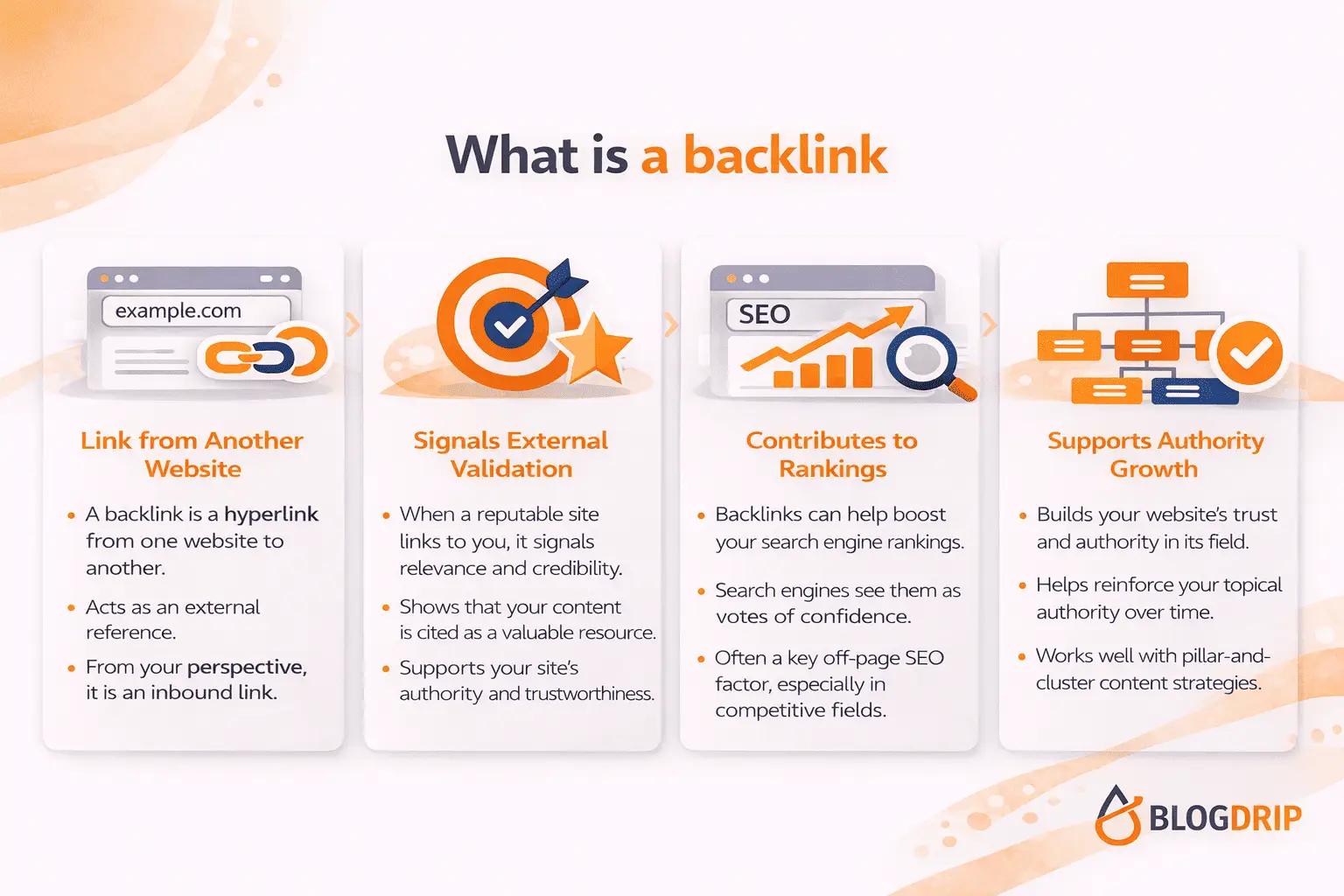
A backlink is a hyperlink on one website that points to a page on another website.
For example, if a marketing blog links to your article as a useful source, that is a backlink to your site. From your point of view, it is an inbound link. From the other site’s point of view, it is an outbound link.
In practical SEO terms, a backlink is an external reference. It shows that another website considered your page relevant enough to mention or cite.
Backlink vs. internal link
A backlink comes from another domain.
An internal link connects one page on your website to another page on the same website.
Both are important, but they serve different purposes. Backlinks help build off-page authority. Internal links help distribute relevance and authority across your own site.
Why Backlinks Matter
Understanding what is a backlink also means understanding why backlinks matter in SEO.
Search engines use many signals to rank pages. Content quality, search intent, site structure, page experience, and technical SEO all matter. Backlinks are part of that mix. They help search engines evaluate how your content is viewed beyond your own website.
They support authority
When relevant websites link to your page, that can act as a trust signal. It suggests your content has value outside your own domain.
This is especially important in competitive search results, where many pages may be targeting the same keyword with similar on-page quality.
They can improve ranking potential
A backlink does not guarantee better rankings, but it can improve a page’s ability to compete. If two pages are equally strong in terms of content and intent, the one with better backlinks often has an advantage.
They reinforce topical relevance
Backlinks can also help strengthen a site’s credibility within a subject area. If your website earns links to useful pages about the same topic, that supports broader topical authority.
This is why backlinks often work best within a well-structured pillar-and-cluster model rather than as isolated wins.
How a Backlink Works
A backlink works by creating a connection between two pages on the web. Search engines crawl that connection and use it as part of their broader understanding of authority, relevance, and site relationships.
In simple terms, the process looks like this:
- another website links to your page
- search engines discover and crawl that link
- the link becomes part of the signals associated with your page
- that may contribute to your page’s SEO strength over time
This does not happen in a fixed or predictable way. Not all backlinks are treated equally, and not all of them influence rankings in the same way.
What makes one backlink more valuable than another
A backlink’s value depends on context.
A link from a trusted, relevant industry website usually carries more strategic value than a link from a weak or unrelated site. Search engines look at more than the existence of the link. They also consider where it comes from, how it appears, and what page it points to.
Source relevance
A backlink from a page related to your topic is generally more useful than one from an unrelated page. Relevance helps search engines understand why the link exists.
Page quality
Links from strong, well-maintained pages tend to be more useful than links from thin or low-quality pages. A backlink is more valuable when it appears in content that has real purpose and editorial standards.
Placement and context
A link placed naturally inside useful content is usually stronger than one placed awkwardly in a footer, sidebar, or low-value section. Editorial context matters.
Destination page
The page being linked to also matters. A backlink to a strong, useful page often creates more SEO value than a backlink to a weak or outdated page.
Backlinks amplify quality. They do not reliably rescue poor content.
Important Backlink Subtopics
To fully understand what is a backlink, it helps to know the related concepts that shape backlink value.
Anchor text
Anchor text is the clickable text of a link. It gives users and search engines context about the destination page.
Natural backlink profiles usually include a mix of branded anchors, topical phrases, generic wording, and plain URLs. Overuse of exact-match keyword anchors can make a link profile look artificial.
Follow and nofollow links
Some links are standard links that search engines can treat as stronger editorial signals. Others use attributes such as nofollow, which changes how the link is interpreted.
This distinction matters, but it is often oversimplified. Even nofollow links can still be useful for referral traffic, visibility, and brand exposure.
Editorial links
An editorial backlink is one that exists because the publisher genuinely chose to reference your page. These are often the most valuable links because they are based on merit and relevance rather than manipulation.
Common Mistakes People Make
Many businesses misunderstand backlinks because they reduce the topic to simple metrics.
Thinking all backlinks are good
Not every backlink is helpful. Some links are weak, irrelevant, or placed in low-quality contexts. A backlink profile should be judged by relevance and trust, not by total count alone.
Focusing only on quantity
A site with fewer but stronger backlinks can outperform a site with a much larger number of poor-quality links. Link count without context tells you very little.
Ignoring the linked page
A backlink to a weak page often underperforms because the page itself is not worth ranking. If the content is thin or poorly matched to intent, the backlink’s impact may be limited.
Treating backlinks separately from site structure
Backlinks work better when linked pages connect into a strong internal linking structure. If your best-linked content sits in isolation, some of the broader SEO value is lost.
Practical Guidance
If you want to use backlinks strategically, start by identifying pages on your site that genuinely deserve references.
These are often:
- in-depth guides
- original research
- strong educational content
- useful resources
- well-built pillar pages
Then ask a practical question: would a credible website genuinely want to cite this page?
That question is more useful than asking how many backlinks you can get.
What a good backlink strategy looks like
A sensible backlink approach usually includes:
- improving content before promoting it
- focusing on relevant sites, not random domains
- earning links that make editorial sense
- supporting linked pages with good internal linking
- measuring authority and visibility, not just link totals
This is a much stronger long-term approach than chasing easy placements.
Timing and Expectations
Backlinks rarely create instant results. Even strong links need time to be crawled, processed, and reflected in rankings.
The timeline depends on the authority of the linking site, the quality of the destination page, the competitiveness of the keyword space, and the strength of your site as a whole.
For newer websites, backlinks often contribute to gradual authority-building. For more established sites, they can help lift already-strong pages into more competitive positions.
The realistic expectation is steady improvement over time, not sudden jumps.
Conclusion
So, what is a backlink?
A backlink is a link from another website to your website. In SEO, it can act as a signal of relevance, credibility, and authority. But its value depends on where it comes from, how it appears, and what page it supports.
That is why backlinks should not be treated as a simple numbers game. The goal is not just to get more links. The goal is to earn the right links to the right pages as part of a wider SEO strategy.
For businesses building organic growth seriously, understanding backlinks is a foundational step. Once you understand what a backlink is, it becomes much easier to understand how linkbuilding, internal linking, and topical authority work together.