
How to Use Them Without Letting the Tools Drive the Strategy
Technical SEO tools are essential, but they are easy to misuse. Many teams build a stack before they build a process. They run crawls, export reports, track dashboards, and still struggle to improve search performance because the tools are being used without a clear framework.
That is the real issue. Technical SEO tools are useful because they help uncover problems that are hard to spot manually. They can surface crawl waste, indexation conflicts, duplicate signals, performance issues, weak internal linking, and structured data problems at scale. What they cannot do is decide what matters most.
For a website building topical authority, this distinction matters. Tools should support the technical SEO strategy, not replace it. This page explains what technical SEO tools are, why they matter, how they work, what categories matter most, common mistakes, and how to use them strategically.
What Are Technical SEO Tools?
Technical SEO tools are platforms and diagnostics tools used to review the technical health of a website from a search perspective.
In practical terms, they help answer questions like these:
- Can search engines crawl the right pages?
- Are important URLs indexable?
- Are canonicals, redirects, and internal links working properly?
- Is the site fast and stable enough?
- Are technical signals consistent across templates and sections?
A tool is not a strategy. It is a way to inspect the technical environment around your pages and find issues that may limit visibility.
What technical SEO tools usually cover
Most technical SEO tools help with one or more of these areas:
- site crawling
- indexation review
- internal linking analysis
- redirect and status code checks
- sitemap and robots diagnostics
- structured data validation
- performance and Core Web Vitals
- duplicate URL detection
Some tools do several of these at once. Others are built for one specific use case.
Why Technical SEO Tools Matter
Technical SEO tools matter because many technical issues are not obvious in normal page review. A page may look fine in a browser while still sending weak or conflicting signals to search engines.
They reveal hidden issues
Problems such as duplicate paths, orphan pages, blocked URLs, broken canonicals, weak crawl depth, or heavy templates are often hard to spot manually. Tools make those patterns visible.
That is why they are closely connected to a broader technical SEO audit process.
They improve decision-making
Used properly, technical SEO tools help teams move from guesswork to evidence. Instead of assuming a page is underperforming because of content, you can test whether the issue is crawl access, indexation, template duplication, or performance.
This fits naturally with related cluster pages such as technical SEO audit, crawling and indexing, and website speed SEO.
They help websites scale
As a site grows, manual review becomes less reliable. More templates, more categories, and more URL patterns create more technical complexity. Tools become more valuable because they help you assess site-wide behavior, not just isolated pages.
How Technical SEO Tools Work
Technical SEO tools generally work by simulating or measuring how a website behaves from a technical search perspective.
Some crawl the site the way a bot might. Others monitor real search visibility, validate markup, or measure loading behavior.
Crawlers surface structural issues
Crawling tools scan URLs, follow internal links, and collect data on canonicals, redirects, status codes, noindex rules, and page depth. They are especially useful for spotting template-level and pattern-level issues.
For example, they can show whether a section has incorrect canonicals, whether internal linking is too shallow, or whether certain folders create many duplicate URLs.
Search visibility tools reveal indexation patterns
Other tools help you understand how search engines appear to be treating the site. These are useful for checking sitemap coverage, indexing gaps, and search result performance patterns.
Performance tools measure page experience
Performance-focused tools help identify loading delays, layout shifts, slow templates, and mobile usability issues. These are particularly important when working on Core Web Vitals and page speed.
Validation tools check technical signals
Some tools focus on narrow but important tasks such as validating structured data, checking robots directives, or reviewing rendering behavior. These are useful when the issue is specific and high impact.
Important Categories of Technical SEO Tools
The most useful way to think about technical SEO tools is by function, not by brand list.
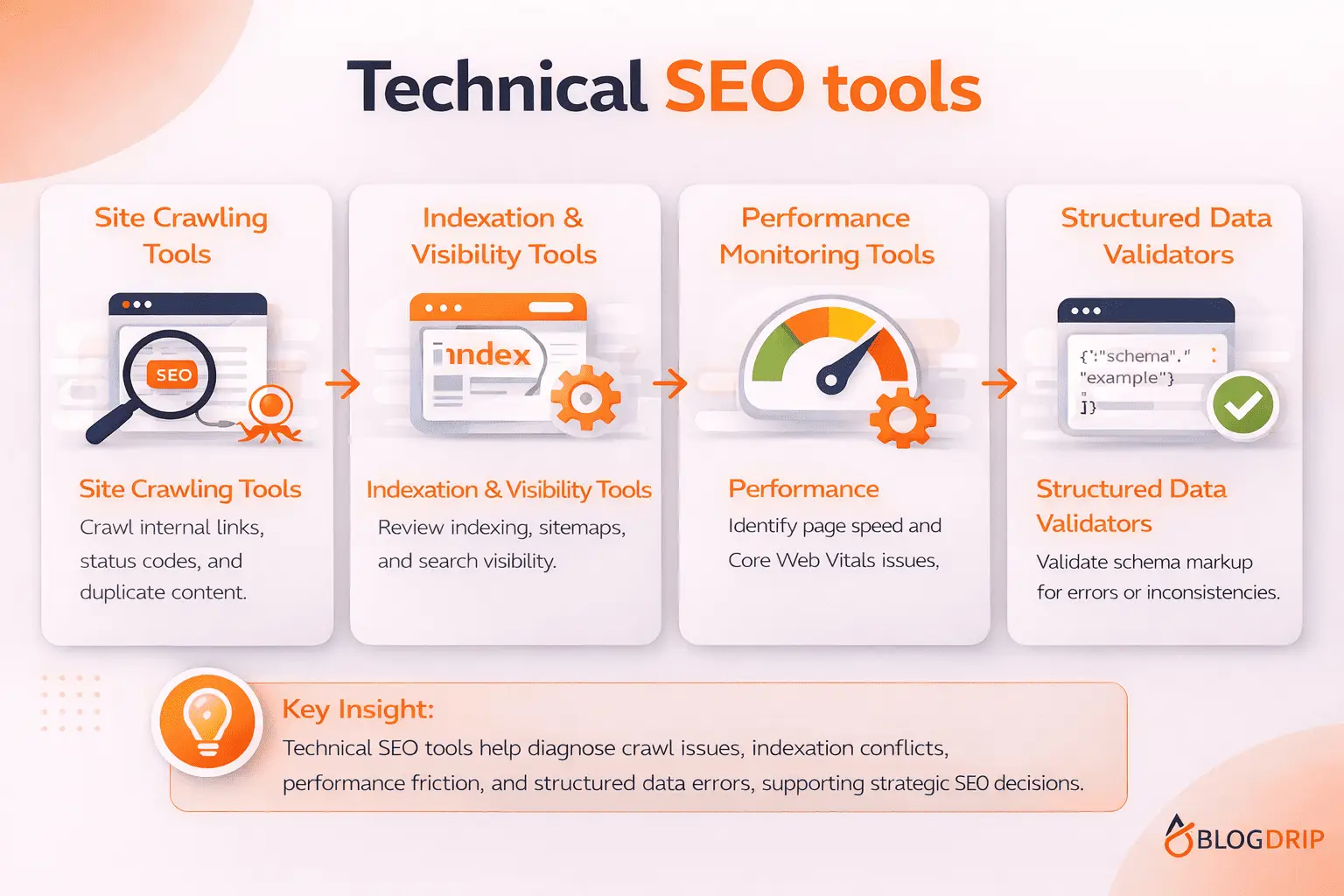
Site Crawling Tools
These are the foundation of most technical SEO work. They help inspect internal linking, page depth, canonicals, redirects, noindex tags, status codes, and duplication patterns.
They are most useful for:
- technical audits
- migration reviews
- internal linking analysis
- duplicate URL detection
- template issue discovery
This section naturally supports a related page on technical SEO audit.
Indexation and Search Visibility Tools
These tools help show how pages are being processed from a search perspective. They are useful for reviewing indexing coverage, sitemap issues, and page visibility trends.
They matter most when you need to know whether pages are even eligible to compete in search.
A natural internal link here would be to crawling and indexing.
Performance and Core Web Vitals Tools
These tools focus on speed, responsiveness, visual stability, and page experience. They help diagnose slow templates, mobile friction, and layout instability.
They fit closely with cluster pages on website speed SEO and Core Web Vitals.
Structured Data Validation Tools
These tools check whether schema markup is valid and aligned with supported formats. They are useful, but only when the page purpose is already clear. Valid markup is helpful, but it does not replace good page structure or clear content.
This connects naturally to structured data SEO.
Common Mistakes When Using Technical SEO Tools
The biggest mistake is letting the tool decide the priorities.
Treating every warning as equally important
Not every issue matters equally. A long export full of warnings can distract teams from the structural issues that actually affect visibility. One canonical conflict across a core template often matters more than dozens of minor page-level warnings.
Using too many tools without a process
A large tool stack does not automatically improve technical SEO. In many cases it creates duplicated data, reporting noise, and weak prioritization. A smaller set of tools used well is often more effective.
Focusing on pages instead of patterns
Technical SEO problems are usually systemic. If an issue affects a page type, the priority is the template or generation rule, not each page individually.
Reporting activity instead of impact
Some teams optimize for cleaner reports instead of stronger search performance. Tools are useful when they lead to better decisions, not just more dashboards.
Practical Guidance
The best way to use technical SEO tools is to begin with the problem, not the platform.
Ask:
- Are important pages failing to rank because they are not indexed?
- Is crawl waste affecting discovery?
- Are duplicate URLs splitting signals?
- Are templates slow or unstable?
- Is the issue diagnosis, monitoring, or implementation planning?
Once the goal is clear, choose the tools that fit that job.
Build a simple working stack
Most teams do not need many tools. In practice, they usually need:
- one strong site crawler
- one reliable indexation and visibility platform
- one performance diagnostics toolset
- one validation process for markup and technical signals
The goal is not maximum coverage. It is clear, usable insight.
Tie tools to workflow
Tools work best when connected to real processes such as monthly reviews, migration checks, pre-launch QA, and template audits. If findings do not lead to action, the value stays limited.
Keep the site structure central
For a pillar-and-cluster site, tool findings should help confirm that the broader technical SEO pillar page and related cluster pages are easy to crawl, internally connected, indexable, and technically consistent.
Timing and Expectations
Technical SEO tools can surface issues quickly, but solving those issues and seeing results often takes time.
Some fixes, such as correcting robots blocks, sitemap errors, or broken canonicals, can have a relatively fast effect. Others, such as template performance improvements or internal linking cleanup, may take longer because search engines need time to recrawl and reassess the site.
It is also important to stay realistic. Tools do not create growth on their own. Their value comes from helping teams make better technical decisions with stronger evidence.
Conclusion
Technical SEO tools matter because they make hidden problems visible and help teams understand how a website behaves from a search perspective. They are essential for diagnosing crawl issues, indexation conflicts, performance friction, duplication patterns, and structural weaknesses.
But their real value is not in the report itself. It is in helping you understand what is holding the right pages back.
As a cluster page, this article should support a broader technical SEO pillar page and connect naturally to related articles on technical SEO audits, crawling and indexing, canonical tags, structured data, website speed, Core Web Vitals, robots.txt, and XML sitemaps. That is the right role for technical SEO tools in a pillar-and-cluster model: not as a substitute for strategy, but as a way to support technical decisions with evidence.