
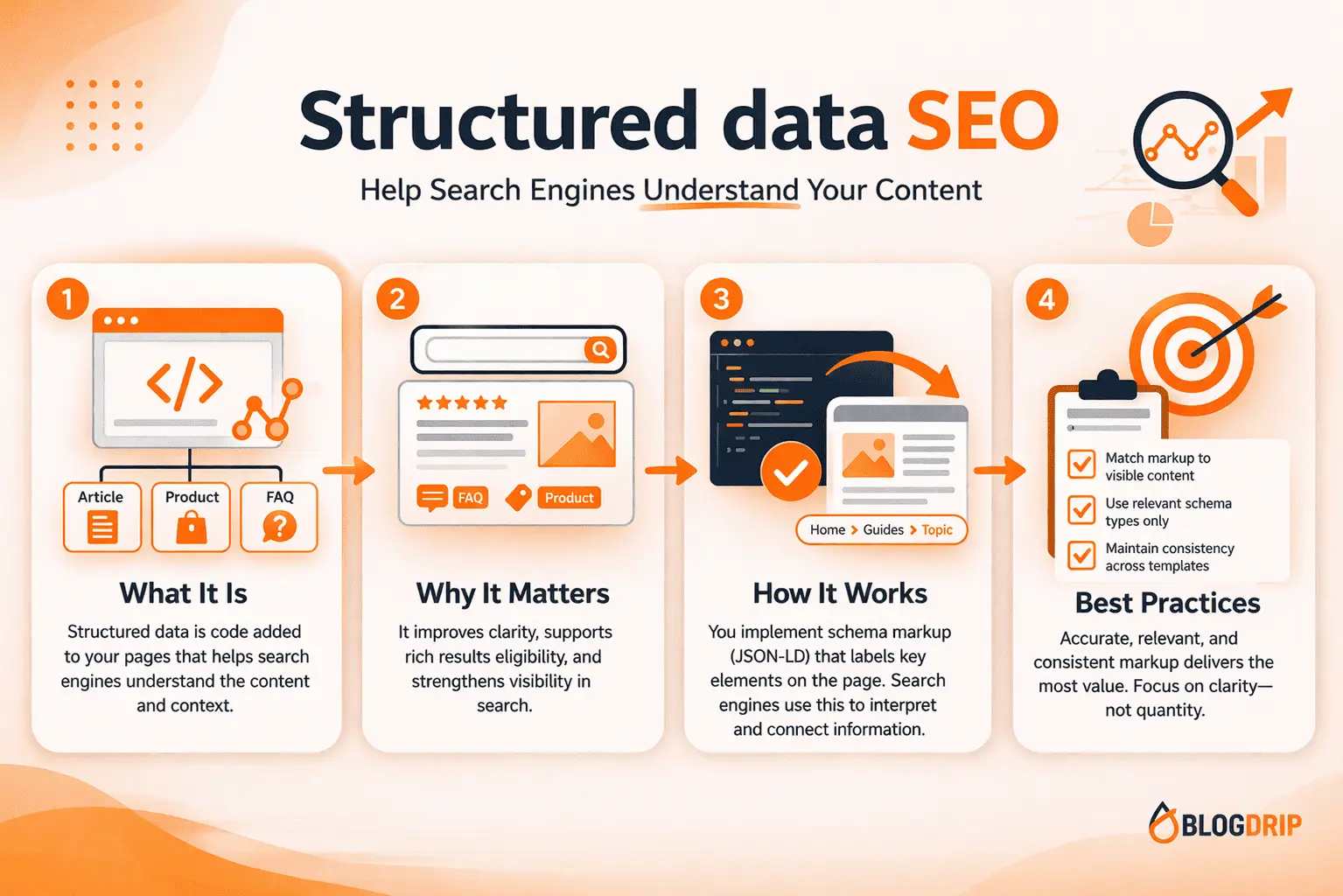
How Schema Helps Search Engines Understand Your Pages
Structured data SEO is often treated as a technical add-on that sits outside the main content strategy. In practice, it is more useful than that, but also narrower than many people assume. Structured data can help search engines interpret page context more clearly, connect entities more accurately, and understand what a page is about. What it cannot do is compensate for weak content, poor technical foundations, or unclear search intent.
That distinction matters. Structured data is valuable because it improves clarity, not because it acts as a shortcut to rankings. For websites building topical authority through a pillar-and-cluster model, that clarity matters. The stronger your site architecture, internal linking, and content hierarchy become, the more useful structured data can be as a supporting signal.
This cluster page explains structured data SEO in practical terms. It covers what structured data is, why it matters, how it works, where it helps, common mistakes, and how to approach it strategically.
What Is Structured Data SEO?
Structured data SEO is the practice of adding machine-readable markup to a page so search engines can better understand the meaning and context of its content.
In practical terms, structured data tells search engines more explicitly what certain page elements represent. Instead of only reading a page like a human would, search engines can also interpret structured labels that identify things such as:
- articles
- products
- organizations
- FAQs
- breadcrumbs
- reviews
- events
- authors
The most common format used today is schema markup, usually implemented in JSON-LD.
What structured data actually does
Structured data helps search engines interpret entities and relationships more clearly. For example, it can indicate that a page is an article, identify the publisher, define a breadcrumb trail, or specify product-related details.
This is why structured data SEO is mainly about clarity and interpretation.
What structured data does not do
Structured data does not guarantee rankings. It does not make thin content strong. It does not replace good copy, internal linking, or technical SEO basics such as crawlability and indexation.
That is why this topic should sit alongside related cluster pages on technical SEO, URL structure SEO, canonical tags, and crawling and indexing rather than being treated as a standalone tactic.
Why Structured Data SEO Matters
Structured data matters because search engines rely on interpretation. The more clearly a website communicates its meaning, the easier it becomes for search engines to process pages accurately.
It improves content interpretation
A search engine can often infer what a page is about from headings, body copy, internal links, and metadata. Structured data adds another layer of precision. It helps confirm that a page is an article, a product, a local business page, or another recognized type.
That extra precision can reduce ambiguity, especially on websites with complex templates or content that could otherwise be interpreted in multiple ways.
It supports search feature eligibility
One of the most visible uses of structured data is its role in supporting eligibility for enhanced search features. Depending on the page type and implementation quality, structured data can help search engines surface richer search presentations.
That does not mean every marked-up page will receive an enhanced result. It means the page is better positioned to qualify when the markup aligns with the content and search engine requirements.
It strengthens technical clarity across the site
For a website building topical authority, structured data can support a broader technical pattern. It reinforces page relationships, helps define content types, and works well alongside breadcrumbs, internal linking, and a clean architecture.
That is why a broader technical SEO pillar page should often link naturally to this topic.
How Structured Data SEO Works
Structured data works by embedding standardized markup into a page in a format search engines can parse.
In most cases, that means using schema vocabulary to label elements and relationships on the page. Search engines then interpret that markup alongside the visible content, metadata, and technical signals already present.
Search engines compare markup with page content
This is an important point. Search engines do not treat markup as independently authoritative. They compare it against what is actually visible on the page.
If your markup says a page contains FAQs, reviews, or product information that users cannot clearly see, that creates inconsistency. Good structured data supports the visible page rather than trying to add meaning that is not really there.
Structured data complements, not overrides
Structured data helps confirm what the page is. It does not overrule weak content, incorrect canonicals, or poor internal linking. It works best when the rest of the SEO system is already coherent.
Important Types of Structured Data in SEO
Not every schema type matters equally. The best approach is to implement markup that reflects the real purpose of the page.
Article and Blog Posting Schema
For editorial content, article-related markup helps define the page as a piece of content with a title, author, publisher, and publication details. This can support clearer interpretation of blog and resource sections.
For content-led sites, this is often one of the most useful structured data types.
Breadcrumb Schema
Breadcrumb markup helps search engines understand the hierarchy of a page within the site. It also reinforces site architecture and page relationships.
This is especially useful in a pillar-and-cluster model where category and subtopic relationships matter. It connects naturally with supporting topics such as site architecture and URL structure SEO.
Product Schema
For ecommerce pages, product schema can clarify product-related information such as price, availability, and reviews when the page genuinely contains those elements.
This must match the visible content and should be maintained carefully, especially on dynamic sites.
Organization and Website Schema
Organization markup helps define the entity behind the website. Website schema can also help clarify general site-level details.
This is not a magic trust signal, but it contributes to a cleaner entity profile around the site.
FAQ and Other Specialized Types
FAQ markup, event schema, local business schema, and similar specialized types can all be useful when the page clearly fits the format. The key is relevance. The more closely the markup matches the real page content, the more useful it becomes.
Common Structured Data SEO Mistakes
The biggest mistakes usually come from treating structured data as a trick rather than a clarity layer.
Adding markup that does not match the page
A common issue is implementing schema for content elements that are not clearly present. For example, adding FAQ markup to pages that do not function like actual FAQ pages, or applying review-related markup where no visible reviews exist.
This weakens trust in the implementation.
Using every schema type available
More schema is not automatically better. Overloaded pages with unnecessary markup often create noise rather than clarity. The goal is relevant markup, not maximum markup.
Ignoring template-level consistency
Structured data problems often come from templates, not individual pages. If schema is poorly configured in a template, the problem can spread across hundreds of URLs.
That is why structured data should be reviewed at the system level.
Treating markup as a replacement for strategy
Structured data does not fix weak page purpose, thin content, or poor search intent targeting. If the underlying content is unclear, the markup will not solve the core issue.
Practical Guidance
The best way to approach structured data SEO is to start with the page type and user purpose.
Ask: what is this page really meant to be? If it is an article, product page, organization page, or FAQ page in a meaningful sense, use the markup that reflects that role clearly.
A practical process usually includes:
- identifying the real page type
- using only relevant schema types
- matching markup to visible content
- implementing at the template level where possible
- checking for consistency across similar pages
- aligning markup with canonicals, breadcrumbs, and internal linking
For a pillar-and-cluster site, structured data works best when it reinforces the same relationships already visible in the site structure. The pillar page, cluster pages, breadcrumb paths, and internal links should all tell the same story.
Timing and Expectations
Structured data improvements can help search engines interpret pages more clearly, but results are not always immediate or dramatic.
In some cases, improved markup can support clearer indexing and better eligibility for enhanced search features. In other cases, the impact is quieter and mostly operational: cleaner interpretation, better entity signals, and more consistent technical structure.
It is important to stay realistic. Structured data is a support layer. It strengthens strong pages. It does not transform weak ones.
Conclusion
Structured data SEO matters because it helps search engines understand what your pages are, how they relate to one another, and which entities they represent.
Used well, it adds clarity to a site that already has strong content, clean architecture, and sound technical foundations. Used poorly, it adds noise and inconsistency without real benefit.
As a cluster page, this article should support a broader technical SEO pillar page and connect naturally to related topics such as URL structure SEO, canonical tags, crawling and indexing, and site architecture. That is the right role for structured data SEO in a pillar-and-cluster model: not as a shortcut, but as a technical layer that helps the right pages make sense.