
Keyword Search Volume: What It Means and How to Use It Correctly
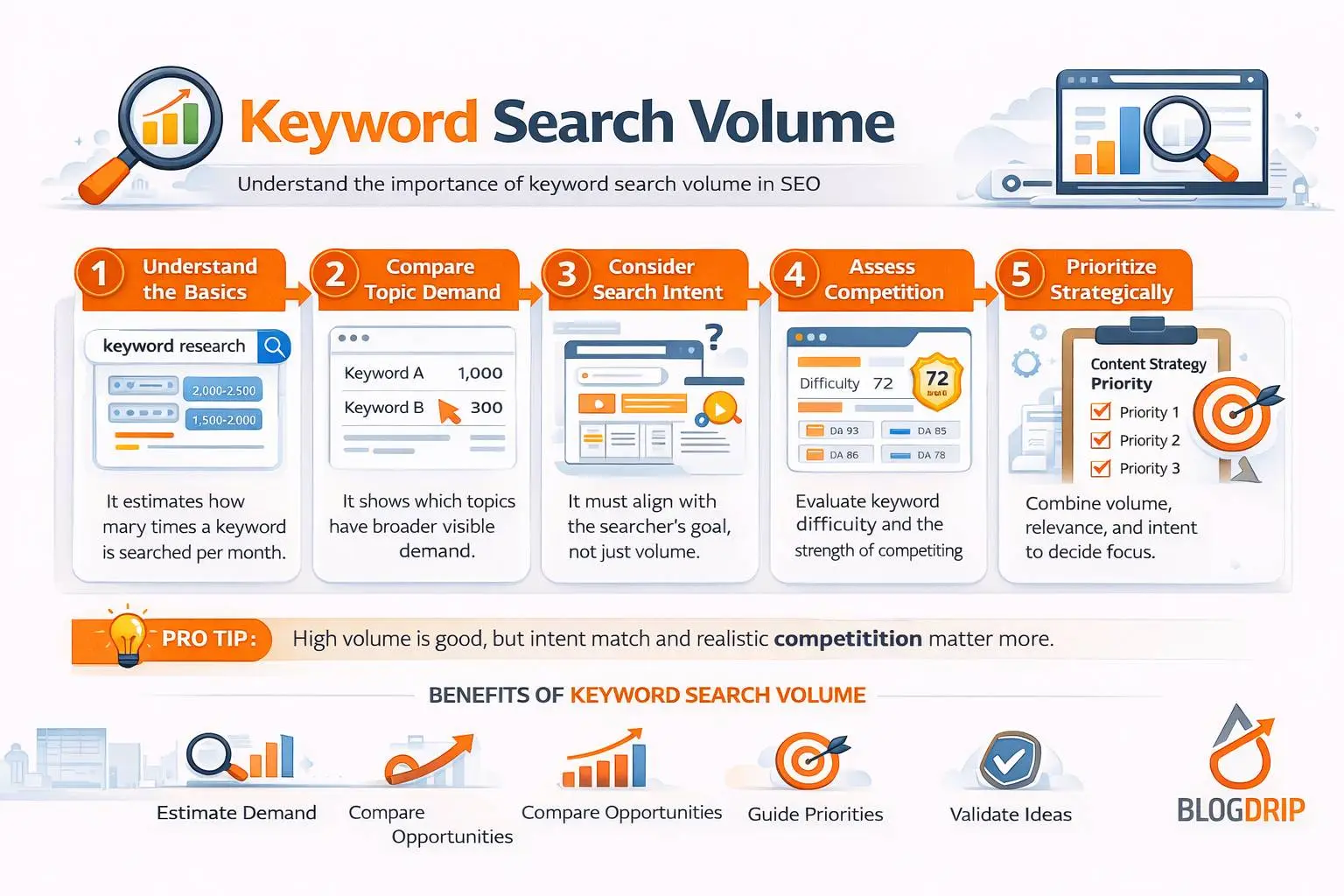
Keyword search volume is the estimated number of times a keyword is searched within a given period, usually per month. In SEO, it is one of the most commonly referenced metrics because it helps indicate how much visible demand may exist around a topic.
That said, keyword search volume is also one of the most misunderstood parts of keyword research. Many people treat it as the main signal for choosing keywords, prioritizing content, or deciding whether a page is worth creating. That usually leads to poor decisions. Search volume can be useful, but it only becomes meaningful when interpreted alongside intent, relevance, competition, and page role.
For websites building authority through a pillar-and-cluster model, this matters a lot. A high-volume term may still be a poor target if the site cannot realistically compete, if the intent does not match the page, or if the topic belongs within an existing cluster rather than on a new URL. Your broader Keyword Research guide already explains that strong SEO depends on more than volume alone and that search intent should often be evaluated before difficulty. This page focuses specifically on keyword search volume, what it means, why it matters, and how to use it with more strategic judgment.
What Is Keyword Search Volume?
Keyword search volume is an estimate of how often users search for a specific keyword over a set period.
In most SEO tools, this is shown as a monthly estimate. For example, a tool may indicate that a keyword gets a few hundred searches per month or several thousand. That number is meant to give direction, not certainty.
In practical terms, keyword search volume helps answer a simple question: how much search demand appears to exist for this term?
But that answer needs context. Search volume does not tell you:
- why users search the term
- whether the traffic would be relevant
- how hard the term is to rank for
- whether the results are dominated by stronger sites
- whether the keyword should be its own page
- how much traffic a ranking page could realistically attract
That is why search volume should be treated as one signal inside a larger keyword strategy, not as a final decision-maker.
Why Keyword Search Volume Matters
Keyword search volume matters because it gives you a sense of relative demand.
Without any visibility into demand, content planning becomes more speculative. You may still create useful pages, but you have less guidance on which topics have clearer search interest and which may be too niche, too uncertain, or simply low priority.
It helps estimate audience interest
One of the clearest benefits of search volume is that it helps show where there may be meaningful search behavior around a topic.
This is useful when comparing similar opportunities. If several keyword options are equally relevant and equally realistic, search volume can help decide which one deserves more attention first.
It supports prioritization
Most websites cannot target every keyword at once. Search volume can help with prioritization when combined with other factors such as intent, business value, and competition.
A higher-volume term may deserve attention sooner if it is also relevant and realistically targetable. But that “if” matters.
It can help shape site structure
Search volume can also influence whether a topic should be treated as a broad page, a supporting cluster article, or a subsection within an existing page.
A broader, higher-demand topic may justify a dedicated pillar or cluster page. A very niche variation may still be valuable, but perhaps as part of a larger article rather than as a separate URL.
How Keyword Search Volume Works
Keyword search volume is usually shown as an estimate rather than an exact count.
Different tools collect and model search data in different ways, which is why the same keyword can show different volume numbers across platforms. That does not make the metric useless. It just means it should be interpreted with caution.
It is directional, not precise
Search volume is best used to compare demand at a relative level rather than as a literal promise of traffic.
A keyword listed at 1,000 monthly searches does not mean you will receive 1,000 visits if you rank. Real traffic depends on ranking position, SERP features, click-through behavior, intent, and whether the query is spread across multiple related phrases.
It is often averaged
Many search volume estimates are based on averaged data. That means they can smooth over seasonality, spikes, or fluctuations in interest.
This matters because some topics are stable year-round, while others rise and fall based on events, trends, or timing.
It does not equal page traffic
A page targeting one keyword can rank for many related terms. On the other hand, a keyword with strong volume may still drive limited traffic if the page ranks poorly, if click-through rates are low, or if the search results are crowded with SERP features.
This is one of the most important distinctions in SEO. Keyword search volume is not the same thing as expected page traffic.
What Keyword Search Volume Is Good For
Search volume is useful when applied in the right way.
Comparing topic demand
If you are choosing between closely related content opportunities, volume can help show which topic has broader visible demand.
Prioritizing similar opportunities
When several keywords are equally relevant and realistically targetable, volume can help guide sequencing.
Identifying broader and narrower topics
Higher-volume keywords often indicate broader themes, while lower-volume terms often reflect more specific angles. This can help shape pillar-and-cluster planning.
Validating demand
Search volume can help confirm that a topic has enough search interest to justify dedicated attention, especially when deciding whether a keyword deserves its own page.
What Keyword Search Volume Does Not Tell You
One reason this metric is misused so often is that people expect it to answer questions it cannot answer.
It does not tell you intent
A high-volume keyword may still be a poor target if the search intent does not match the page you plan to create.
It does not tell you relevance
A keyword can have strong demand and still be weak strategically if it attracts the wrong audience or sits outside your site’s expertise.
It does not tell you ranking difficulty clearly
Some tools pair volume with difficulty metrics, but search volume itself does not tell you how hard a term will be to win.
It does not guarantee value
A lower-volume keyword can sometimes be more useful than a higher-volume one if it reflects clearer intent, stronger topical fit, or better alignment with business goals.
Important Factors to Evaluate Alongside Search Volume
Search volume becomes much more useful when it is interpreted in context.
Search intent
Intent should usually come before volume. A keyword with lower volume but clear informational intent may be a much better fit for a cluster article than a higher-volume term with mixed or commercial intent.
Relevance
The keyword should align with your audience, your expertise, and your wider site goals. Irrelevant traffic rarely produces strong long-term value.
Competition
A keyword with higher search volume may also be far more competitive. If your site cannot realistically compete, the opportunity may be less attractive than a smaller but more attainable term.
Topic role within the cluster
Some keywords deserve standalone pages. Others belong as supporting subsections or semantically related terms within an existing article.
Search volume can inform that decision, but it should not control it on its own.
Business value
Some informational keywords support trust, internal linking, and topical depth even if they do not convert directly. Others may bring traffic with little strategic value. Volume alone cannot distinguish that.
Common Mistakes With Keyword Search Volume
A lot of SEO mistakes begin when search volume is treated too simplistically.
Choosing keywords based on volume alone
This is the most common mistake. A keyword with high volume may still have the wrong intent, low relevance, or unrealistic competition.
Ignoring low-volume terms
Lower-volume keywords are often dismissed too quickly, even though they can be highly valuable in cluster content, long-tail targeting, and niche SEO opportunities.
Assuming search volume equals traffic potential
Pages do not rank for one phrase alone, and click behavior is not evenly distributed. Real traffic outcomes are always more complicated than the headline volume number.
Treating tool data as exact truth
Different tools estimate search volume differently. The metric should be used as guidance, not as a precise measurement.
Forgetting site authority
A large site and a newer site may interpret the same volume opportunity differently. A term that is realistic for one may be a poor near-term target for the other.
Practical Guidance for Using Keyword Search Volume Well
The best way to use keyword search volume is to treat it as a filtering and prioritization aid rather than a target-setting obsession.
Start with relevance and intent. Ask whether the keyword fits your audience and whether the page type matches what the searcher expects. Then review the live search results to understand the competitive landscape. After that, use search volume to help compare opportunities and decide where to focus first.
A practical process often looks like this:
- confirm the topic fits your site
- review intent in the live SERP
- assess competition realistically
- decide whether the term belongs on a new page or within an existing one
- use search volume as one factor in prioritization
For a pillar-and-cluster strategy, this usually means broad higher-demand terms may support more central pages, while lower-volume supporting terms help build topical depth through focused cluster articles. That layered approach is usually more effective than chasing only the biggest numbers.
It is also worth remembering that some of the best cluster pages are not built on huge search volume. They are built on clear purpose. A focused page can still strengthen internal relevance, attract qualified traffic, and support the authority of the wider cluster.
Timing and Expectations
Search volume can help improve keyword choices quickly, but it does not produce SEO outcomes by itself.
Its value appears first in better prioritization and more informed topic selection. Rankings and traffic gains come later through content quality, intent alignment, internal linking, and consistent execution.
For established sites, using search volume more intelligently can improve performance relatively quickly when it leads to better targeting or smarter content consolidation. For newer sites, it is often most useful when it helps avoid overly ambitious keyword choices and encourages more realistic cluster planning.
Search volume helps guide the decision. It does not replace the rest of the work.
Conclusion
Keyword search volume is a useful metric because it helps estimate visible demand around a search term.
But its real value depends on how it is used. On its own, it can be misleading. Interpreted alongside intent, relevance, competition, and page role, it becomes a much more useful part of keyword strategy.
For a website building authority through a pillar-and-cluster model, keyword search volume should support smarter prioritization rather than dominate it. The goal is not to chase the biggest number. It is to choose topics that your site can realistically rank for, structure well, and turn into genuinely useful content.