
Free Keyword Tools: What They Are and How to Use Them Well
Free keyword tools help you discover search terms, explore keyword ideas, and understand how people search without paying for a premium SEO platform. They are often the starting point for smaller businesses, in-house marketers, freelancers, and newer websites that need practical SEO direction before investing in more advanced software.
That said, free keyword tools are often misunderstood. Some people dismiss them as too limited to be useful. Others expect them to replace a full keyword research process. The truth sits in the middle. Free keyword tools can be highly useful, but only when you understand what they can do well, where they fall short, and how to use them within a broader SEO strategy.
For a website building topical authority through a pillar-and-cluster model, free keyword tools can still support meaningful work. They can help surface topic ideas, question-based queries, long-tail variations, and early cluster opportunities. Your broader Keyword Research guide already explains how research supports intent analysis, keyword mapping, and site structure. This page focuses specifically on free keyword tools, what they are, why they matter, and how to use them strategically rather than mechanically.
What Are Free Keyword Tools?
Free keyword tools are SEO tools, search features, or research resources that help you find keyword ideas and search patterns without requiring a paid subscription.
In practical terms, they can help answer questions like these:
- What related terms do people search for?
- Which questions exist around this topic?
- Are there long-tail keyword opportunities here?
- How does the wording of search demand change by topic?
- What subtopics could support a pillar page or cluster article?
Some free keyword tools are standalone SEO tools with limited free access. Others are search engine features, browser-based tools, or content ideation platforms that indirectly support keyword research.
The key point is that they provide directional insight. They do not usually give the same depth, scale, or workflow support as premium platforms, but they can still be valuable for research, especially when paired with manual SERP analysis and strategic judgment.
Why Free Keyword Tools Matter
Free keyword tools matter because they lower the barrier to entry for SEO research.
Not every business can justify paying for a premium SEO suite at the start. Some teams need to validate opportunities, build initial topic coverage, or test content strategy before investing in more advanced tools. Free tools make that possible.
They help smaller teams get started
For early-stage websites, solo marketers, and budget-conscious teams, free keyword tools can provide enough visibility to begin building a structured content plan.
That is especially useful when the goal is to identify initial topic clusters, question-based content, or long-tail opportunities rather than conduct large-scale enterprise research.
They support content ideation
One of the most useful roles of free keyword tools is generating ideas.
Even when they do not provide full datasets, they can reveal the language people use, the questions tied to a topic, and the subtopics worth exploring. That can be enough to shape cluster content around a core pillar page.
They encourage better keyword habits
Because free keyword tools often provide less data than premium platforms, they can actually encourage a healthier process. Instead of over-focusing on metrics, they push users to think more carefully about intent, relevance, and the actual search results.
That is often a good discipline. SEO decisions should not be based on volume alone.
They remain useful even with paid tools
Free tools are not only for beginners. Even experienced SEO professionals use them alongside paid platforms because they can surface real phrasing, live SERP patterns, or question-based demand in ways that complement more formal keyword datasets.
How Free Keyword Tools Work
Free keyword tools work by exposing parts of the search ecosystem that help you understand demand and phrasing.
Different tools do this in different ways.
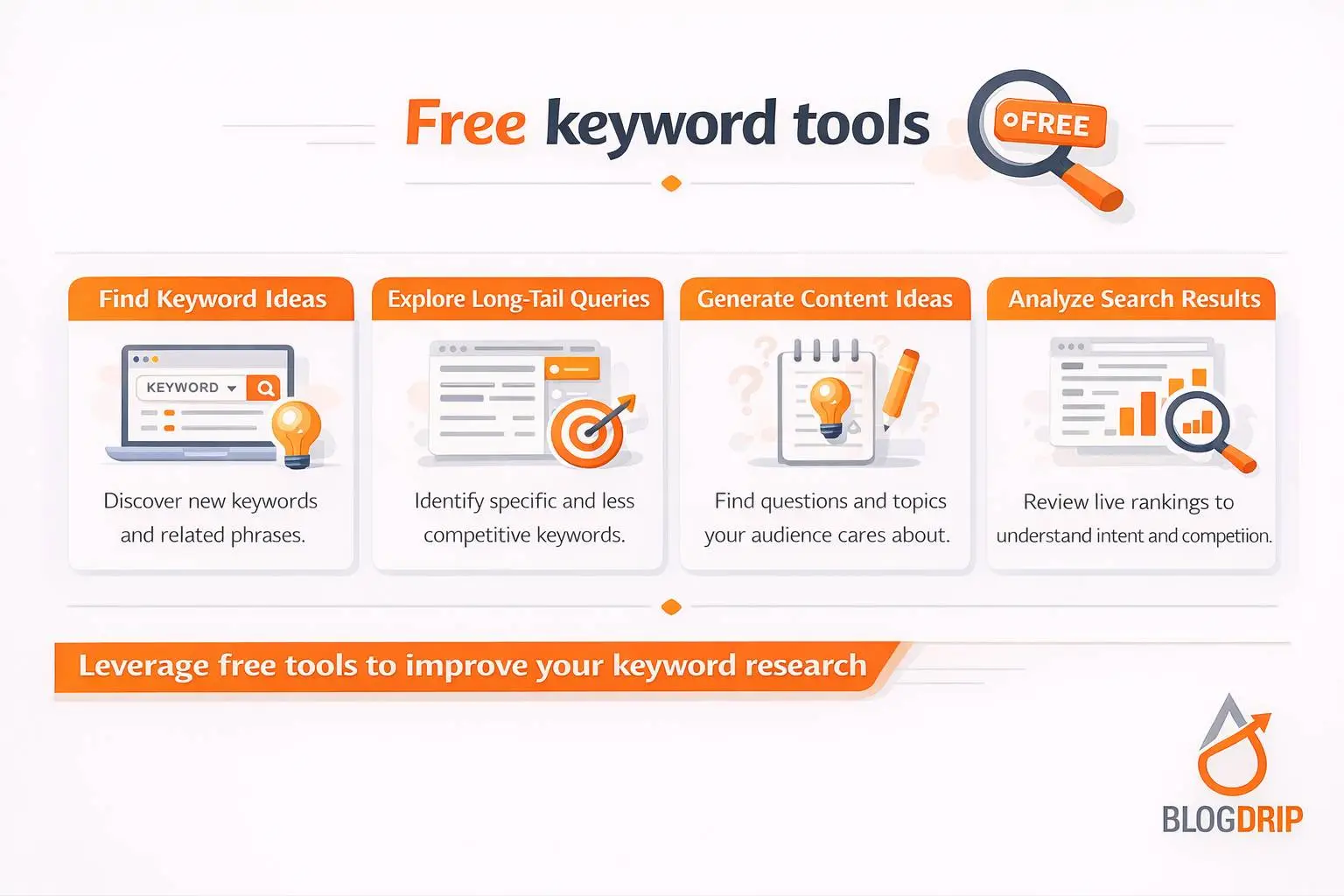
Search suggestion tools
Some free tools rely on autocomplete suggestions and related search behavior. These are useful for discovering how searchers phrase topics and what related terms tend to appear around a keyword.
They are especially helpful for finding long-tail keywords and question-based angles.
Search result analysis tools
Some free tools focus more on reviewing the live search results page. These help you analyze what types of pages rank, how search intent is being interpreted, and what kind of content appears to satisfy the query.
This is often one of the most valuable uses of free tools because intent analysis matters more than metrics alone.
Question and topic generators
Some free tools surface common questions, modifiers, and related content ideas. These can be especially useful for building content clusters, FAQs, and supporting articles beneath a broader topic.
For a pillar-and-cluster strategy, this kind of output can help define which narrower pages deserve their own URL.
Limited-data keyword platforms
Some paid SEO platforms also offer free tiers, restricted searches, or partial access. These tools can provide useful signals, but usually with limitations around depth, filtering, export options, or the number of searches available.
They are helpful for small projects, but they usually become restrictive as content operations grow.
What Free Keyword Tools Are Good At
Free keyword tools can be very useful when used for the right purposes.
Discovering topic variations
They are often strong at revealing how people phrase a topic in multiple ways. This is useful when building semantic coverage and deciding how a page should be framed.
Finding long-tail opportunities
Free tools are especially good for uncovering narrower keyword variations and question-based searches. That makes them useful for cluster pages, blog articles, and informational content.
Supporting content outlines
When free tools reveal related questions and subtopics, they can improve the structure of a page by showing what supporting themes matter within the broader topic.
Validating audience language
Internal teams often describe topics differently from how users search for them. Free keyword tools can help bridge that gap by exposing real search phrasing.
Where Free Keyword Tools Fall Short
Free keyword tools are useful, but they do have real limits.
Limited data depth
Most free tools do not provide the same amount of keyword data, filtering, competitive analysis, or SERP history as paid platforms. That makes them less effective for large-scale planning or advanced prioritization.
Restricted workflows
Free tools are usually weaker when you need to cluster large sets of keywords, compare multiple competitors, or build full editorial roadmaps across many pages.
Inconsistent metrics
Some free tools provide little to no keyword metrics. Others provide simplified or partial data. That is not always a problem, but it means you need to rely more on manual judgment.
Less support for mapping and prioritization
Free tools may help you find keyword ideas, but they usually do less to help you decide which page should own the term, how topics should cluster, or which opportunities matter most strategically.
That part still has to be done manually.
Common Mistakes When Using Free Keyword Tools
A lot of weak SEO decisions come from misunderstanding what free keyword tools are meant to do.
Expecting them to replace strategy
A free tool can help you discover ideas, but it cannot define your content architecture or make judgment calls about what your site should prioritize.
Treating free data as complete
Free tools often provide partial visibility. If you treat their output as the full market, you may miss important context or overestimate the completeness of your research.
Ignoring the live search results
Even when a free tool provides keyword ideas, you still need to review the actual search results. That is where intent, competition, and format become much clearer.
Overvaluing easy-to-find long-tail terms
Free tools often surface lots of long-tail phrases. That can be useful, but not every variation deserves its own page. Some terms belong together on one stronger article.
Failing to connect research to structure
Keyword ideas only become valuable when they are grouped, prioritized, and assigned to the right pages. Without that step, even good tool output leads to scattered content.
How to Use Free Keyword Tools Strategically
The best way to use free keyword tools is to combine them with structured SEO thinking.
Start with a core topic that matters to your audience and your site. Use the free tool to expand that topic into related terms, supporting questions, and more specific search variations. Then move beyond the tool and ask the strategic questions that really shape performance:
- Is this keyword relevant to our audience and expertise?
- What intent does it reflect?
- Does it belong on a pillar page or a cluster page?
- Can related terms be grouped on one page?
- Is there already an existing page that should own this topic?
This matters because free keyword tools are most useful for discovery, not final decision-making.
For a site using a pillar-and-cluster model, that often means using free tools to identify supporting subtopics around a broader theme. A main pillar page on Keyword Research may be supported by focused articles on search intent, long-tail keywords, keyword mapping, free keyword tools, and similar topics. That is where free research becomes structurally useful.
When Free Keyword Tools Are Enough and When They Are Not
Free keyword tools are often enough when:
- you are building early-stage topic clusters
- you need initial keyword ideas
- you are researching informational content
- your site is still relatively small
- you are validating content direction before scaling up
They become less sufficient when:
- you need deeper competitive analysis
- you are managing a larger site
- you need extensive keyword clustering
- you want more precise workflow support
- you are prioritizing content at scale across many categories
That does not mean free tools stop being useful. It means they usually work best as part of a mixed process rather than the entire process.
Timing and Expectations
Free keyword tools can improve keyword research immediately, but they do not create SEO results by themselves.
Their first value usually shows up in better content ideas, stronger topic coverage, clearer long-tail targeting, and more informed research habits. Ranking and traffic gains come later through the quality of the pages built from those decisions.
For newer sites, free keyword tools can be especially valuable because they help surface realistic opportunities without requiring a major software investment. For more established sites, they still remain useful for supplemental research, question discovery, and validating phrasing.
The key is to treat them as research aids, not shortcuts.
Conclusion
Free keyword tools help you discover keyword ideas, question-based queries, and search phrasing without needing a paid SEO platform.
They matter because they make SEO research more accessible and provide enough visibility to support meaningful content planning, especially for smaller teams and early-stage sites. But their real value comes from how they are used. On their own, they provide ideas. Within a broader keyword strategy, they help shape topic clusters, support intent analysis, and guide better content decisions.
For a website building topical authority through a pillar-and-cluster model, free keyword tools can absolutely be useful. The key is to use them as part of a strategic process that turns keyword discovery into structure, relevance, and clearer page roles.