
Technical SEO vs On-Page SEO: What’s the Difference and Why Both Matter
Many SEO discussions treat technical SEO and on-page SEO as separate disciplines, but in practice they are closely connected. If you only focus on one, your results are usually limited. A page may be well written and keyword-aligned, but struggle because of crawl issues or weak indexation. Just as often, a technically sound page underperforms because the content does not match search intent or lacks clear optimization.
That is why understanding technical SEO vs on-page SEO matters. This is not just a definitional comparison. It affects how you prioritize work, diagnose performance issues, and build a site that can grow sustainably in search.
This cluster page explains the difference between technical SEO and on-page SEO, where they overlap, why both matter, and how to apply them strategically. It should also sit naturally beneath a broader technical SEO pillar page, with contextual internal links to related supporting articles on crawlability, indexation, site speed, internal linking, and content optimization.
What Is Technical SEO vs On-Page SEO?
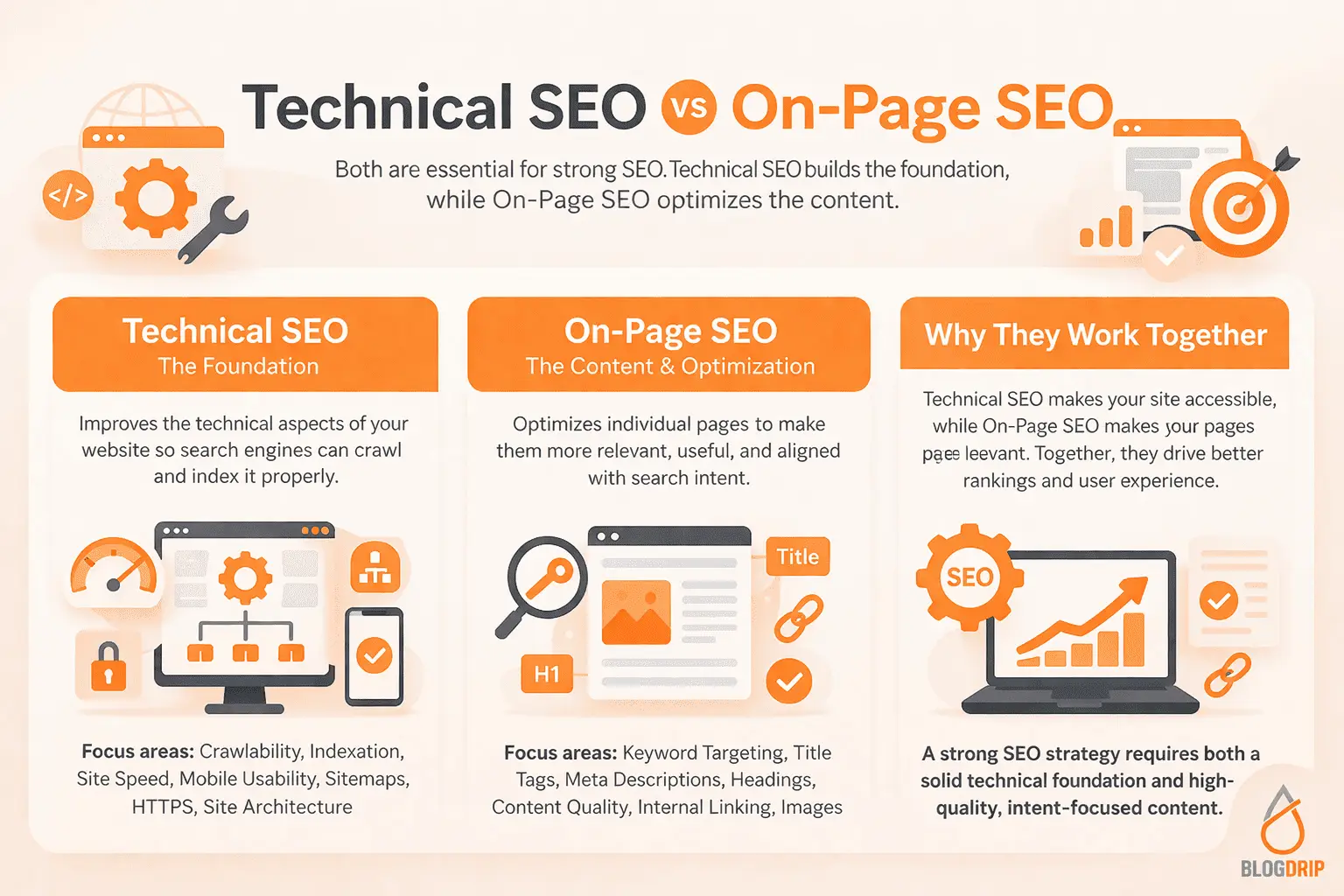
The clearest way to understand technical SEO vs on-page SEO is to look at what each one is responsible for.
Technical SEO focuses on the infrastructure of the website. It helps search engines discover, crawl, render, understand, and index pages correctly. It deals with the technical conditions that allow a page to compete in search.
On-page SEO focuses on the content and signals that appear on the page itself. It helps search engines understand what the page is about and helps users find content that matches their intent.
In simple terms:
- technical SEO makes pages accessible and processable
- on-page SEO makes pages relevant and understandable
Both are essential, but they solve different problems.
Technical SEO in practical terms
Technical SEO usually includes areas such as:
- crawlability
- indexation control
- XML sitemaps
- canonical tags
- redirects and status codes
- site speed
- mobile usability
- structured data
- JavaScript rendering
- site architecture
A good related internal link here would be a supporting article on what technical SEO is.
On-page SEO in practical terms
On-page SEO usually includes:
- keyword targeting
- search intent alignment
- title tags
- meta descriptions
- heading structure
- content depth
- internal linking within content
- image optimization
- topical coverage
- entity relevance and semantic clarity
This area is often closely tied to content strategy, content briefs, and editorial quality control.
Why the Difference Matters
The comparison between technical SEO and on-page SEO matters because teams often misdiagnose SEO problems.
If a page is not performing, the issue is not always the content. It may be poorly linked, excluded from the index, duplicated through URL variations, or slowed down by weak templates. On the other hand, a technically healthy page may still fail because the topic is weak, the search intent is mismatched, or the content lacks depth.
Understanding the difference helps you identify the real source of underperformance.
Technical SEO affects access
Technical SEO determines whether search engines can efficiently reach and process your pages. If that foundation is weak, even strong content may not perform as expected.
This connects naturally to cluster pages on crawlability, indexation, and canonical tags.
On-page SEO affects relevance
On-page SEO influences how clearly a page matches a search query and satisfies user intent. A technically perfect page will not rank well if the content is thin, generic, or poorly optimized.
That makes on-page work central to traffic growth, especially in competitive search results.
Technical SEO vs On-Page SEO: The Core Difference
The main difference is that technical SEO focuses on the website’s backend and structural conditions, while on-page SEO focuses on the meaning, quality, and optimization of individual pages.
Technical SEO asks questions like:
- Can search engines crawl this page?
- Should this page be indexed?
- Is the canonical version clear?
- Does the site structure support discovery?
- Is the page fast and mobile-friendly?
On-page SEO asks different questions:
- Does this page target the right keyword theme?
- Does it match the search intent?
- Is the title clear and compelling?
- Is the content useful and comprehensive?
- Are the headings and internal links helping users and search engines understand the topic?
That distinction is useful because it clarifies responsibility. Technical SEO is often about systems, templates, and infrastructure. On-page SEO is usually about page-level optimization and content quality.
How Technical SEO and On-Page SEO Work Together
Although the difference is clear, the two disciplines are not isolated.
A page needs technical accessibility and content relevance at the same time. That is why the strongest SEO strategies do not choose between them. They combine them.
Technical SEO supports on-page performance
A well-optimized page cannot perform fully if it is blocked from crawling, buried deep in the site, or competing with duplicate versions. Technical SEO creates the conditions for the on-page work to matter.
For example, a strong article targeting a valuable keyword may still struggle if:
- it is three or four levels too deep in the site
- internal links to it are weak
- the canonical signal points elsewhere
- it loads poorly on mobile
- it is not consistently included in the crawl path
On-page SEO gives technical pages a reason to rank
The reverse is also true. A technically clean page does not deserve rankings by default. Search engines still need a reason to rank it. That reason comes from content quality, search intent alignment, relevance, and usefulness.
This is where many sites fall short. They fix technical issues but expect traffic growth without improving the page itself.
Important Subtopics in the Comparison
A good article on technical SEO vs on-page SEO should go beyond simple definitions and explain where the difference shows up most clearly.
Site Architecture vs Content Optimization
Technical SEO shapes the structure around your pages. On-page SEO shapes the substance within them.
Site architecture affects how easily pages are discovered and how topical relationships are understood. Content optimization affects how clearly a page answers a query and competes in search.
For a pillar-and-cluster website, both matter. The technical SEO pillar page needs strong internal linking and crawlable structure, while each cluster page needs clear intent alignment and useful page-level optimization.
Indexation vs Keyword Targeting
Technical SEO helps determine whether a page should appear in search results at all. On-page SEO helps determine which searches it should appear for.
If indexation is weak, a page may not be visible. If keyword targeting is weak, the page may be visible but irrelevant.
That is why these areas should not be treated as substitutes.
Page Speed vs Content Quality
Page speed belongs primarily to technical SEO. Content quality belongs primarily to on-page SEO. Both influence performance, but in different ways.
A fast page with weak content is still weak. A slow page with strong content may also underperform. The best results usually come when both are handled properly.
A natural supporting link here would be a cluster article on site speed for SEO.
Structured Data vs On-Page Clarity
Structured data is usually part of technical SEO because it helps search engines interpret page information more clearly. On-page clarity, however, still depends on what users can actually read and understand on the page.
Schema markup can support understanding, but it cannot compensate for vague or shallow content.
Common Mistakes
One common mistake is assuming technical SEO is more important than on-page SEO, or the other way around. In reality, the answer depends on the problem being solved.
If a site has major crawl and indexation issues, technical SEO may deserve immediate priority. If the site is technically sound but pages are thin and poorly targeted, on-page SEO is likely the bigger opportunity.
Another mistake is separating the two too rigidly. Internal linking, for example, sits between both disciplines. It is part of site structure, but it also helps define topical context within content.
Teams also make the mistake of using tools in isolation. A technical audit may highlight crawl or speed issues, while content tools highlight optimization gaps. Neither gives the full picture alone.
Practical Guidance
The best way to handle technical SEO vs on-page SEO is to evaluate both before deciding where to prioritize.
Start with the fundamentals:
- Make sure important pages are crawlable, indexable, and technically accessible.
- Confirm that the content matches search intent and covers the topic properly.
- Check titles, headings, and internal links for clarity.
- Review canonical signals, mobile usability, and performance.
- Look for systemic issues before treating problems as page-specific.
In a pillar-and-cluster model, this becomes even more important. Your broader technical SEO guide should support cluster pages on crawlability, indexation, and site speed, while related content optimization pages address keyword targeting, search intent, and on-page structure.
That creates a more complete topical ecosystem.
Timing and Expectations
Improvements in technical SEO and on-page SEO do not always show results at the same speed.
Technical fixes can sometimes produce visible changes relatively quickly, especially when they address crawl blocks, accidental noindex tags, broken canonicals, or major mobile issues. On-page improvements may take longer, particularly when search engines need time to reassess relevance and compare the updated page against competitors.
In many cases, the biggest gains come from addressing both together rather than waiting for one discipline to “finish” before starting the other.
Conclusion
The real difference in technical SEO vs on-page SEO is that technical SEO helps search engines access and process your pages, while on-page SEO helps them understand why those pages are relevant.
One supports accessibility and structure. The other supports relevance and quality. Neither is enough on its own.
For a website building topical authority, this comparison matters because it helps prioritize work more accurately. A strong technical SEO pillar page should connect naturally to supporting cluster articles on crawlability, indexation, site speed, and structured data, while adjacent content pages cover on-page optimization, keyword targeting, and search intent. That is how both disciplines work best: not in competition, but in coordination.