
How to Choose Keywords for SEO
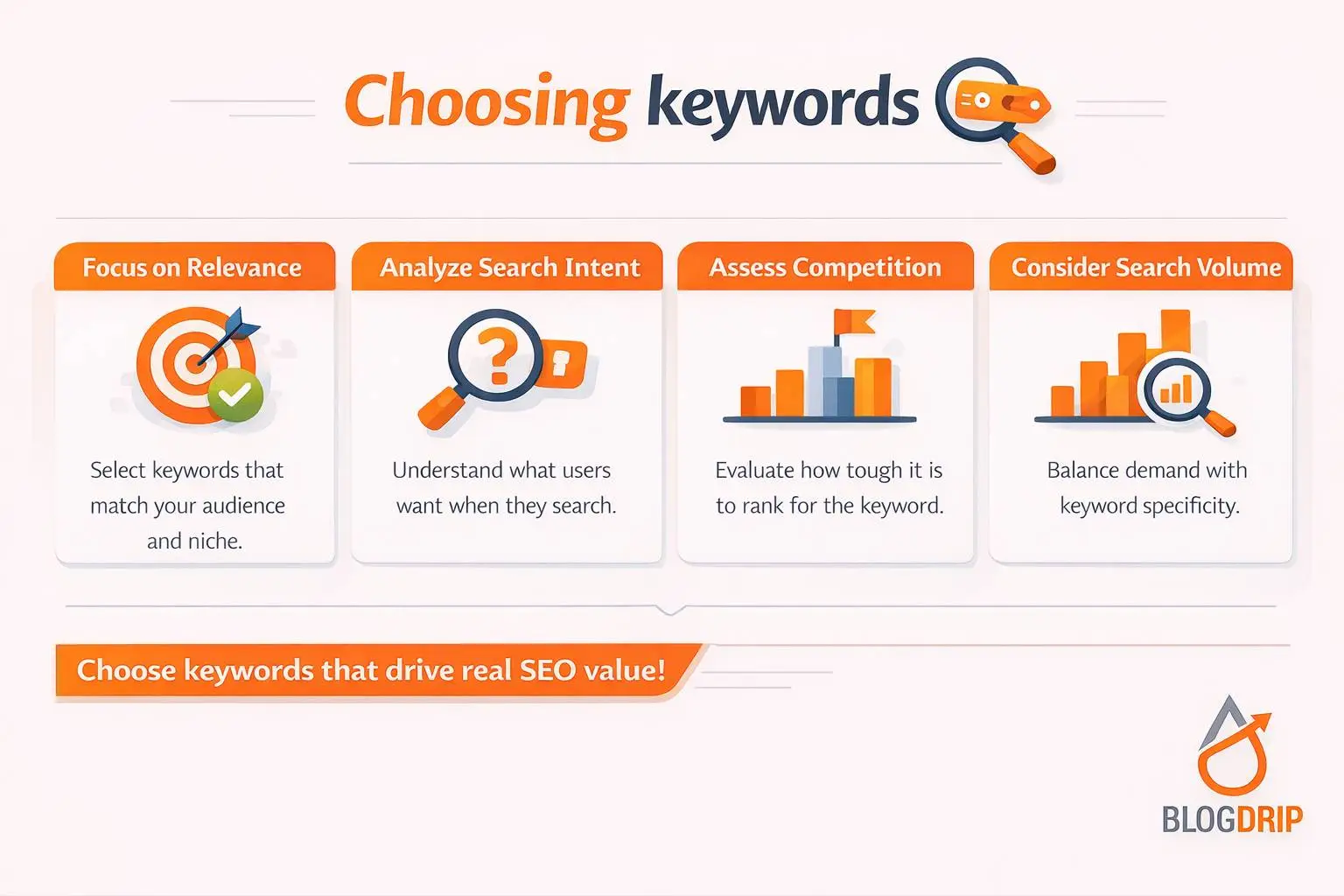
To choose keywords well, you need to identify search terms that are relevant to your business, aligned with user intent, realistic for your site to target, and useful within your wider content strategy. That sounds straightforward, but in practice it is where many SEO plans either become focused and effective or scattered and inefficient.
A lot of websites do not struggle because they lack keyword ideas. They struggle because they choose the wrong ones. They prioritize search volume over relevance, create content around terms that do not match intent, or chase competitive phrases without a realistic path to ranking. The result is often wasted content effort and pages that never become meaningful SEO assets.
That is why learning how to choose keywords matters. It is not just about finding phrases people search for. It is about deciding which opportunities deserve your time, which page type fits each term, and how those choices support a broader pillar-and-cluster structure. Your main Keyword Research guide already explains the larger role of search demand, intent, and topic architecture in SEO planning. This page focuses more specifically on how to choose keywords correctly and strategically.
What Does It Mean to Choose Keywords?
To choose keywords means deciding which search terms your website should target and which ones it should ignore, postpone, or group elsewhere.
In practical terms, that means evaluating each keyword against a set of strategic questions:
- Is this keyword relevant to our audience and expertise?
- What is the searcher trying to accomplish?
- What type of page would need to rank for it?
- Is this a realistic opportunity for our site right now?
- Does this keyword belong on a pillar page, a cluster page, or another page type?
- Will ranking for this term support broader business and content goals?
That last point matters. Keyword choice is not just a content decision. It is also a prioritization decision.
A good keyword is not simply one with traffic. It is one that fits the site.
Why Choosing Keywords Matters
Keyword choice matters because SEO performance depends heavily on what you decide to target before content is created.
Without a clear process, teams often publish content around terms that look promising in a tool but do not fit the site’s actual strengths or structure.
It affects relevance
If a keyword is only loosely related to your business or audience, the traffic it brings may have limited value. A page can attract visits and still fail strategically if it does not connect to the problems your site is meant to solve.
Choosing keywords carefully helps make sure traffic is relevant, not just visible.
It affects page performance
A page may be well written and optimized, but if the chosen keyword is too broad, too competitive, or misaligned with intent, ranking becomes much harder.
Choosing better keywords often improves SEO more than adding more content around poor targets.
It shapes site architecture
Keyword choices determine which pages deserve to exist and how they should relate to each other.
In a pillar-and-cluster model, broad foundational terms often support pillar pages, while narrower queries support cluster articles. Choosing keywords well helps define those roles early and prevents content overlap later.
It improves resource allocation
Most teams cannot pursue every keyword opportunity at once. Good keyword selection helps focus content effort on the topics that offer the strongest balance of relevance, realism, and strategic value.
How to Choose Keywords
Choosing keywords well is not about one metric. It is a multi-step evaluation process.
Start with topics, not random phrases
A strong keyword process usually starts with broad topics that matter to your audience and align with your expertise.
If you begin only with isolated keywords from a tool, you often end up with disconnected opportunities and no clear structure. A better approach is to define the subject areas your site should be known for, then identify keyword opportunities within those themes.
For example, a site building authority around SEO may focus on topics such as Keyword Research, search intent, keyword mapping, technical SEO, and on-page optimization. Once the topics are clear, keyword selection becomes more strategic.
Check relevance first
Before reviewing volume or difficulty, ask whether the keyword actually fits your site.
Relevance should be judged by:
- audience fit
- topical fit
- expertise fit
- business fit
A keyword with strong volume can still be a poor target if it attracts the wrong searcher or sits outside the site’s credible scope. Relevance is one of the most important filters because it affects both ranking quality and business value.
Evaluate search intent
Once relevance is established, look at intent.
This means understanding what the user wants when they search the term. Are they trying to learn, compare, navigate, or act?
For example:
- an informational keyword may suit a cluster article
- a commercial keyword may suit a comparison page
- a transactional keyword may suit a service or product page
Choosing keywords without checking intent is one of the fastest ways to create the wrong page for the query.
Review the live search results
The search results page is one of the best tools for keyword choice because it shows how search engines currently interpret the term.
Look at the top results and ask:
- What kind of pages are ranking?
- Are they broad guides or narrow how-to articles?
- Are they beginner-focused or advanced?
- Are they editorial, commercial, or product-led?
- Can our site produce something that genuinely fits and competes?
This step matters because some keywords look attractive until you see the actual result landscape.
Assess competition realistically
Competition should be judged with more nuance than a single difficulty score.
Look at the authority and quality of the pages ranking now. Consider how established those domains are, how complete the content is, and whether the search results are dominated by major brands or a mix of sites.
A keyword may be worth pursuing later, but not necessarily now. Choosing keywords well often means sequencing opportunities rather than chasing the hardest ones first.
Consider business and strategic value
A keyword should also support the broader purpose of the site.
Ask:
- Will this attract a useful audience?
- Does it support a core topic cluster?
- Can it guide users toward related pages or commercial content?
- Does it strengthen our authority in a subject we want to own?
Some informational keywords may not convert directly, but they can still be valuable if they build trust, support internal links, and strengthen topical coverage.
Important Factors to Consider When Choosing Keywords
A good keyword decision usually comes from balancing several factors rather than maximizing one.
Search volume
Search volume can help identify demand, but it should not dominate the decision. High volume is not automatically better, especially if the keyword is vague, too broad, or poorly aligned with intent.
In many cases, a lower-volume keyword with clearer purpose is the better target.
Specificity
More specific keywords often reveal clearer needs and make it easier to create focused content.
This is one reason long-tail keywords are often valuable in cluster content. They may have lower volume, but they usually improve alignment between page and query.
Intent clarity
A keyword is easier to choose when the underlying intent is clear. Ambiguous keywords are not always bad, but they require more careful review of the live results.
When intent is mixed, you need to decide whether your site can realistically fit the dominant interpretation.
Topic fit within the cluster
A strong keyword should fit naturally into your site’s wider structure.
Some terms deserve standalone cluster pages. Others are better handled as supporting sections within an existing article. Good keyword choice includes deciding whether a keyword needs its own URL at all.
Current site authority
A realistic keyword strategy takes the site’s current strength into account.
Newer or lower-authority sites often benefit from more specific, lower-competition targets. More established sites may be able to compete for broader terms. Choosing keywords without accounting for site strength often leads to poor prioritization.
Common Mistakes When Choosing Keywords
Many SEO problems begin at the keyword selection stage.
Choosing based on volume alone
This is one of the most common mistakes. High volume can be attractive, but it does not guarantee relevance, conversions, or realistic ranking potential.
Ignoring intent
A keyword may look relevant, but if the dominant results show a different intent from the page you plan to create, performance is likely to suffer.
Treating every keyword as a separate page
Not every keyword deserves its own article. Closely related terms often belong on one strong page. Splitting them unnecessarily can create thin content and cannibalization.
Chasing keywords outside your expertise
A keyword may be popular, but if it sits outside your brand’s credible scope, the resulting content often feels weaker and less useful.
Overlooking existing pages
Sometimes the right keyword does not need a new article. It needs to be assigned to an existing page that can be improved, expanded, or better optimized.
Practical Guidance for Choosing Better Keywords
A practical way to choose keywords is to apply a simple sequence.
Start with a topic that matters to your audience and your business. Identify a group of possible keywords within that topic. Then narrow the list by relevance, intent, competitiveness, and role within your site structure.
For each keyword, decide whether it should:
- anchor a pillar page
- support a focused cluster article
- strengthen an existing page
- be saved for later
- be dropped entirely
This is where keyword selection becomes strategic rather than mechanical.
For a site using pillar-and-cluster architecture, it also helps to think in terms of page purpose. One keyword may support a broad guide. Another may support a definition page. Another may support a more specific process article. That separation helps the site grow with more clarity and less duplication.
It is also worth reviewing keyword choices regularly. Search results change, site authority improves, and topic priorities evolve. A keyword that is not viable today may become a better opportunity later.
Timing and Expectations
Choosing keywords well improves SEO decision-making immediately, but ranking results still take time.
Its earliest benefits usually appear in better content planning, cleaner briefs, stronger topic targeting, and fewer wasted pages. Traffic and ranking gains come later as the content is published, linked, and evaluated over time.
For established sites, better keyword selection can improve performance relatively quickly when it leads to sharper targeting or better use of existing assets. For newer sites, the benefits may build more gradually, especially when the strategy relies on lower-competition terms and cluster depth.
Either way, keyword choice is a foundation, not a shortcut.
Conclusion
To choose keywords well, you need to balance relevance, intent, competition, specificity, and strategic value.
That is what turns keyword research into real SEO direction. Without careful keyword selection, even strong content can end up targeting the wrong opportunities. With it, your pages become more focused, your topic clusters become more coherent, and your chances of earning meaningful visibility improve.
For a website building topical authority through a pillar-and-cluster model, choosing keywords is not just the first planning step. It is one of the decisions that shapes everything that follows.