
Keyword Mapping: How to Assign Keywords to the Right Pages
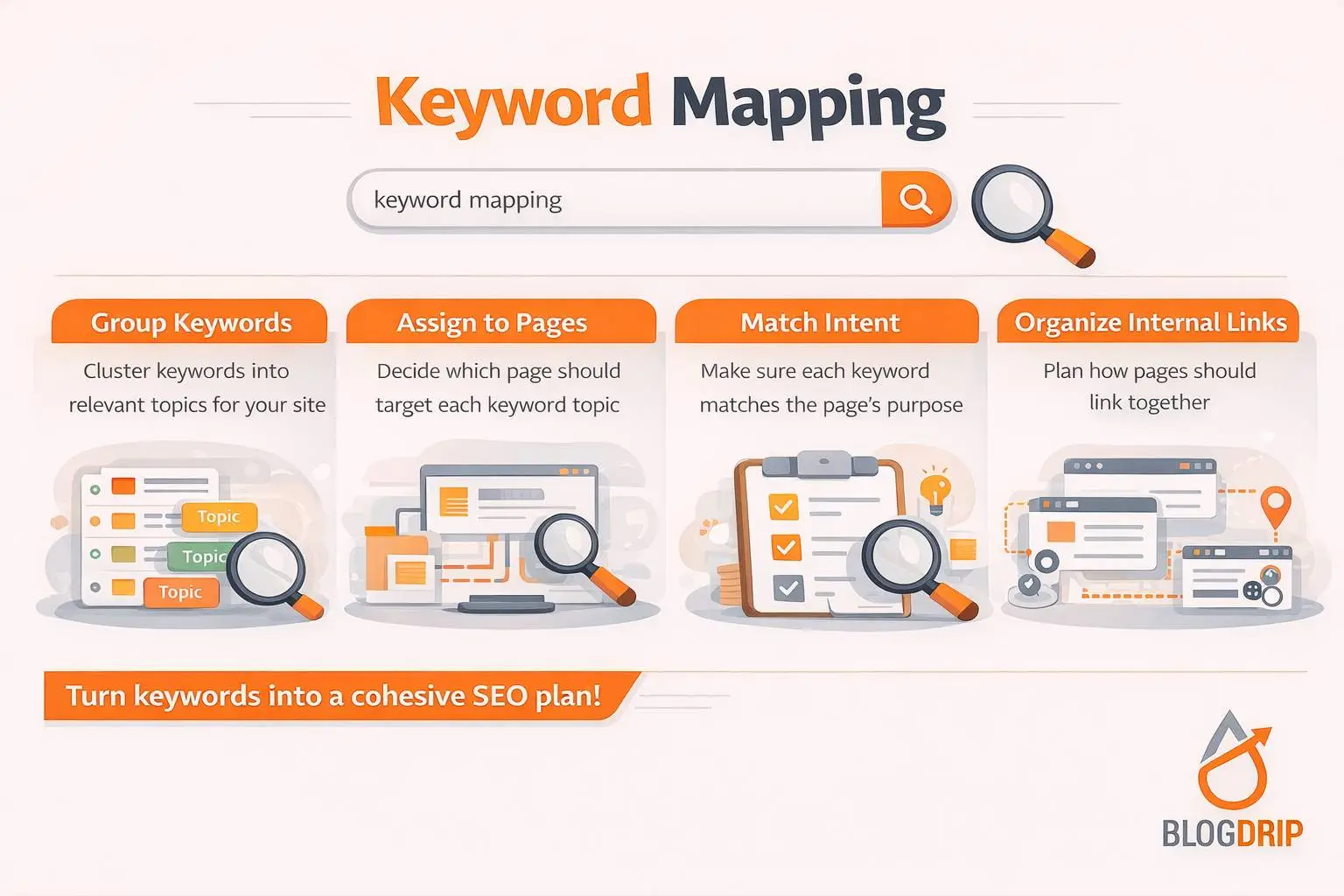
Keyword mapping is the process of assigning target keywords to specific pages on a website so that each page has a clear role in the SEO strategy. It sits between keyword research and content execution. Research tells you which opportunities exist. Keyword mapping decides where those opportunities should live.
This matters because many SEO problems are not caused by a lack of keywords. They are caused by poor keyword distribution. Websites often publish multiple pages that target the same search intent, leave valuable topics unmapped, or create content without defining which page should own which term. That leads to cannibalization, weak internal structure, and content that competes with itself.
A strong keyword mapping process helps avoid that. It clarifies which page should rank for which topic, supports pillar-and-cluster architecture, and turns keyword research into a practical site plan. Your broader Keyword Research guide already explains why mapping is essential to turning research into implementation. This page focuses specifically on what keyword mapping is, why it matters, and how to do it correctly in a real SEO workflow.
What Is Keyword Mapping?
Keyword mapping is the process of matching keywords or keyword clusters to individual URLs.
In practical terms, it answers questions like these:
- Which keyword should this page target?
- Which page should own this topic?
- Are multiple pages competing for the same intent?
- Should this keyword be part of an existing article or a new page?
- How should related pages connect within the wider topic cluster?
A keyword map is usually not just a list of terms next to page titles. A useful map also reflects intent, page type, strategic priority, and content relationships.
That is why keyword mapping is not an administrative step. It is a structural SEO activity. It helps define what each page is supposed to do.
Why Keyword Mapping Matters
Keyword mapping matters because SEO works best when each page has a distinct purpose.
Without mapping, websites often build content in a fragmented way. Teams create pages based on isolated keyword opportunities, internal requests, or what seems useful in the moment. Over time, that creates overlap and confusion.
It reduces keyword cannibalization
One of the clearest benefits of keyword mapping is that it helps prevent multiple pages from targeting the same intent.
If two or three pages are all trying to rank for a similar query, search engines may struggle to understand which one should be prioritized. That can dilute performance across the whole group rather than helping any one page rank strongly.
It supports clearer site structure
Keyword mapping helps turn a keyword list into a logical website structure.
This is especially important in a pillar-and-cluster model. A broad topic should usually live on a pillar page, while narrower supporting terms belong on cluster articles. Mapping helps make those distinctions early, before content is published.
It improves internal linking
When you know which page owns which keyword cluster, internal linking becomes much more deliberate.
Instead of linking randomly between vaguely related pages, you can connect content based on topic hierarchy and search intent. That improves both usability and crawl clarity.
It makes content planning more efficient
Keyword mapping also improves editorial planning. It shows which topics already have a page, which need a new page, and which existing pages should be improved or consolidated.
That reduces waste and makes it easier to prioritize work that supports the wider strategy.
How Keyword Mapping Works
Keyword mapping works by turning keyword research into a page-level plan.
Start with keyword research and clustering
A keyword map should never begin with random page assignment. First, you need a researched keyword set and a basic understanding of how terms group together.
That usually means:
- identifying core topics
- expanding into related and long-tail terms
- reviewing search intent
- clustering terms that can be covered on the same page
This matters because not every keyword deserves its own URL. Many closely related phrases should be mapped to a single strong page rather than split into thin articles.
Review the existing site
Before mapping keywords to new pages, look at what already exists.
Ask:
- Do we already have a page that should own this topic?
- Is that page aligned with the right intent?
- Does it need to be improved rather than replaced?
- Are there older pages overlapping with the same keyword cluster?
This step is essential. Many keyword mapping mistakes happen when teams create new content without checking whether the topic already has a home.
Assign one primary cluster to one page
A useful rule is that each page should have one main keyword target or keyword cluster that reflects a single dominant intent.
That does not mean a page can rank for only one phrase. It means the page should have one clear strategic focus.
For example, a cluster page about keyword mapping may also rank for related phrases such as SEO keyword mapping, keyword map, or how to map keywords to pages. But the page still needs one core purpose.
Define page role and intent
Once a keyword cluster is assigned, define what kind of page it should be.
That usually includes:
- page type
- primary intent
- supporting subtopics
- internal linking role
- relationship to pillar and cluster content
A page targeting an informational keyword should not be mapped like a transactional landing page. The mapping process works best when it includes both topic and intent, not topic alone.
Important Elements of a Good Keyword Map
A strong keyword map is more than a spreadsheet of terms and URLs. It should support decisions.
Primary keyword or keyword cluster
Each page should have a clear main target. In many cases, this is better understood as a keyword cluster rather than one exact phrase.
Search engines evaluate topic relevance more broadly than they used to, so the goal is not exact-match repetition. The goal is clarity of topic ownership.
Search intent
Intent should always be part of the map. Two keywords may look similar but require different page formats.
For example, an informational query and a commercial comparison query may sit in the same broader topic area, but they should not usually be mapped to the same page.
Page type
Keyword maps become much more useful when they reflect page type.
Examples include:
- pillar page
- cluster article
- service page
- product page
- category page
- comparison page
This helps keep the architecture coherent.
Existing URL or planned URL
A keyword map should show whether the keyword belongs to an existing page or a planned new page.
That distinction matters because strong SEO often comes from improving the right existing content, not just publishing more.
Internal linking relationships
A good map also shows how pages should support one another.
In a cluster structure, this means identifying which pages should link up to the pillar page, which related pages should connect laterally, and how the overall topic network should be reinforced.
Common Keyword Mapping Mistakes
Keyword mapping is straightforward in theory, but a few mistakes repeatedly cause problems.
Mapping one keyword per page too rigidly
Not every variation needs its own article. Treating every keyword as a separate page often creates thin content and internal competition.
A better approach is to map related terms by shared intent and topic.
Ignoring search intent differences
Some keywords may look related but actually belong on different page types. If intent is ignored, pages become unfocused or misaligned with the results they are trying to rank in.
Creating new pages without checking existing content
This is one of the most common problems. Teams create a new page for a keyword that should have been assigned to an existing URL. That leads to duplication and cannibalization.
Leaving pages without a clear target
Some sites publish content that has no defined keyword ownership at all. Those pages may still have value for users, but from an SEO perspective, they often lack focus and underperform.
Failing to update the map over time
A keyword map should evolve as the site grows. New content, shifting rankings, and changing search behavior can all affect how topics should be assigned.
Practical Guidance for Better Keyword Mapping
A practical keyword mapping process starts by thinking in topics and page roles rather than isolated phrases.
Begin with your core subject areas and identify the pillar pages that should anchor those themes. Then map narrower supporting terms to cluster pages that answer specific questions or subtopics. This usually creates a cleaner and more scalable structure than assigning keywords one by one without context.
It is also important to map based on realistic page ownership. If an existing article already covers the topic and has some authority, improving that page is often better than starting over on a new URL.
For most teams, a useful keyword map includes:
- page title or URL
- primary keyword cluster
- search intent
- page type
- content status
- strategic priority
- internal link relationships
This helps turn mapping into an operational tool rather than a static document.
Within a content cluster, keyword mapping is especially valuable because it keeps related pages distinct. One article may define a concept. Another may explain why it matters. Another may cover the process of applying it. That separation helps the cluster grow without repeating the same framing across multiple pages.
Timing and Expectations
Keyword mapping can improve clarity immediately, but ranking outcomes still take time.
Its first impact is usually structural. You get better targeting, clearer page roles, stronger briefs, and less overlap. Those improvements then support better SEO performance over time.
For established sites, keyword mapping can produce relatively fast gains when it leads to content consolidation, clearer intent matching, or stronger internal linking. For newer sites, the value often shows up in building a more disciplined architecture from the start.
Either way, keyword mapping is not a shortcut. It is a planning advantage. It helps make sure that the content you publish has a better chance of performing because it is assigned more intelligently.
Conclusion
Keyword mapping is the process of assigning keywords to the right pages so that each URL has a clear topic, a clear intent, and a clear role in the wider SEO structure.
It matters because keyword research alone does not tell you where opportunities should live. Without mapping, content often overlaps, pages compete with each other, and site architecture becomes harder to scale.
With a strong keyword mapping process, your research becomes more actionable. It supports better internal linking, cleaner topic clusters, and a website that grows with more clarity and less duplication. For any site building authority through a pillar-and-cluster model, that makes keyword mapping a foundational part of practical SEO execution.