
Keyword Strategy: How to Turn Keyword Research Into SEO Direction
Keyword strategy is the process of deciding which keywords to target, how to prioritize them, and where they should live across your website. It takes raw keyword research and turns it into a structured SEO plan.
That distinction matters. Many websites collect keyword data, but far fewer use it strategically. They export lists from tools, note search volumes, and start publishing pages without a clear framework. The result is usually fragmented content, overlapping topics, weak internal linking, and pages that target phrases without serving a defined role in the site architecture.
A strong keyword strategy solves that problem. It helps you decide what to create, what to improve, what to consolidate, and how each page contributes to broader topical authority. For a site built on a pillar-and-cluster model, keyword strategy is what connects research to execution. Your broader Keyword Research guide already explains how keyword discovery supports SEO planning. This page focuses more specifically on what keyword strategy is and how to build one that is practical, realistic, and scalable.
What Is Keyword Strategy?
Keyword strategy is the framework used to organize, prioritize, and apply keywords across a website.
In practical terms, it answers questions like these:
- Which keywords are worth targeting?
- Which ones belong on pillar pages versus cluster pages?
- Which pages already exist and should be improved rather than replaced?
- Which topics deserve new content?
- How should keywords be grouped to avoid overlap?
- How should internal links reinforce those topic relationships?
Keyword strategy is not the same as keyword research. Keyword research is about discovery and evaluation. Keyword strategy is about decisions.
That means a keyword strategy is not just a list of target terms. It is a plan for how your site will compete in search with a clear structure behind it.
Why Keyword Strategy Matters
Keyword strategy matters because SEO performance depends on more than identifying good keywords. It depends on using them coherently.
Without a strategy, content production often becomes reactive. Teams publish articles based on isolated keyword opportunities, internal requests, or whatever looks attractive in a tool that week. Over time, this creates duplication, weak page roles, and an uneven content footprint.
It gives keywords a clear purpose
A keyword on its own does not tell you what to do with it. A strategy does.
It helps distinguish whether a term should be targeted through a broad guide, a focused cluster article, a commercial page, or an update to an existing URL. That clarity is what makes the research usable.
It improves site structure
A strong keyword strategy supports cleaner site architecture.
Instead of creating disconnected articles, you build around topics, subtopics, and intentional internal relationships. This is especially important for topical authority, where breadth alone is not enough. The structure needs to make sense.
It reduces content overlap
Many SEO issues come from pages competing with one another because keywords were assigned without a wider plan.
Keyword strategy helps avoid cannibalization by defining which page owns which topic and where closely related terms should be clustered rather than split.
It supports better prioritization
Not every keyword deserves equal effort. Some terms are high priority because they align strongly with business goals, existing authority, or realistic ranking opportunities. Others may be useful later, but not now.
A keyword strategy helps sequence effort instead of treating all opportunities the same.
How Keyword Strategy Works
Keyword strategy works by turning keyword data into a structured set of content and optimization decisions.
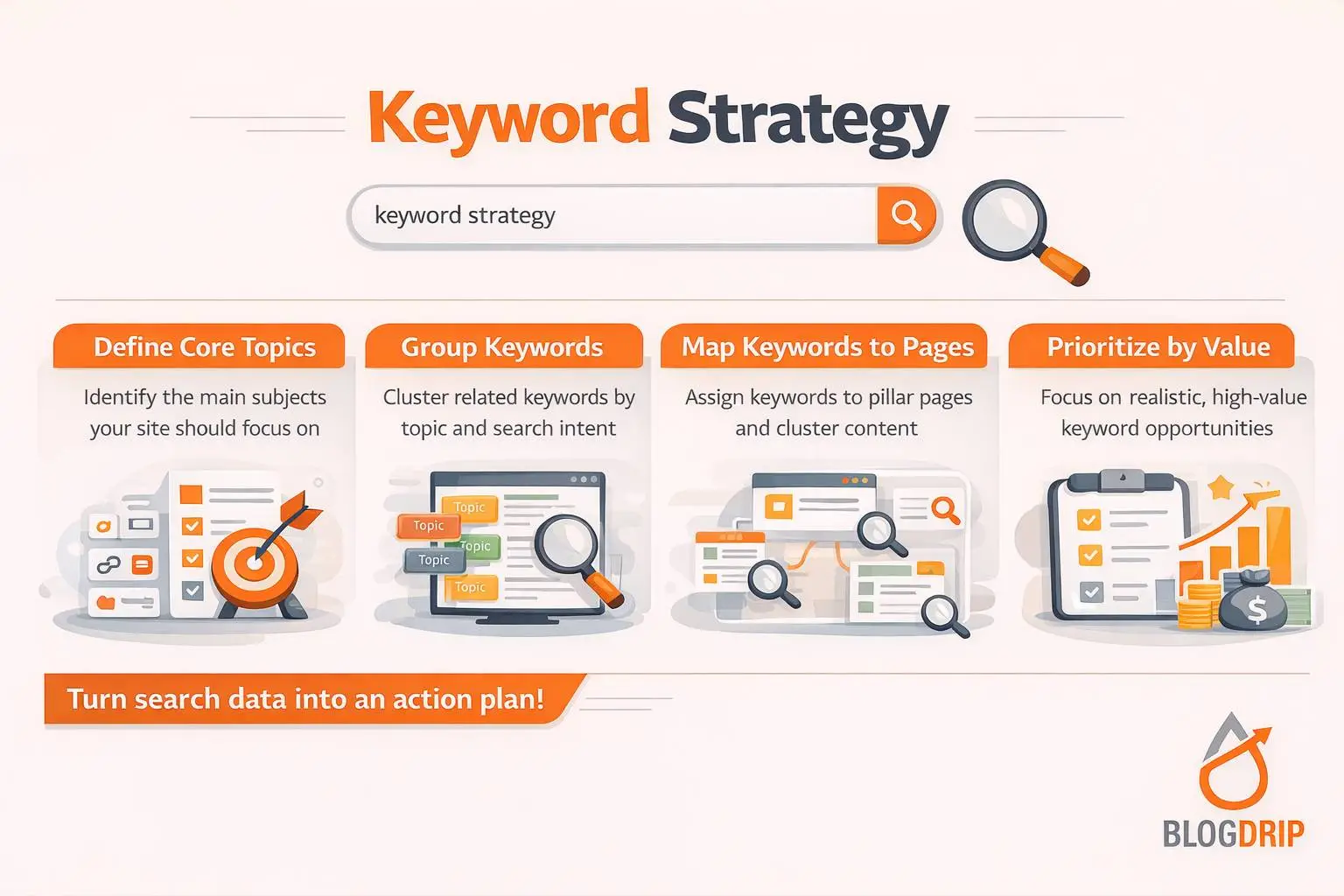
Start with core topics
A useful strategy begins with the main subjects your site should be known for.
These are not just keywords with volume. They are the broader topic areas that reflect your expertise, your audience’s needs, and your commercial relevance. For a site focused on SEO, those topics might include Keyword Research, on-page SEO, technical SEO, internal linking, and content strategy.
Once those core topics are clear, you can begin building keyword clusters underneath them.
Group keywords by intent and topic
The next step is to organize keywords by what they mean and what kind of page they require.
This usually involves looking at:
- topical similarity
- search intent
- page format
- level of specificity
- role within the site structure
For example, broad educational terms may belong on pillar pages, while narrower queries such as long-tail questions or process-based topics may belong on supporting cluster pages.
A strategy becomes stronger when keywords are grouped around shared intent rather than separated mechanically.
Map keywords to pages
Keyword mapping is where strategy becomes actionable.
Each important cluster should be assigned to a specific page or planned page. This helps define ownership and prevents multiple URLs from competing for the same intent.
At this stage, you also need to ask:
- Is there already a page that should own this topic?
- Does that page need improvement, expansion, or consolidation?
- Should this keyword be part of an existing cluster rather than a new article?
Good keyword strategy is often as much about restraint as expansion.
Prioritize based on realism and value
Once keywords are mapped, they should be prioritized.
That priority should not rely on search volume alone. A more useful framework considers:
Relevance
How closely does the keyword align with your audience, offer, and expertise?
Intent fit
Does the keyword match the type of page you are able to create well?
Competition
Is this a realistic opportunity for the site’s current authority level?
Business value
Could ranking for this topic support qualified traffic, trust, or meaningful next steps for the user?
Strategic importance
Does the keyword strengthen a core topic cluster or fill an important content gap?
When these factors are considered together, prioritization becomes far more useful than a simple volume-based sort.
Important Elements of a Strong Keyword Strategy
A good keyword strategy is not just organized. It is structurally sound.
Topic clustering
Topic clustering is essential because strong SEO rarely comes from isolated pages. It comes from clear coverage of a subject area.
A pillar page can cover the broad theme, while supporting cluster pages target narrower questions or related subtopics. That creates depth without forcing everything into one article.
Search intent alignment
Every keyword strategy should be grounded in search intent.
If the keyword suggests informational intent, the page should educate. If it suggests commercial intent, comparison or solution-focused content may be more appropriate. Strategy fails when keywords are assigned without respecting the intent behind them.
Internal linking logic
Keywords should not only be mapped to pages. They should also be connected through internal links that reinforce the relationship between topics.
This is especially important for cluster structures. Internal links help users move between related pages and help search engines interpret topic depth and hierarchy.
Content lifecycle planning
A useful keyword strategy also accounts for what already exists on the site.
Some opportunities require new pages. Others require improving weak pages, merging overlapping articles, or reworking pages that target the wrong intent. Strategy should include these decisions rather than assuming every opportunity means creating something new.
Common Keyword Strategy Mistakes
Keyword strategy often breaks down when teams treat keywords as isolated tasks rather than parts of a wider system.
Confusing research with strategy
Collecting keywords is not the same as having a keyword strategy. Research gives you raw material. Strategy decides what to do with it.
Chasing volume without structure
A high-volume term may look attractive, but if it does not fit the site’s authority, page type, or broader cluster, it may not be the right priority.
Creating too many similar pages
This is one of the most common problems. Slight keyword variations are often treated as separate opportunities when they should be grouped together. That leads to thin content and internal competition.
Ignoring existing assets
Teams often focus only on new content opportunities and overlook the fact that many keywords can be won more effectively by improving or consolidating existing pages.
Failing to connect strategy to business goals
Not every ranking is equally useful. A strong keyword strategy considers whether a topic supports the brand, the audience, and the wider goals of the site.
Practical Guidance for Building a Better Keyword Strategy
A practical keyword strategy starts by stepping back from individual keywords and looking at the website as a system.
First, define the main topics the site should own. Then gather keyword opportunities within those themes and group them by intent, similarity, and page role. Review the live search results so that keyword decisions are grounded in actual ranking patterns, not assumptions.
From there, build a keyword map that shows:
- the target keyword cluster
- the intended page
- the page type
- the intent
- the strategic priority
- relevant internal linking relationships
This process is especially useful for cluster content because it makes each page more distinct. One page may explain what a concept is. Another may explain why it matters. Another may show how to apply it. That distinction helps the cluster grow without repeating the same framing over and over.
It is also worth reviewing keyword strategy regularly. Rankings change, competitors improve, and search behavior evolves. A strategy should not be rebuilt every week, but it should be revisited often enough to stay relevant.
Timing and Expectations
Keyword strategy improves decision-making immediately, but SEO outcomes still take time.
Its first impact is usually better prioritization, cleaner briefs, stronger page targeting, and less wasted content production. Traffic and ranking gains come later through consistent execution.
For established sites, a better keyword strategy can improve performance relatively quickly when it leads to consolidation, clearer internal linking, or stronger intent alignment. For newer sites, the benefits are just as real, but often build more gradually as authority develops.
That is why keyword strategy should be viewed as a foundation. It does not create rankings on its own, but it makes the rest of the SEO work far more coherent.
Conclusion
Keyword strategy is the process of deciding how keywords should shape the structure, priorities, and direction of your SEO effort.
It matters because keyword research alone is not enough. Without a strategy, even good keyword ideas often turn into disconnected content, overlapping pages, and missed opportunities. With a strategy, keywords become part of a deliberate system that supports topic coverage, internal linking, and clearer page roles.
For a website building authority through a pillar-and-cluster model, keyword strategy is what turns search data into a content architecture that can grow intelligently over time.