
How to Determine Search Intent for SEO
To determine search intent, you need to understand what a user is actually trying to achieve with a search query, then assess which type of content best satisfies that goal. In SEO, this is a practical skill, not just a theory. It helps decide whether a page should educate, compare, convert, or guide the user to a specific destination.
This matters because many content failures are really intent failures. A page may target the right keyword, include solid on-page optimization, and still underperform because it solves the wrong problem. The user searches for one thing, but the page delivers something else.
For websites using a pillar-and-cluster model, determining search intent is one of the most important planning steps. It helps define which topics belong on broad pillar pages, which deserve focused cluster articles, and which should be handled by service or landing pages instead. Your broader Keyword Research guide already frames search intent as central to topic selection and content mapping. This page takes the next step and focuses specifically on how to determine search intent accurately in real SEO work.
What Does It Mean to Determine Search Intent?
To determine search intent means to identify the purpose behind a search query.
You are not only asking what words the user typed. You are asking why they typed them.
In practical terms, that usually means figuring out whether the user wants to:
- learn something
- find a specific brand or page
- compare options
- take action or buy
Those categories are useful, but real intent analysis goes further than labeling a keyword. It also involves understanding the expected page format, the level of depth the searcher likely wants, and how search engines are already interpreting the query.
For example, someone searching “determine search intent” is most likely looking for a process or framework. They want to understand how to evaluate queries, not just read a definition of search intent itself. That distinction shapes the article.
Why Determining Search Intent Matters
Search intent matters because search engines are trying to rank the page that best satisfies the searcher’s goal. That means keyword relevance alone is not enough.
It improves content targeting
If you determine search intent correctly before creating a page, you can choose the right format and structure from the start.
That leads to more focused content. Instead of trying to cover every possible angle, the page can address the actual need behind the query.
It reduces wasted effort
A lot of SEO waste comes from publishing pages that were never aligned with the intent in the first place.
You might write a blog post for a keyword that really needs a landing page. Or you might publish a broad guide for a query that needs a concise answer and practical checklist. Determining search intent early helps prevent those mismatches.
It strengthens topical structure
Intent also helps define page roles within a content cluster.
A broad informational query may belong on a pillar page. A narrower process-based query like this one works better as a cluster page. Other terms may support comparison pages or commercial pages. That distinction helps avoid overlap and makes internal linking more useful.
It supports better ranking potential
If the current search results are dominated by a specific content type, that is a strong signal. Determining search intent correctly means you are far more likely to create the kind of page that can compete in those results.
The Main Search Intent Types to Recognize
Before explaining how to determine search intent, it helps to understand the main categories you are trying to identify.
Informational intent
Informational intent means the user wants to learn, understand, or solve a problem.
These searches often include words like what, why, how, guide, examples, or tips. But many informational queries are implied rather than explicit.
Examples include:
- what is keyword research
- long tail keywords
- determine search intent
This page is targeting informational intent.
Navigational intent
Navigational intent means the user wants to reach a specific website, product, or page.
These searches are often branded and are less about learning than arriving somewhere directly.
Examples include:
- google analytics login
- ahrefs site explorer
- blogdrip homepage
Commercial intent
Commercial intent means the user is comparing or evaluating options before making a decision.
These queries often include modifiers such as best, top, review, compare, alternatives, or versus.
Examples include:
- best keyword research tools
- seo software comparison
- top content optimization tools
Transactional intent
Transactional intent means the user is ready to act.
These searches often include words like buy, pricing, service, demo, quote, or subscription.
Examples include:
- buy rank tracker
- keyword research service pricing
- request seo audit
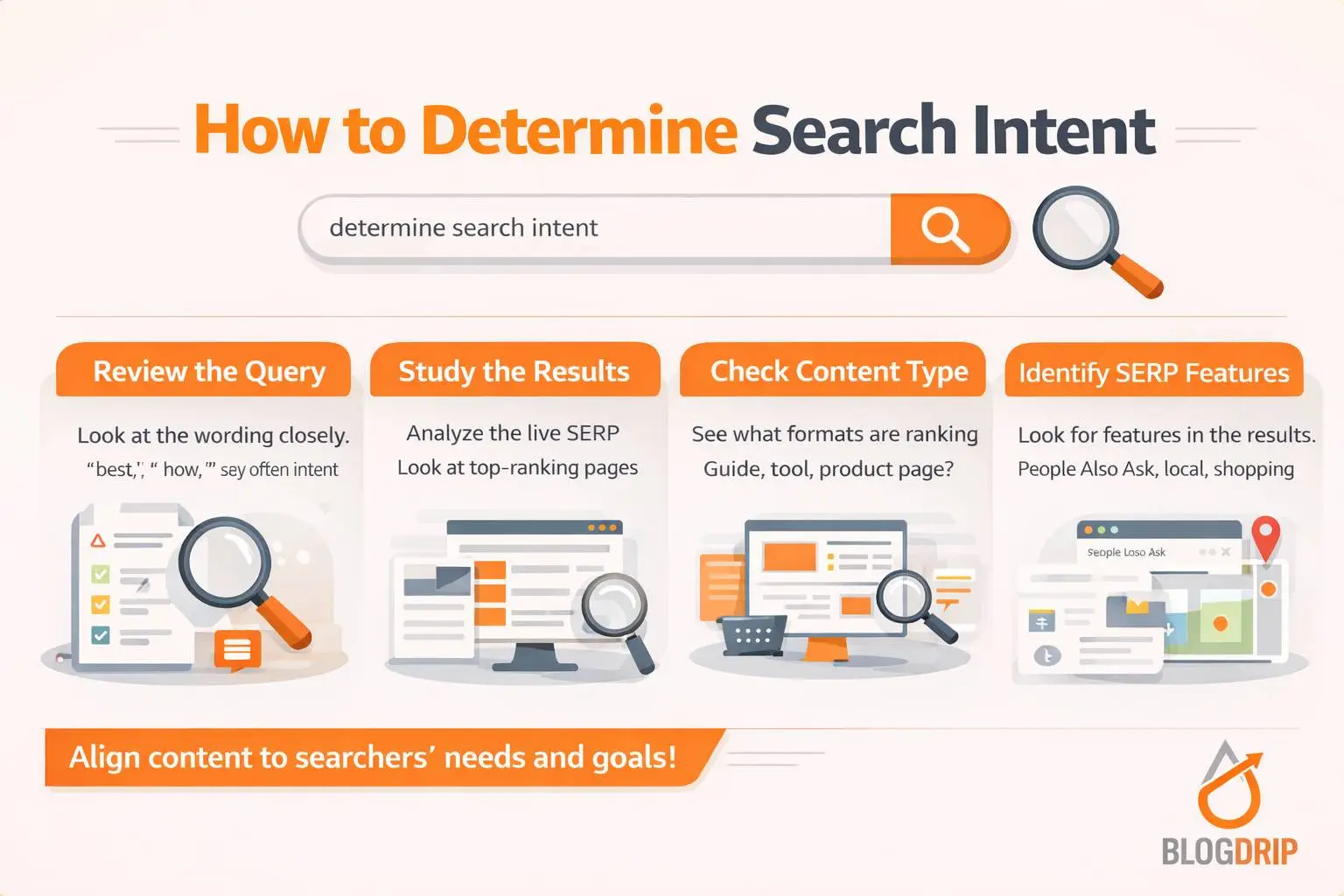
How to Determine Search Intent
Determining search intent is not guesswork. It is a repeatable process based on multiple signals.
Start with the query itself
The first step is to look carefully at the wording of the keyword.
Certain modifiers give strong clues:
- “what is” often signals informational intent
- “best” often signals commercial intent
- “buy” usually signals transactional intent
- brand names often signal navigational intent
This is a useful starting point, but not enough by itself. Many queries are ambiguous or carry mixed signals. That is why the next step matters more.
Review the live search results
The most reliable way to determine search intent is to study the current search engine results page.
Look at the first page and ask:
- What types of pages are ranking?
- Are they blog posts, category pages, service pages, tool pages, or product pages?
- Are they broad guides or narrow answers?
- Are they educating, comparing, or converting?
The results page is effectively telling you how search engines currently interpret the query. That makes it one of the strongest intent signals available.
If most top results are educational articles, the intent is likely informational. If most are vendor pages or software listings, the intent is probably commercial or transactional.
Analyze the format of ranking content
Intent is not only about category. It is also about format.
For example, even within informational intent, different content formats may dominate:
- definition-style pages
- step-by-step tutorials
- list articles
- tool roundups
- FAQs
- short explanatory pages
A query like “determine search intent” usually implies a how-to format rather than a simple glossary page. That helps shape not just the topic, but the content structure.
Look for SERP features
Search engine results pages often include features that reveal more about intent.
Common examples include:
- featured snippets
- People Also Ask results
- video results
- local packs
- shopping results
- comparison-style snippets
A featured snippet and FAQ-heavy result set often support informational intent. Shopping results or strong product listings suggest more commercial or transactional intent. These features can help confirm the content type users expect.
Compare the angle of the top pages
Once you know what page types rank, look at how they frame the topic.
Ask:
- Are they beginner-oriented or advanced?
- Are they theoretical or practical?
- Are they concise or comprehensive?
- Do they explain concepts or emphasize action?
Two pages may both be informational, but one may focus on explanation while another focuses on application. Determining search intent accurately often requires noticing that difference.
Important Factors That Make Intent Harder to Judge
Search intent is not always obvious. Some queries are straightforward, but others are mixed or evolving.
Mixed intent queries
Some keywords bring up a combination of page types because users may have more than one possible goal.
For example, a query might show educational guides, software pages, and comparison articles all on the first page. In those cases, intent is not fully settled. You need to decide which interpretation best fits your site and whether the results leave room for the page you want to create.
Broad queries
Broad terms often hide multiple user needs. A head term like “SEO tools” could mean the user wants a list, a category, a comparison, or a vendor platform.
The broader the term, the more carefully you need to review the search results instead of relying on assumptions.
Intent shifts over time
Search intent can change. Search behavior evolves, competitors publish new content, and Google adjusts how it interprets a query.
That means intent analysis is not a one-time step. It should be revisited when updating pages or re-evaluating underperformance.
Common Mistakes When Trying to Determine Search Intent
A few mistakes show up repeatedly in SEO planning.
Relying only on keyword modifiers
Words like “best” and “how” are helpful clues, but they are not enough on their own. Some queries behave differently from what the wording suggests.
Ignoring the current SERP
This is one of the biggest mistakes. If you do not review the live results, you are guessing. Search engines are already showing you how they interpret the query.
Treating all informational queries the same
Not all informational searches need the same format. Some need a short definition. Others need a detailed framework, examples, or step-by-step guidance.
Forcing the wrong page type
Sometimes teams want a query to fit a blog post because content production is easier that way. But if the results clearly favor product pages or commercial comparisons, forcing the wrong format usually leads to poor performance.
Practical Guidance for Determining Search Intent Correctly
A useful workflow is to treat intent analysis as part of keyword qualification.
Before assigning a keyword to content, ask:
- What is the most likely intent category?
- What page types currently rank?
- What format dominates the results?
- What level of depth seems expected?
- Does this query belong on a pillar page, a cluster article, or a commercial page?
That process turns keyword research into better content planning.
For a topic cluster, this is especially valuable. It helps distinguish between related pages that might otherwise blur together. One article may explain what search intent is. Another may explain how to determine it. Another may focus on why it matters. Those differences help each page serve a clearer role without duplicating the same framing.
Timing and Expectations
Learning how to determine search intent can improve content strategy quickly, but the impact on rankings depends on execution.
If you are updating an existing page that already has some visibility, aligning it more closely with intent can improve performance relatively quickly. If you need to rebuild a page completely or create a different page type, the timeline may be longer.
For newer sites, intent analysis is still essential, but it works best when combined with realistic keyword targeting, good internal linking, and strong overall content quality.
Determining search intent improves your decisions before content is published. That is where much of its value lies.
Conclusion
To determine search intent, you need to go beyond the keyword itself and understand what the searcher is really trying to achieve.
That means analyzing the query, reviewing the live search results, assessing the dominant page format, and matching your content to the expectation behind the search. Done properly, this helps reduce wasted effort, improve relevance, and create pages that fit more naturally into a strong SEO structure.
For a website building topical authority, determining search intent is not a minor optimization step. It is part of the decision-making process that shapes what content gets created and why it deserves to rank.