
Technical SEO: The Pillar Page for Building a Search-Ready Website
Technical SEO is the foundation that allows every other SEO effort to perform properly. You can publish excellent content, earn relevant backlinks, and target the right keywords, but if search engines struggle to crawl, understand, or index your website, your growth will be limited.
That is why technical SEO deserves a central place in any serious search strategy. It is not a narrow specialist discipline that sits outside content and marketing. It is the infrastructure that supports visibility, usability, and long-term organic performance.
For business owners and marketers, technical SEO often feels opaque because many of its issues are hidden below the surface. A site can look polished to users while still sending weak signals to search engines. Pages may load, but slowly. Navigation may work, but important content may be buried too deep. Templates may look clean, but create duplicate URLs, bloated code, or indexation problems at scale.
This pillar page explains technical SEO in practical terms. It covers what it is, why it matters, how it works, the major areas it includes, common mistakes, and how to approach it strategically. It is designed to serve as a central resource that can support related cluster content such as crawlability, indexation, site speed, XML sitemaps, structured data, canonical tags, Core Web Vitals, mobile optimization, and technical SEO audits.
What Is Technical SEO?
Technical SEO is the process of improving a website’s technical setup so search engines can efficiently crawl, render, understand, and index its pages.
In practical terms, technical SEO helps remove friction between your website and search engines. It ensures that the right pages are discoverable, accessible, fast, structured clearly, and eligible to compete in search results.
It is different from content SEO and off-page SEO, although all three are connected.
Content SEO focuses on relevance, intent alignment, and topical depth. Off-page SEO focuses on authority signals such as links and brand mentions. Technical SEO focuses on whether your website can support those efforts in a way that search engines can process reliably.
A technically strong website usually does the following well:
- makes important pages easy to find and crawl
- prevents wasted crawl activity on low-value URLs
- helps search engines understand page relationships
- supports fast, stable page performance
- works properly across devices
- reduces indexation errors and duplication issues
Technical SEO is not about chasing obscure tweaks. At its best, it is about creating a site architecture and technical environment that allows your content strategy to scale.
Why Technical SEO Matters
Technical SEO matters because rankings do not depend on content alone. Search engines need to discover pages, access their content, interpret signals correctly, and decide that those pages deserve to be indexed and surfaced.
If technical barriers exist, even strong pages can underperform.
It affects crawl efficiency
Search engines allocate limited crawl resources to each site. If your website creates unnecessary URL variations, duplicate pages, faceted navigation problems, or broken internal linking paths, crawlers may spend time on low-value URLs instead of your important content.
For larger websites, this becomes a major issue. For smaller sites, it is still relevant because poor crawl paths can slow discovery and reduce overall clarity.
A related supporting article here would be a cluster page on crawl budget and crawl efficiency.
It affects indexation quality
Not every crawlable page should be indexed. Technical SEO helps you guide search engines toward the pages that matter and away from pages that dilute quality signals.
Examples include tag pages, filtered URLs, duplicate product variants, internal search results, staging environments, and thin utility pages. Without proper control, these can clutter the index and weaken the overall site profile.
This connects naturally to cluster content on indexation management, robots directives, and canonical tags.
It affects page experience and performance
Performance is not just a usability issue. Slow, unstable pages can reduce engagement, lower conversion rates, and create a weaker overall search experience. Technical SEO works closely with development and UX to improve loading behavior, responsiveness, layout stability, and mobile usability.
That makes topics like site speed optimization and Core Web Vitals important parts of the broader technical SEO framework.
It supports topical authority
Topical authority is not built by publishing articles alone. It depends on how clearly your site is structured, how cluster pages connect back to a central pillar page, how internal links distribute context and authority, and how efficiently search engines can interpret those relationships.
A strong technical setup supports the broader content cluster model. Your content architecture becomes easier to crawl, easier to understand, and more scalable over time.
How Technical SEO Works
Technical SEO works by aligning your website’s infrastructure with the way search engines process the web.
Search engines generally move through four broad stages: discovery, crawling, rendering, and indexation. Technical SEO influences each stage.
Discovery
Search engines first need to find your URLs. They do that through internal links, XML sitemaps, external backlinks, and prior crawl history.
If important pages are orphaned, buried too deep, or absent from a clean internal linking structure, they are harder to discover quickly. Good technical SEO ensures that important content is connected within the site architecture and supported by logical navigation.
A strong pillar page should naturally link to cluster articles such as XML sitemaps, internal linking for SEO, and site architecture best practices.
Crawling
Once a URL is discovered, crawlers try to access it. This is where technical issues often begin.
Poor server responses, redirect chains, broken links, blocked resources, or confusing URL parameters can waste crawl activity or prevent full access. Technical SEO helps ensure that crawlers reach the right pages without unnecessary obstacles.
Rendering
Modern pages often rely on JavaScript, dynamic components, and client-side rendering. Search engines can render many of these pages, but that does not mean rendering is always efficient or error-free.
If important content or links only appear after scripts execute poorly, the page may be partially understood or delayed in processing. Technical SEO includes making sure critical content is accessible in a search-friendly way.
This is a good place to internally link to a cluster page on JavaScript SEO or rendering and search engine accessibility.
Indexation
After a page is crawled and rendered, search engines decide whether to include it in the index. That decision depends on quality, uniqueness, technical signals, and overall site confidence.
Technical SEO influences indexation through canonicals, meta robots tags, status codes, duplicate control, content accessibility, and page quality signals.
A well-optimized site helps search engines understand which pages should represent the site in search results and which should not.
Core Elements of Technical SEO
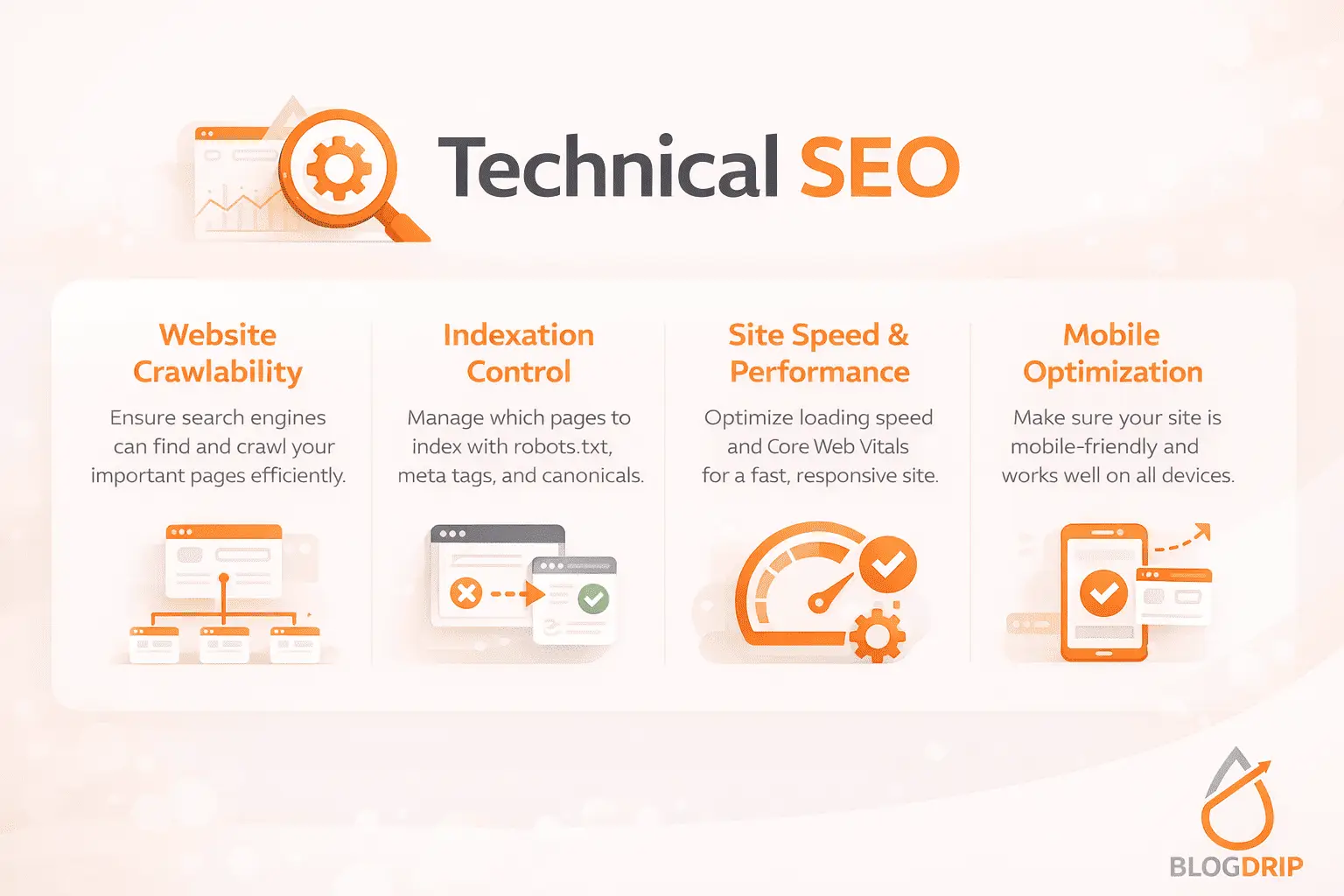
Technical SEO includes several major areas. Some matter to nearly every site. Others become more important as a website grows in size, complexity, or international reach.
Website Architecture and Internal Linking
A good site architecture makes important content easy to reach in as few clicks as possible. It also helps search engines understand hierarchy, relationships, and topic clusters.
For a pillar-and-cluster strategy, this matters even more. Your pillar page on technical SEO should link naturally to supporting articles such as:
- crawlability
- indexation
- site speed
- structured data
- canonical tags
- XML sitemaps
- hreflang
- mobile SEO
- pagination
- redirect management
- technical SEO audits
Each of those pages should also link back to the pillar page using varied, natural anchor text such as “technical SEO fundamentals,” “our guide to technical SEO,” or “this technical SEO pillar.”
The goal is not to force links everywhere. The goal is to create a clear topical network that helps both users and search engines move through the subject logically.
What strong architecture usually looks like
Strong architecture tends to have shallow click depth, clear navigation paths, clean URL structures, and contextual internal links between related pages.
Weak architecture often produces isolated articles, overlapping content hubs, thin archive pages, and inconsistent linking patterns.
Crawlability and Indexation Control
Crawlability and indexation are related, but they are not the same.
A page can be crawlable but not indexable. It can also be indexable in theory but difficult to discover in practice.
Technical SEO requires clear control over both.
Key mechanisms that influence this area
Robots.txt
The robots.txt file gives crawl instructions, but it does not remove pages from the index by itself. It is useful for managing crawler access, especially for low-value or sensitive sections, but it must be used carefully. Blocking the wrong paths can prevent search engines from understanding important content.
Meta robots tags
Meta robots directives control whether a page should be indexed or whether links on the page should be followed. These are more precise than robots.txt for page-level control.
Canonical tags
Canonical tags help indicate the preferred version of similar or duplicate pages. They are especially important on sites with filter combinations, tracking parameters, printer-friendly versions, or repeated content patterns.
XML sitemaps
XML sitemaps help search engines discover URLs you want considered for crawling and indexation. They should support your preferred indexable pages, not act as a dumping ground for every URL your CMS generates.
This section naturally supports cluster pages on robots.txt, meta robots, canonical tags, and XML sitemaps.
Site Speed and Performance
Technical SEO is closely tied to performance because slow, unstable pages create friction for both users and search engines.
A fast site does not guarantee rankings, but performance problems can weaken otherwise strong pages.
Why performance matters strategically
Performance influences user satisfaction, engagement, and conversion behavior. On mobile devices and slower networks, performance gaps become even more visible. Technical SEO should therefore include collaboration between SEO, development, and UX rather than treating page speed as a standalone score-chasing exercise.
What to focus on
Look at the real causes of slow pages, not just generic recommendations. Common issues include unoptimized images, heavy scripts, unnecessary third-party tools, render-blocking resources, bloated templates, and poor caching setups.
The most useful related article here would be a cluster page on site speed for SEO, with another on Core Web Vitals explained.
Mobile Optimization
Search visibility depends heavily on mobile usability because search engines evaluate pages through a mobile-first lens.
A technically sound site should provide the same core content, structured data, metadata, and internal linking across mobile and desktop experiences. Problems often arise when mobile templates hide content, collapse navigation badly, or introduce rendering issues that do not exist on desktop.
Technical SEO should validate that mobile pages are not only responsive, but functionally complete.
A related internal link here could point to a cluster page on mobile SEO best practices.
Structured Data and Search Understanding
Structured data helps search engines interpret page entities and context more clearly. It does not replace content quality, but it can support stronger understanding and improve eligibility for enhanced search features.
For example, structured data can help clarify articles, FAQs, products, organizations, reviews, breadcrumbs, and other page elements. The implementation needs to match visible content and follow supported schema types.
The mistake many sites make is adding schema mechanically without strategic purpose. Technical SEO should treat structured data as a clarity layer, not as a shortcut.
This section can link naturally to cluster content on structured data for SEO and schema markup implementation.
HTTPS, Security, and Technical Trust Signals
Trustworthiness in SEO is not only about brand reputation or content credibility. It also includes technical trust signals.
A secure site using HTTPS is standard. Mixed content issues, certificate problems, insecure resources, and careless migrations can create warnings, crawl inefficiencies, or user distrust.
Technical SEO should also cover basics such as secure redirects, correct canonicalization between HTTP and HTTPS versions, and avoiding accidental duplication across protocol or subdomain variants.
International and Multi-Regional Technical SEO
For websites targeting multiple countries or languages, technical SEO becomes more complex.
Hreflang implementation, regional URL structures, localization consistency, and correct canonical relationships all matter. Errors in this area can lead to wrong-page rankings, duplicate conflicts, or cannibalization between country versions.
Not every website needs international SEO, but for those that do, it must be handled carefully. This is a separate cluster-worthy topic such as hreflang and international technical SEO.
Common Technical SEO Mistakes
Many technical SEO problems come from misalignment rather than neglect. Content teams, developers, and marketers often make reasonable local decisions that create bigger SEO issues over time.
Treating technical SEO as a one-time project
Technical SEO is not a single audit followed by permanent stability. Websites change constantly through redesigns, plugin updates, CMS changes, product launches, content expansion, and development releases.
Ongoing monitoring matters more than one-off checklists.
Letting low-value pages enter the index
A common issue is allowing search engines to index pages that add little unique value, such as internal search results, duplicate archive pages, thin tag pages, session-based URLs, or parameter-driven variations.
This weakens site quality signals and creates noise.
Misusing canonical tags
Canonicals are often implemented inconsistently, pointed to non-equivalent pages, or contradicted by internal linking. They are a hint, not a guarantee. When technical signals conflict, search engines may ignore them.
Ignoring internal linking depth
Even strong content can struggle if it sits too deep in the site or receives little contextual support. Technical SEO should not be isolated from internal linking strategy.
Focusing on tools more than outcomes
Many teams become overly dependent on audit scores, third-party checklists, or surface-level warnings. Tools are useful, but they are not the strategy. A technically mature site prioritizes issues based on business impact, crawl/indexation risk, and scalability.
Practical Guidance for Applying Technical SEO Correctly
Technical SEO works best when it is prioritized, not treated as a giant backlog of equal issues.
Start with the fundamentals
First confirm that your most important pages are crawlable, indexable, internally linked, fast enough, mobile-friendly, and returning the correct status codes. Basic failures here matter more than advanced edge cases.
Align technical work with business priorities
A service business with fifty pages does not need the same technical SEO roadmap as a multinational ecommerce site with faceted navigation and millions of URLs.
Your technical priorities should reflect site size, platform complexity, and revenue model.
Audit templates, not just pages
Many SEO issues are systemic. They come from page templates, CMS logic, or platform rules rather than isolated URLs. That is why technical SEO should assess patterns across the site.
A related cluster article could focus on how to run a technical SEO audit.
Use internal linking intentionally
For a pillar-and-cluster model, internal linking should reinforce topical relationships. Your technical SEO pillar page should link out to detailed supporting pages, and those pages should return authority and context back to the pillar.
Use natural anchor variation rather than repeating the same keyword every time.
Collaborate with developers early
Technical SEO recommendations become far more effective when SEO is involved during planning, not only after launches. Redesigns, migrations, and platform changes are where major technical SEO losses often happen.
Timing and Expectations
Technical SEO results do not always appear immediately.
Some fixes can produce relatively fast improvements, especially when they resolve crawl blocks, accidental noindex tags, broken canonicals, or major performance bottlenecks. Others take longer because search engines need time to recrawl, reprocess, and reassess the site.
In practice, timelines depend on several factors:
- how serious the issue was
- how much of the site it affected
- how frequently the site is crawled
- whether other quality or authority constraints still exist
Technical SEO also does not work in isolation. Fixing technical issues creates the conditions for better SEO performance, but rankings still depend on content quality, competition, internal linking, search intent alignment, and authority.
That is why technical SEO should be viewed as an enabler, not a magic lever.
Conclusion
Technical SEO is the operational backbone of organic growth. It ensures that search engines can access, interpret, and prioritize the pages you actually want to rank. Without it, content strategy becomes less efficient, internal linking becomes less effective, and authority is harder to consolidate.
For a website building topical authority, technical SEO should sit at the center of a structured content ecosystem. This pillar page can support a wider cluster of articles on crawlability, indexation, sitemaps, canonical tags, structured data, performance, mobile SEO, and audits. Together, those pages create both user value and search clarity.
The strategic takeaway is simple: technical SEO is not about chasing technical perfection for its own sake. It is about removing obstacles, strengthening site structure, and giving your best content the strongest possible chance to perform.
When that foundation is solid, every other SEO investment works harder.