
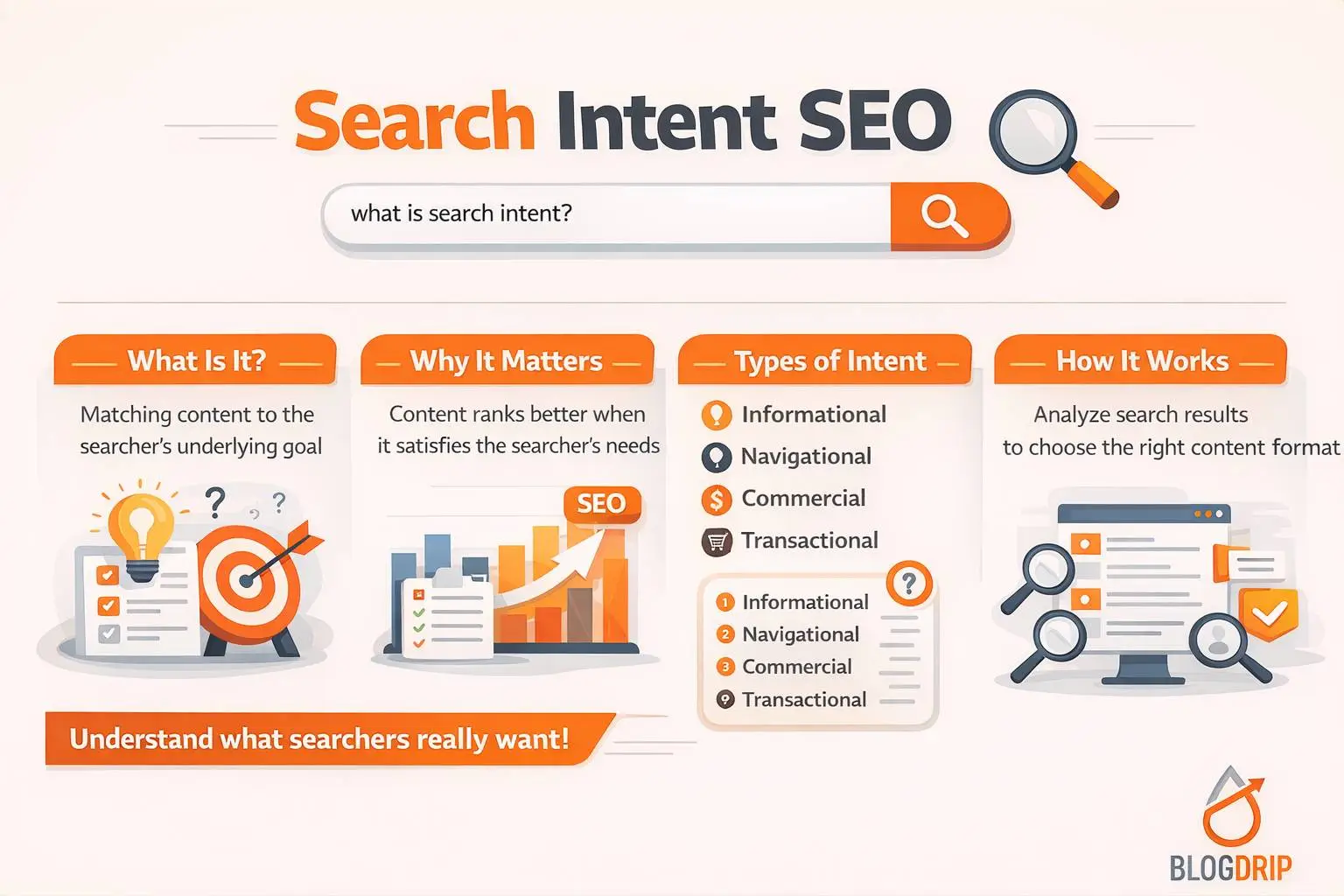
Search Intent SEO: What It Is and Why It Matters
Search intent SEO is the practice of understanding what a user actually wants when they type a query into a search engine, then creating a page that matches that expectation. It is one of the most important parts of modern SEO because rankings are no longer won by keyword placement alone. Pages perform when they satisfy the reason behind the search.
That distinction matters more than many teams realize. A page can target the right keyword, include strong on-page optimization, and still fail if it does not match intent. In many cases, underperforming content is not weak because the writing is poor or the keyword is wrong. It underperforms because the page solves a different problem than the user came to solve.
For websites building topical authority, search intent is also a structural issue. It helps determine whether a topic belongs on a pillar page, a focused cluster article, a comparison page, or a service page. Your broader Keyword Research guide already frames search intent as one of the core principles behind topic selection and content mapping. This page focuses specifically on search intent SEO as its own subject and explains how to apply it well.
What Is Search Intent SEO?
Search intent SEO means optimizing content around the purpose behind a query, not just the wording of the query itself.
In practical terms, it asks:
- What is the searcher trying to accomplish?
- What kind of answer are they expecting?
- What page format is most likely to satisfy that expectation?
- Does our page match that need clearly enough to deserve a ranking?
A keyword tells you what people typed. Search intent tells you why they typed it.
For example, someone searching for “search intent SEO” usually wants a clear explanation of the concept, why it matters, and how it affects content strategy. They are not looking for a product checkout page or a generic marketing pitch. That means this page needs to educate first.
This is why search intent SEO sits at the intersection of keyword research, content strategy, and on-page optimization. It is not just an editorial concern. It is a ranking concern.
Why Search Intent SEO Matters
Search intent matters because search engines aim to rank pages that best satisfy the user’s goal. That means relevance is no longer just topical. It is functional.
It improves ranking potential
A page that matches intent has a much better chance of ranking than a page that only matches the phrase.
If users search a query and the results are mostly educational guides, then a service page will usually struggle. If the results are mostly product pages or comparisons, then a broad informational article may not be the strongest fit.
This is why intent analysis should happen before content is created, not after rankings disappoint.
It improves content relevance
Intent gives a page a clearer job to do.
Instead of trying to cover everything loosely, content can be built around the exact expectation behind the search. That usually makes the article more focused, easier to structure, and more useful to the reader.
It reduces wasted SEO effort
A lot of SEO waste comes from targeting the right topic with the wrong page type.
Teams may invest in writing, design, and optimization but still miss performance because the content format does not line up with the search result landscape. Search intent SEO helps avoid that by forcing a more realistic content decision at the start.
It supports a stronger content cluster
In a pillar-and-cluster model, intent helps define which page should cover which query.
A broad educational query may belong on a pillar page. A narrow question may belong on a cluster page. A comparison term may deserve a different supporting article. Intent helps those distinctions stay clean, which improves internal linking and reduces overlap.
The Main Types of Search Intent
Search intent is often grouped into broad categories. These categories are useful, but they should be treated as working models rather than rigid labels.
Informational intent
Informational intent means the user wants to learn, understand, or solve a problem.
These searches often include words like what, why, how, guide, tips, or examples. But not always. Many informational searches are phrased more simply.
Examples include:
- what is search intent
- how search intent affects SEO
- search intent SEO
This page targets informational intent because the user is looking for explanation and guidance.
Navigational intent
Navigational intent means the user is trying to reach a specific brand, website, or page.
These are often branded searches. The goal is not to explore the topic broadly, but to get somewhere specific.
Examples include:
- ahrefs login
- google search console
- blogdrip homepage
These are usually not the main target of educational SEO content unless the brand itself is central to the page.
Commercial intent
Commercial intent suggests the user is evaluating options before making a decision.
These searches often include modifiers like best, top, review, compare, alternatives, or versus.
Examples include:
- best keyword research tools
- seo platform comparison
- top rank tracking software
These queries usually need comparison-driven or evaluative content, not a purely educational definition page.
Transactional intent
Transactional intent means the user is close to taking action.
These searches may include words such as buy, pricing, service, quote, demo, or subscription.
Examples include:
- buy seo software
- keyword research service pricing
- request seo consultation
These usually belong on product, service, or landing pages rather than blog content.
How Search Intent SEO Works in Practice
Search intent SEO is not just theory. It changes how you choose keywords, shape content, and evaluate whether a page should exist.
Start with the current search results
The fastest way to understand intent is to review what already ranks.
Look at the first page and ask:
- Are the results mostly guides, tools, category pages, or service pages?
- Is the content broad or specific?
- Are users being educated, compared, or pushed toward action?
- What format does Google appear to trust for this query?
This matters because the results page is a live signal of what search engines currently believe satisfies the search.
Match the page format to the query
Once intent is clear, the page format should follow it.
If the query is informational, build an educational page. If it is commercial, comparison content may be more appropriate. If it is transactional, a landing page may be the better asset.
A common SEO mistake is forcing blog content onto terms that require a different page type.
Align depth with intent
Not every informational query needs a long pillar page. Some only need a focused explanation. Some commercial searches need comparison tables and buyer context. Some transactional pages need clarity and conversion support, not long educational copy.
Search intent SEO helps determine not only what kind of page to create, but how deep it should go.
Important Signals That Help You Identify Intent
Intent is usually inferred from multiple signals rather than one obvious clue.
Query wording
Certain modifiers strongly suggest a type of intent. “What is” usually signals information. “Best” often signals comparison. “Buy” usually signals action.
But wording alone is not enough. Some searches have implied intent that only becomes clear when you check the results.
SERP format
The search results page often reveals intent better than any keyword tool.
If the top results are beginner guides, that tells you something. If they are product pages, that tells you something else. If featured snippets, videos, comparison pages, or local results dominate, the expected content format becomes clearer.
Content angle of ranking pages
Look at how current top-ranking pages frame the topic.
Are they defining the term, teaching a process, listing tools, or selling a solution? This helps you understand not only the general intent but also the depth and angle search engines are rewarding.
Common Search Intent SEO Mistakes
Search intent is simple in principle, but many websites still get it wrong.
Targeting keywords instead of needs
This is the most common mistake. Teams optimize for the phrase while ignoring the underlying goal. The page may mention the right words, but it does not actually answer the reason for the search.
Creating the wrong page type
A blog article may target a query that really needs a landing page. A service page may target a query that clearly needs a guide. This mismatch is one of the main reasons otherwise solid pages fail to rank.
Treating all informational intent the same
Not all informational searches are equally broad. Some users want a simple definition. Others want a detailed process. Others want advanced analysis. Intent matching requires nuance, not just labeling a query as “informational.”
Ignoring intent changes over time
Search behavior and result pages can evolve. A keyword that once rewarded definition pages may later favor tools, comparisons, or fresher formats. Intent should be reviewed periodically, especially for competitive topics.
Practical Guidance for Using Search Intent SEO Well
A strong process starts by treating search intent as a planning requirement, not a finishing touch.
When researching a topic, do not stop at keyword discovery. Review the search results carefully and decide what kind of page makes sense before assigning the brief. That step saves time and usually leads to stronger content decisions.
For cluster content, this is especially useful. A broad topic may support several related pages, but each one should satisfy a distinct intent. One page may define the concept. Another may explain why it matters. Another may compare tools or methods. That separation helps the site grow without creating duplicate framing.
It is also worth remembering that intent matching does not mean copying the current top results. It means understanding what users expect, then meeting that expectation with clearer, better-structured, and more useful content.
Timing and Expectations
Improving intent alignment can lead to meaningful gains, but the timeline depends on what changes are being made.
If a page already has some authority and traffic, aligning it more closely with search intent can improve performance relatively quickly. If the issue is deeper, such as needing a different page type or a broader restructuring of the cluster, results may take longer.
For newer sites, search intent SEO is still critical, but it works best as part of a wider foundation that includes strong content quality, internal linking, and realistic keyword targeting.
Intent improves your odds. It does not replace the rest of SEO.
Conclusion
Search intent SEO is the practice of understanding what a searcher wants and building the right page to satisfy that need.
That makes it one of the most important parts of modern search strategy. It improves relevance, strengthens content planning, reduces wasted effort, and helps ensure that each page has a clear role within a broader topic cluster.
For websites building topical authority, search intent is not a small on-page detail. It is part of the framework that decides what content gets created, how it is structured, and why it deserves to rank.